
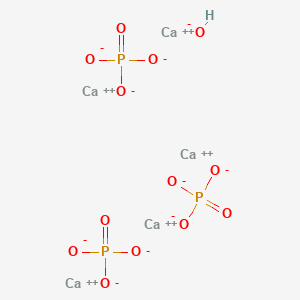
Hydroxylapatite (Ca5(OH)(PO4)3)
Hydroxylapatite is a mineral with formula of Ca5(PO4)3OH. The corresponding IMA (International Mineralogical Association) number is IMA2010 s.p.. The IMA symbol is Hap. — RRUFF Project
- IUPAC name
- pentacalcium;hydroxide;triphosphate
- Molecular formula
- Ca5HO13P3
- Molecular weight
- 502.3 g/mol
- Exact mass
- 501.675955 Da
- Topological polar surface area
- 260.0 Ų
- Hydrogen-bond donors
- 1
- Hydrogen-bond acceptors
- 13
- Covalent units
- 9
- Defined stereocentres
- 0
Also known as
16 more reported names
External database identifiers
- ChEMBL:CHEMBL2218916
- EPA DTXSID:DTXSID50872537
- PubMed:22939914
- PubMed:21705322
- PubMed:11518271
Evidence from additional scientific databases
NIH PubChem PUG-View
Attributed physical-property, hazard, environmental and use annotations.
- Color/Form: Hexagonal needles arranged in rosettes Source: Hazardous Substances Data Bank (HSDB)
- Color/Form: Finely divided, crystalline, nonstoichiometric material. Source: Hazardous Substances Data Bank (HSDB)
- Density: Density: 3.1 to 3.2 /Apatite/ Source: Hazardous Substances Data Bank (HSDB)
- Physical Description: Dry Powder Source: EPA Chemical Data Reporting (CDR)
- Physical Description: Solid; [Merck Index] White suspension; [MSDSonline] Source: Haz-Map, Information on Hazardous Chemicals and Occupational Diseases
- Solubility: Practically insol in water, even when freshly prepared Source: Hazardous Substances Data Bank (HSDB)
- Note: This chemical does not meet GHS hazard criteria for 97.8% (362 of 370) of all reports. Source: European Chemicals Agency (ECHA)
- GHS Hazard Statements: Not Classified; Reported as not meeting GHS hazard criteria by 362 of 370 companies (only 2.2% companies provided GHS information). For more detailed information, please visit ECHA C&L website. Source: European Chemicals Agency (ECHA)
- ECHA C&L Notifications Summary: Aggregated GHS information provided per 370 reports by companies from 5 notifications to the ECHA C&L Inventory.; Reported as not meeting GHS hazard criteria per 362 of 370 reports by companies.; There are 3 notifications provided by 8 of 370 reports by companies with hazard statement code(s).; Information may vary between notifications depending on impurities, additives, and other factors. The percentage value in parenthesis indicates the notified classification ratio from companies that provide hazard codes. Only hazard codes with percentage values above 10% are shown. For more detailed information, please visit ECHA C&L website. Source: European Chemicals Agency (ECHA)
- Note: This chemical does not meet GHS hazard criteria for 94% (188 of 200) of all reports. Source: European Chemicals Agency (ECHA)
- GHS Hazard Statements: Not Classified; Reported as not meeting GHS hazard criteria by 188 of 200 companies (only 6% companies provided GHS information). For more detailed information, please visit ECHA C&L website. Source: European Chemicals Agency (ECHA)
- ECHA C&L Notifications Summary: Aggregated GHS information provided per 200 reports by companies from 6 notifications to the ECHA C&L Inventory.; Reported as not meeting GHS hazard criteria per 188 of 200 reports by companies.; There are 3 notifications provided by 12 of 200 reports by companies with hazard statement code(s).; Information may vary between notifications depending on impurities, additives, and other factors. The percentage value in parenthesis indicates the notified classification ratio from companies that provide hazard codes. Only hazard codes with percentage values above 10% are shown. For more detailed information, please visit ECHA C&L website. Source: European Chemicals Agency (ECHA)
- Consumer Uses: Not Known or Reasonably Ascertainable; Filler Source: EPA Chemical Data Reporting (CDR)
- Industry Uses: Processing aids not otherwise specified; Filler; Soil amendments (fertilizers); Stabilizing agent Source: EPA Chemical Data Reporting (CDR)
- Sources/Uses: Naturally occurring mineral in phosphate rocks and in bone; [Merck Index] Used in fertilizers, laser crystals, ion-exchange chromatography (especially for proteins), artificial bone and teeth, and calcium/phosphorus supplement; [HSDB] Source: Haz-Map, Information on Hazardous Chemicals and Occupational Diseases
- Uses: Source of phosphorus & phosphoric acid; mfr of fertilizers; laser crystals /Apatite/ Source: Hazardous Substances Data Bank (HSDB)
- Uses: USED IN DENTURE & ORTHOPEDIC MATERIALS; USED IN ION-EXCHANGE CHROMATOGRAPHY ESPECIALLY FOR PROTEINS Source: Hazardous Substances Data Bank (HSDB)
- Uses: MEDICATION Source: Hazardous Substances Data Bank (HSDB)
- Uses: Prosthetic aid (artificial bone and teeth). Source: Hazardous Substances Data Bank (HSDB)
- Uses: For more Uses (Complete) data for HYDROXYAPATITE (6 total), please visit the HSDB record page. Source: Hazardous Substances Data Bank (HSDB)
- Uses: Plastics -> Typical concentration range in plastic materials -> 5% Source: NORMAN Suspect List Exchange
Mapped by: Existing checksum-valid CAS to unique PubChem CID match. Retrieved: 2026-08-31. Open source record
Scientific classifications and hazard annotations provide context and do not replace the market-specific regulatory decision shown above.
Additional source coverage and match status
| Source | Result | Checked |
|---|---|---|
| NIH PubChem PUG-View | Exact match | 2026-08-31 |
A recorded no-match is useful evidence that the source was checked; it is not a claim that the substance does not exist elsewhere.
Retrieved from NIH PubChem on 2026-09-02 by checksum-valid CAS matching. Chemical properties do not replace the regulatory decision on this page.