
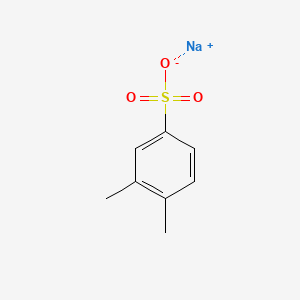
CAS 1300-72-7PubChem CID 23668192
Sodium Xylenesulfonate
Xylenesulfonic acid, sodium salt is an odorless white crystalline powder. (NTP, 1992) — CAMEO Chemicals
- IUPAC name
- sodium 3,4-dimethylbenzenesulfonate
- Molecular formula
- C8H9NaO3S
- Molecular weight
- 208.21 g/mol
- Exact mass
- 208.01700960 Da
- Topological polar surface area
- 65.6 Ų
- Hydrogen-bond donors
- 0
- Hydrogen-bond acceptors
- 3
- Covalent units
- 2
- Defined stereocentres
- 0
Also known as
NaxonateXylenesulfonic Acid Sodium SaltHydrotropeStepanate XNaxonate GRichonate SXSCyclophil sxs30Conco SXS
16 more reported names
Surco SXSUltrawet 40SXEltesol SX 30Xylenesulfonic acid, sodium saltSodium xylenesulphonateCaswell No. 799AG4LZF950URSodium dimethylbenzenesulfonateCCRIS 4893HSDB 776Benzenesulfonic acid, dimethyl-, sodium saltNCI-C55403EINECS 215-090-9EPA Pesticide Chemical Code 079019Dimethylbenzenesulfonic acid, sodium saltEC 215-090-9
External database identifiers
- ChEMBL:CHEMBL1559841
- EPA DTXSID:DTXSID70274034
Evidence from additional scientific databases
NIH PubChem PUG-View
Exact identifier match23668192
Attributed physical-property, hazard, environmental and use annotations.
- Boiling Point: 315 °F at 760 mmHg (NTP, 1992) Source: CAMEO Chemicals
- Boiling Point: 157 °C Source: ILO-WHO International Chemical Safety Cards (ICSCs)
- Density: 1.23 (NTP, 1992) - Denser than water; will sink Source: CAMEO Chemicals
- Melting Point: 81 °F (NTP, 1992) Source: CAMEO Chemicals
- Melting Point: 27 °C Source: ILO-WHO International Chemical Safety Cards (ICSCs)
- Physical Description: Xylenesulfonic acid, sodium salt is an odorless white crystalline powder. (NTP, 1992) Source: CAMEO Chemicals
- Physical Description: White solid; [ICSC] Colorless solid; [CHEMINFO] Faintly beige powder; [MSDSonline] Source: Haz-Map, Information on Hazardous Chemicals and Occupational Diseases
- Physical Description: WHITE CRYSTALS OR POWDER. Source: ILO-WHO International Chemical Safety Cards (ICSCs)
- Solubility: greater than or equal to 100 mg/mL at 68 °F (NTP, 1992) Source: CAMEO Chemicals
- Solubility: Solubility in water, g/100ml at 20 °C: 40 Source: ILO-WHO International Chemical Safety Cards (ICSCs)
- Substance: Sodium Xylenesulfonate Source: NTP Technical Reports
- NTP Technical Report: TR-464: Toxicology and Carcinogenesis Studies of Technical Grade Sodium Xylenesulfonate (CASRN 1300-72-7) in F344/N Rats and B6C3F1 Mice (Dermal Studies) (1998 ) Source: NTP Technical Reports
- Peer Review Date: 12/05/95 Source: NTP Technical Reports
- Conclusion for Male Rat: No Evidence Source: NTP Technical Reports
- Conclusion for Female Rat: No Evidence Source: NTP Technical Reports
- Conclusion for Male Mice: No Evidence Source: NTP Technical Reports
- Conclusion for Female Mice: No Evidence Source: NTP Technical Reports
- Summary: Under the conditions of these 2-year dermal studies, there was no evidence of carcinogenic activity of sodium xylenesulfonate in male or female F344/N rats administered 60, 120, or 240 mg/kg or in male or female B6C3F1 mice administered 182, 364, or 727 mg/kg.; Increased incidences of epidermal hyperplasia in female rats and male mice may have been related to exposure to sodium xylenesulfonate. Source: NTP Technical Reports
- First Aid: EYES: First check the victim for contact lenses and remove if present. Flush victim's eyes with water or normal saline solution for 20 to 30 minutes while simultaneously calling a hospital or poison control center. Do not put any ointments, oils, or medication in the victim's eyes without specific instructions from a physician. IMMEDIATELY transport the victim after flushing eyes to a hospital even if no symptoms (such as redness or irritation) develop.; SKIN: IMMEDIATELY flood affected skin with water while removing and isolating all contaminated clothing. Gently wash all affected skin areas thoroughly with soap and water. IMMEDIATELY call a hospital or poison control center even if no symptoms (such as redness or irritation) develop. IMMEDIATELY transport the victim to a hospital for treatment after washing the affected areas.; INHALATION: IMMEDIATELY leave the contaminated area; take deep breaths of fresh air. If symptoms (such as wheezing, coughing, shortness of breath, or burning in the mouth, throat, or chest) develop, call a physician and be prepared to transport the victim to a hospital. Provide proper respiratory protection to rescuers entering an unknown atmosphere. Whene Source: CAMEO Chemicals
- Note: This chemical does not meet GHS hazard criteria for 33.2% (556 of 1675) of reports. Source: European Chemicals Agency (ECHA)
- Signal: Warning Source: European Chemicals Agency (ECHA)
- GHS Hazard Statements: H319 (66.8%): Causes serious eye irritation [Warning Serious eye damage/eye irritation] Source: European Chemicals Agency (ECHA)
- Precautionary Statement Codes: P264+P265, P280, P305+P351+P338, and P337+P317 (click each P-code to see the statement) Source: European Chemicals Agency (ECHA)
- ECHA C&L Notifications Summary: Aggregated GHS information provided per 1675 reports by companies from 12 notifications to the ECHA C&L Inventory.; Reported as not meeting GHS hazard criteria per 556 of 1675 reports by companies.; There are 11 notifications provided by 1119 of 1675 reports by companies with hazard statement code(s).; Information may vary between notifications depending on impurities, additives, and other factors. The percentage value in parenthesis indicates the notified classification ratio from companies that provide hazard codes. Only hazard codes with percentage values above 10% are shown. For more detailed information, please visit ECHA C&L website. Source: European Chemicals Agency (ECHA)
- Signal: Warning Source: Hazardous Chemical Information System (HCIS), Safe Work Australia
- GHS Hazard Statements: H319: Causes serious eye irritation [Warning Serious eye damage/eye irritation] Source: Hazardous Chemical Information System (HCIS), Safe Work Australia
- Precautionary Statement Codes: P264+P265, P280, P305+P351+P338, and P337+P317 (click each P-code to see the statement) Source: Hazardous Chemical Information System (HCIS), Safe Work Australia
- Cosmetic Ingredient Review Conclusion: Sodium Xylenesulfonate ... safe as cosmetic ingredient in the present practice of use and concentration as described in this safety assessment, when formulated to be nonirritating Source: Cosmetic Ingredient Review (CIR)
- Cosmetic Ingredient Review Finding(s): Safe for use in cosmetics, with qualifications Source: Cosmetic Ingredient Review (CIR)
- Cosmetic Ingredient Review Link: CIR ingredient: Sodium Xylenesulfonate Source: Cosmetic Ingredient Review (CIR)
- Sources/Uses: Used as a hydrotropic solvent in liquid household detergents, shampoos, degreasing compounds, glues in the leather industry, and printing pastes in the textile industry; Also used to extract pentosans and lignin in the paper industry; [HSDB] Source: Haz-Map, Information on Hazardous Chemicals and Occupational Diseases
- Industrial Processes with risk of exposure: Pulp and Paper Processing [Category: Industry]; Leather Tanning and Processing [Category: Industry]; Textiles (Printing, Dyeing, or Finishing) [Category: Industry] Source: Haz-Map, Information on Hazardous Chemicals and Occupational Diseases
- Uses: SOLUBILIZER /TECHNICAL/ Source: Hazardous Substances Data Bank (HSDB)
- Uses: HYDROTROPE IN LIQUID HOUSEHOLD DETERGENTS, SHAMPOOS, & DEGREASING CMPD USED IN TEXTILE INDUST, PRINTING PASTES USED IN TEXTILE INDUST; AGENT TO EXTRACT PENTOSANS & LIGNIN IN PAPER INDUST; ADDITIVE FOR GLUES USED IN LEATHER INDUST Source: Hazardous Substances Data Bank (HSDB)
- Uses: ...coupling agents, solubilizers, or hydrotope...in commercial...liquid detergent compositions, both for hand dish washing and laundering, where high concentrations of organic surfactants need to be kept in homogeneous solution Source: Hazardous Substances Data Bank (HSDB)
Mapped by: Existing checksum-valid CAS to unique PubChem CID match. Retrieved: 2026-08-31. Open source record
Scientific classifications and hazard annotations provide context and do not replace the market-specific regulatory decision shown above.
Additional source coverage and match status
| Source | Result | Checked |
|---|---|---|
| NIH PubChem PUG-View | Exact match | 2026-08-31 |
A recorded no-match is useful evidence that the source was checked; it is not a claim that the substance does not exist elsewhere.
Retrieved from NIH PubChem on 2026-08-31 by checksum-valid CAS matching. Chemical properties do not replace the regulatory decision on this page.