
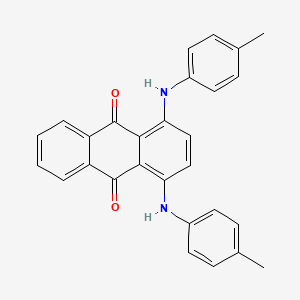
CAS 128-80-3PubChem CID 31416
Cyanine Green G Base
- IUPAC name
- 1,4-bis(4-methylanilino)anthracene-9,10-dione
- Molecular formula
- C28H22N2O2
- Molecular weight
- 418.5 g/mol
- Exact mass
- 418.168127949 Da
- XLogP3
- 7.8
- Topological polar surface area
- 58.2 Ų
- Hydrogen-bond donors
- 2
- Hydrogen-bond acceptors
- 4
- Covalent units
- 1
- Defined stereocentres
- 0
Also known as
D.C. Green No. 61,4-di-4-toluidinoanthraquinoneRefChem:416470Solvent green 3Quinizarin Green SS1,4-Bis(p-tolylamino)anthracene-9,10-dioneC.I. Solvent Green 3Waxoline Green G
16 more reported names
Sudan Green 4BQuinazarin greenArlosol Green BOrganol Green JQuinizarine Green BaseArlosol Green BSAmaplast Green OZArlosol Green BSS11091 GreenWaxoline GreenMacro-lex Green 5BD & C Green no. 6Nitro Fast Green GBOrganol Fast Green JC-Green 10D&C Green 6
External database identifiers
- EPA DTXSID:DTXSID9044376
- PubMed:8669891
Evidence from additional scientific databases
NIH PubChem PUG-View
Exact identifier match31416
Attributed physical-property, hazard, environmental and use annotations.
- Color/Form: Dark burgundy Source: Hazardous Substances Data Bank (HSDB)
- Color/Form: Dark violet needles Source: Hazardous Substances Data Bank (HSDB)
- Color/Form: Solid at 20 °C Source: Hazardous Substances Data Bank (HSDB)
- Density: 0.45 g/mL Source: Hazardous Substances Data Bank (HSDB)
- Melting Point: 218 °C Source: Hazardous Substances Data Bank (HSDB)
- Physical Description: Dark violet solid; [Merck Index] Source: Haz-Map, Information on Hazardous Chemicals and Occupational Diseases
- Solubility: In 2-methoxymethanol, 2 mg/mL; in ethanol 0.3 mg/mL Source: Hazardous Substances Data Bank (HSDB)
- Solubility: Soluble in 3.4 g/100 mL alcohol at 25 °C. Soluble in hydrochloric and sulfuric acid. Sparingly soluble in methanol, ethyl ether. Source: Hazardous Substances Data Bank (HSDB)
- Solubility: Slightly soluble in acetone, ethyl acetate, mineral oil, oleic acid, stearic acid. Soluble in benzene, toluene. Source: Hazardous Substances Data Bank (HSDB)
- Note: This chemical does not meet GHS hazard criteria for 97.8% (2848 of 2913) of all reports. Source: European Chemicals Agency (ECHA)
- GHS Hazard Statements: Not Classified; Reported as not meeting GHS hazard criteria by 2848 of 2913 companies (only 2.2% companies provided GHS information). For more detailed information, please visit ECHA C&L website. Source: European Chemicals Agency (ECHA)
- ECHA C&L Notifications Summary: Aggregated GHS information provided per 2913 reports by companies from 14 notifications to the ECHA C&L Inventory.; Reported as not meeting GHS hazard criteria per 2848 of 2913 reports by companies.; There are 11 notifications provided by 65 of 2913 reports by companies with hazard statement code(s).; Information may vary between notifications depending on impurities, additives, and other factors. The percentage value in parenthesis indicates the notified classification ratio from companies that provide hazard codes. Only hazard codes with percentage values above 10% are shown. For more detailed information, please visit ECHA C&L website. Source: European Chemicals Agency (ECHA)
- Environmental Bioconcentration: An estimated BCF of 500 was calculated in fish for D&C Green No. 6(SRC), using an estimated log Kow of 8.69(1) and a regression-derived equation(2). According to a classification scheme(3), this BCF suggests the potential for bioconcentration in aquatic organisms is high(SRC), provided the compound is not metabolized by the organism(SRC). Source: Hazardous Substances Data Bank (HSDB)
- Environmental Fate: TERRESTRIAL FATE: Based on a classification scheme(1), an estimated Koc value of 4.8X10+6(SRC), determined from a structure estimation method(2), indicates that D&C Green No. 6 is expected to be immobile in soil(SRC). Volatilization of D&C Green No. 6 from moist soil surfaces is not expected to be an important fate process(SRC) given an estimated Henry's Law constant of 1.5X10⁻¹⁶ atm-cu m/mole(SRC), using a fragment constant estimation method(3). D&C Green No. 6 is not expected to volatilize from dry soil surfaces(SRC) based upon an estimated vapor pressure of 7.0X10⁻¹³ mm Hg at 25 °C(SRC), determined from a fragment constant method(4). D&C Green No. 6 was shown to be susceptible to photolysis on soil, with two photoproducts detected, not identified(5). Biodegradation data in soil were not available(SRC, 2011). Source: Hazardous Substances Data Bank (HSDB)
- Environmental Fate: AQUATIC FATE: Based on a classification scheme(1), an estimated Koc value of 4.8X10+6(SRC), determined from a structure estimation method(2), indicates that D&C Green No. 6 is expected to adsorb to suspended solids and sediment(SRC). Volatilization from water surfaces is not expected(3) based upon an estimated Henry's Law constant of 1.5X10⁻¹⁶ atm-cu m/mole(SRC), developed using a fragment constant estimation method(4). According to a classification scheme(5), an estimated BCF of 500(SRC), from an estimated log Kow of 8.69(6) and a regression-derived equation(7), suggests the potential for bioconcentration in aquatic organisms is high, provided the compound is not metabolized by the organism(SRC). Biodegradation data in water were not available(SRC, 2011). Source: Hazardous Substances Data Bank (HSDB)
- Environmental Fate: ATMOSPHERIC FATE: According to a model of gas/particle partitioning of semivolatile organic compounds in the atmosphere(1), D&C Green No. 6, which has an estimated vapor pressure of 7.0X10⁻¹³ mm Hg at 25 °C(SRC), determined from a fragment constant method(2), is expected to exist solely in the particulate phase in the ambient atmosphere. Particulate-phase D&C Green No. 6 may be removed from the air by wet or dry deposition(SRC). D&C Green No. 6 absorbs light at wavelengths 644 nm(3), and therefore may be susceptible to direct photolysis by sunlight(SRC). Source: Hazardous Substances Data Bank (HSDB)
- Sources/Uses: Used for sutures; Approved for external drugs and cosmetics; [Merck Index] Source: Haz-Map, Information on Hazardous Chemicals and Occupational Diseases
- Uses: Coloring fats, oils, waxes, hydrocarbon solvents, hydrocarbon-base wood stains, cellulose acetate, polystyrene and soap, and in the preparation of oleic or stearic rotogravure inks. Source: Hazardous Substances Data Bank (HSDB)
- Uses: Coloring contact lenses; ... coloring polyethylene terephthalate surgical sutures, including sutures for ophthalmic use; ... coloring polyglycolic acid surgical sutures with diameter greater than U.S.P. size 8-0, including sutures for ophthalmic use; ... coloring poly(glycolic acid-co-trimethylene carbonate) sutures (also referred to as 1,4-dioxan-2,5-dione polymer with 1,3-dioxan-2-one) for general surgical use; and ... coloring polymethylmethacrylate support haptics of intraocular lenses. Source: Hazardous Substances Data Bank (HSDB)
- Uses: Military smoke dye grenades used for communication Source: Hazardous Substances Data Bank (HSDB)
Mapped by: Existing checksum-valid CAS to unique PubChem CID match. Retrieved: 2026-08-31. Open source record
Scientific classifications and hazard annotations provide context and do not replace the market-specific regulatory decision shown above.
Additional source coverage and match status
| Source | Result | Checked |
|---|---|---|
| NIH PubChem PUG-View | Exact match | 2026-08-31 |
A recorded no-match is useful evidence that the source was checked; it is not a claim that the substance does not exist elsewhere.
Retrieved from NIH PubChem on 2026-09-02 by checksum-valid CAS matching. Chemical properties do not replace the regulatory decision on this page.