
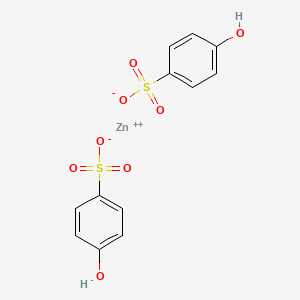
Zinc Phenolsulfonate
Zinc phenolsulfonate appears as a colorless to white crystalline solid which turns pink on exposure to air. The primary is the threat to the environment. Immediate steps should be taken to limit its spread to the environment. It is soluble in water. It is used as an insecticide and in medicine. — CAMEO Chemicals
- IUPAC name
- zinc bis(4-hydroxybenzenesulfonate)
- Molecular formula
- C12H10O8S2Zn
- Molecular weight
- 411.7 g/mol
- Exact mass
- 409.910851 Da
- Topological polar surface area
- 172.0 Ų
- Hydrogen-bond donors
- 2
- Hydrogen-bond acceptors
- 8
- Covalent units
- 3
- Defined stereocentres
- 0
Also known as
16 more reported names
External database identifiers
- EPA DTXSID:DTXSID1059571
Evidence from additional scientific databases
NIH PubChem PUG-View
Attributed physical-property, hazard, environmental and use annotations.
- Boiling Point: 248 °F at 760 mmHg (decomposes) (USCG, 1999) Source: CAMEO Chemicals
- Color/Form: Colorless transparent crystals or white granular powder Source: Hazardous Substances Data Bank (HSDB)
- Density: greater than 1 at 68 °F (USCG, 1999) Source: CAMEO Chemicals
- Odor: Odorless Source: Hazardous Substances Data Bank (HSDB)
- Physical Description: Zinc phenolsulfonate appears as a colorless to white crystalline solid which turns pink on exposure to air. The primary is the threat to the environment. Immediate steps should be taken to limit its spread to the environment. It is soluble in water. It is used as an insecticide and in medicine. Source: CAMEO Chemicals
- Physical Description: Octahydrate: Odorless solid; Effloresces in dry air; [Merck Index] Source: Haz-Map, Information on Hazardous Chemicals and Occupational Diseases
- Solubility: Solubility: 62.5 g/100 cc cold water; 250 g/100 cc water at 100 °C; 55.6 g/100 cc alcohol at 25 °C /Octahydrate/ Source: Hazardous Substances Data Bank (HSDB)
- pH: Moderate acidity Source: Hazardous Substances Data Bank (HSDB)
- Carcinogen Classification: No indication of carcinogenicity to humans (not listed by IARC). Source: Toxin and Toxin Target Database (T3DB)
- Exposure Routes: Oral (L49) ; inhalation (L49) ; dermal (L49) Source: Toxin and Toxin Target Database (T3DB)
- First Aid: INHALATION: move to fresh air.; INGESTION: if large amount has been swallowed, induce vomiting, followed by prompt and complete gastric lavage, cathartics, and demulcents.; EYES or SKIN: flush with water. (USCG, 1999) Source: CAMEO Chemicals
- Note: This chemical does not meet GHS hazard criteria for 46.8% (36 of 77) of reports. Source: European Chemicals Agency (ECHA)
- Signal: Warning Source: European Chemicals Agency (ECHA)
- GHS Hazard Statements: H302 (53.2%): Harmful if swallowed [Warning Acute toxicity, oral]; H315 (51.9%): Causes skin irritation [Warning Skin corrosion/irritation]; H319 (51.9%): Causes serious eye irritation [Warning Serious eye damage/eye irritation]; H335 (51.9%): May cause respiratory irritation [Warning Specific target organ toxicity, single exposure; Respiratory tract irritation] Source: European Chemicals Agency (ECHA)
- Precautionary Statement Codes: P261, P264, P264+P265, P270, P271, P280, P301+P317, P302+P352, P304+P340, P305+P351+P338, P319, P321, P330, P332+P317, P337+P317, P362+P364, P403+P233, P405, and P501 (click each P-code to see the statement) Source: European Chemicals Agency (ECHA)
- ECHA C&L Notifications Summary: Aggregated GHS information provided per 77 reports by companies from 5 notifications to the ECHA C&L Inventory. Each notification may be associated with multiple companies.; Reported as not meeting GHS hazard criteria per 36 of 77 reports by companies.; There are 4 notifications provided by 41 of 77 reports by companies with hazard statement code(s).; Information may vary between notifications depending on impurities, additives, and other factors. The percentage value in parenthesis indicates the notified classification ratio from companies that provide hazard codes. Only hazard codes with percentage values above 10% are shown. For more detailed information, please visit ECHA C&L website. Source: European Chemicals Agency (ECHA)
- Health Effects: Chronic exposure to zinc causes anemia, atazia, lethargy, and decreases the level of good cholesterol in the body. It is also believed to cause pancreatic and reproductive damage. (L49) Source: Toxin and Toxin Target Database (T3DB)
- Cosmetic Ingredient Review Finding(s): Safe in the present practices of use and concentration. Ingredient, concentration, and use information are available in documents discoverable at https://cir-reports.cir-safety.org Source: Cosmetic Ingredient Review (CIR)
- Toxicity Summary: Anaemia results from the excessive absorption of zinc suppressing copper and iron absorption, most likely through competitive binding of intestinal mucosal cells. Unbalanced levels of copper and zinc binding to Cu,Zn-superoxide dismutase has been linked to amyotrophic lateral sclerosis (ALS). Stomach acid dissolves metallic zinc to give corrosive zinc chloride, which can cause damage to the stomach lining. Metal fume fever is thought to be an immune response to inhaled zinc. (L48, L49, A49) Source: Toxin and Toxin Target Database (T3DB)
- Cosmetic Ingredient Review Link: CIR ingredient: Zinc Phenolsulfonate Source: Cosmetic Ingredient Review (CIR)
- Sources/Uses: Used in insecticides, topical antiperspirants, mouthwashes, and veterinary wound antiseptics; [HSDB] An astringent; [EPA OHM/TADS] Source: Haz-Map, Information on Hazardous Chemicals and Occupational Diseases
- Industrial Processes with risk of exposure: Using Disinfectants or Biocides [Category: Clean]; Farming (Pesticides) [Category: Industry] Source: Haz-Map, Information on Hazardous Chemicals and Occupational Diseases
- Uses: IN INSECTICIDE FORMULATIONS Source: Hazardous Substances Data Bank (HSDB)
- Uses: MEDICATION Source: Hazardous Substances Data Bank (HSDB)
- Uses: MEDICATION (VET) Source: Hazardous Substances Data Bank (HSDB)
- Uses: COMMONLY USED TOPICALLY AS ANTIPERSPIRANT Source: Hazardous Substances Data Bank (HSDB)
Mapped by: Existing checksum-valid CAS to unique PubChem CID match. Retrieved: 2026-08-31. Open source record
Scientific classifications and hazard annotations provide context and do not replace the market-specific regulatory decision shown above.
Additional source coverage and match status
| Source | Result | Checked |
|---|---|---|
| NIH PubChem PUG-View | Exact match | 2026-08-31 |
A recorded no-match is useful evidence that the source was checked; it is not a claim that the substance does not exist elsewhere.
Retrieved from NIH PubChem on 2026-09-02 by checksum-valid CAS matching. Chemical properties do not replace the regulatory decision on this page.