
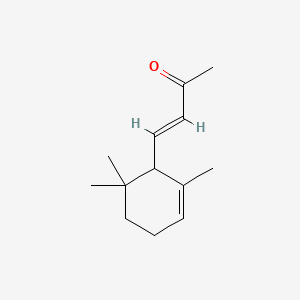
Alpha-Ionone
alpha-ionone has been reported in Camellia sinensis, Leonurus japonicus, and other organisms with data available. — LOTUS - the natural products occurrence database
- IUPAC name
- (E)-4-(2,6,6-trimethylcyclohex-2-en-1-yl)but-3-en-2-one
- Molecular formula
- C13H20O
- Molecular weight
- 192.30 g/mol
- Exact mass
- 192.151415257 Da
- XLogP3
- 3.0
- Topological polar surface area
- 17.1 Ų
- Hydrogen-bond donors
- 0
- Hydrogen-bond acceptors
- 1
- Covalent units
- 1
- Defined stereocentres
- 0
Also known as
16 more reported names
External database identifiers
- ChEBI:CHEBI:32319
- ChEMBL:CHEMBL472877
- EPA DTXSID:DTXSID0035160
- PubMed:27226631
- PubMed:15598656
Evidence from additional scientific databases
NIH PubChem PUG-View
Attributed physical-property, hazard, environmental and use annotations.
- Boiling Point: 258 °C at 760 mm Hg Source: Hazardous Substances Data Bank (HSDB)
- Boiling Point: Pale yellow to yellow liquid; Specific gravity: 0.933-0.937 25/25 °C; Boiling point: 126-128 °C at 12 mm Hg /mixed ionone isomers/ Source: Hazardous Substances Data Bank (HSDB)
- Boiling Point: 237 °C Source: Joint FAO/WHO Expert Committee on Food Additives (JECFA)
- Color/Form: Colorless to slightly yellow liquid Source: Hazardous Substances Data Bank (HSDB)
- Density: 0.9319 at 20/4 °C Source: Hazardous Substances Data Bank (HSDB)
- Density: 0.927-0.933 Source: Joint FAO/WHO Expert Committee on Food Additives (JECFA)
- Flash Point: 118 °C (244 °F) - closed cup Source: Hazardous Substances Data Bank (HSDB)
- LogP: log Kow = 3.85 Source: Hazardous Substances Data Bank (HSDB)
- Odor: It has a warm, woody, floral odor with balsamic and sweet tones and is strongly reminiscent of violet flowers. Source: Hazardous Substances Data Bank (HSDB)
- Odor: Sweet-floral odor, reminiscent of violets Source: Hazardous Substances Data Bank (HSDB)
- Physical Description: Liquid; CBI Source: EPA Chemical Data Reporting (CDR)
- Physical Description: colourless to pale-yellow liquid with a warm, woody, violet-floral odour Source: Joint FAO/WHO Expert Committee on Food Additives (JECFA)
- Refractive Index: Index of refraction: 1.4982 at 20 °C Source: Hazardous Substances Data Bank (HSDB)
- Refractive Index: 1.497-1.502 Source: Joint FAO/WHO Expert Committee on Food Additives (JECFA)
- Solubility: In water, 106 mg/L at 25 °C Source: Hazardous Substances Data Bank (HSDB)
- Solubility: Soluble in alcohol, most fixed oils, propylene glycol; insoluble in glycerin Source: Hazardous Substances Data Bank (HSDB)
- Solubility: Miscible with absolute alcohol. Soluble in 2 to 3 parts of 70% alcohol, ether, chloroform, benzene. Very slightly soluble in water. /mixed ionone isomers/ Source: Hazardous Substances Data Bank (HSDB)
- Solubility: soluble in alcohol, propylene glycol, most fixed oils; insoluble in glycerol and water Source: Joint FAO/WHO Expert Committee on Food Additives (JECFA)
- Solubility: 1 ml in 3 ml 70% alcohol; 1 ml in 10 ml 60% alcohol (in ethanol) Source: Joint FAO/WHO Expert Committee on Food Additives (JECFA)
- Vapor Pressure: 0.019 mm Hg at 25 C (extrapolated from higher temperatures) Source: Hazardous Substances Data Bank (HSDB)
- Carcinogen Classification: No indication of carcinogenicity to humans (not listed by IARC). Source: Toxin and Toxin Target Database (T3DB)
- GHS Hazard Statements: Not Classified; Reported as not meeting GHS hazard criteria by 1609 of 1789 companies Source: European Chemicals Agency (ECHA)
- ECHA C&L Notifications Summary: Aggregated GHS information provided per 1789 reports by companies from 10 notifications to the ECHA C&L Inventory.; Reported as not meeting GHS hazard criteria per 1609 of 1789 reports by companies.; There are 8 notifications provided by 180 of 1789 reports by companies with hazard statement code(s).; Information may vary between notifications depending on impurities, additives, and other factors. The percentage value in parenthesis indicates the notified classification ratio from companies that provide hazard codes. Only hazard codes with percentage values above 10% are shown. For more detailed information, please visit ECHA C&L website. Source: European Chemicals Agency (ECHA)
- Signal: Warning Source: Hazardous Chemical Information System (HCIS), Safe Work Australia
- GHS Hazard Statements: H315: Causes skin irritation [Warning Skin corrosion/irritation]; H317: May cause an allergic skin reaction [Warning Sensitization, Skin] Source: Hazardous Chemical Information System (HCIS), Safe Work Australia
- Precautionary Statement Codes: P261, P264, P272, P280, P302+P352, P321, P332+P317, P333+P317, P362+P364, and P501 (click each P-code to see the statement) Source: Hazardous Chemical Information System (HCIS), Safe Work Australia
- Signal: Danger Source: Hazardous Substances Data Bank (HSDB)
- GHS Hazard Statements: H334: May cause allergy or asthma symptoms or breathing difficulties if inhaled [Danger Sensitization, respiratory] Source: Hazardous Substances Data Bank (HSDB)
- Precautionary Statement Codes: P233, P260, P271, P284, P304+P340, P342+P316, P403, and P501 (click each P-code to see the statement) Source: Hazardous Substances Data Bank (HSDB)
- NFPA Health Rating: 0 - Materials that, under emergency conditions, would offer no hazard beyond that of ordinary combustible materials. Source: Hazardous Substances Data Bank (HSDB)
- NFPA Fire Rating: 1 - Materials that must be preheated before ignition can occur. Materials require considerable preheating, under all ambient temperature conditions, before ignition and combustion can occur. Source: Hazardous Substances Data Bank (HSDB)
- NFPA Instability Rating: 0 - Materials that in themselves are normally stable, even under fire conditions. Source: Hazardous Substances Data Bank (HSDB)
- Toxicity Summary: IDENTIFICATION AND USE: Alpha-ionone (AI) is a colorless to slightly yellow liquid. AI is a fragrance ingredient in perfumery, in cosmetics and personal care products, in household cleaners and detergents. Flavoring agent in beverages, baked goods, and candies. Used as an ingredient in dog/cat repellent. It is registered for pesticide use in the USA but approved pesticide uses may change periodically and so federal, state and local authorities must be consulted for currently approved uses. HUMAN EXPOSURE AND TOXICITY: AI (32 % in acetone) was found to be a moderate irritant. No reactions were observed with 1% AI; 5% AI produced one irritant/questionable reaction. ANIMAL STUDIES: No skin irritation was observed in miniature swine using neat AI. In guinea pigs AI was reported to be moderately irritating in skin test. AI produced severe skin irritation reaction in rabbits. AI was tested in a 90-days oral toxicity study using male and female rats. Body weigh gains and feed intake were reduced slightly in both males and females (10 mg/kg). In rats diet containing mixture of AI (60%) and beta-ionone produced swelling of hepatic parenchymal cells after 17 weeks. No mutagenic activity was Source: Hazardous Substances Data Bank (HSDB)
- Environmental Bioconcentration: An estimated BCF of 161 was calculated in fish for alpha-ionone(SRC), using a log Kow of 3.85(1) and a regression-derived equation(2). According to a classification scheme(3), this BCF suggests the potential for bioconcentration in aquatic organisms is high(SRC), provided the compound is not metabolized by the organism(SRC). Source: Hazardous Substances Data Bank (HSDB)
- Environmental Fate: TERRESTRIAL FATE: Based on a classification scheme(1), an estimated Koc value of 670(SRC), determined from a structure estimation method(2), indicates that alpha-ionone is expected to have low mobility in soil(SRC). Volatilization of alpha-ionone from moist soil surfaces is expected to be an important fate process(SRC) given an estimated Henry's Law constant of 4.5X10⁻⁵ atm-cu m/mole(SRC), derived from its vapor pressure, 0.019 mm Hg(3), and water solubility, 106 mg/L(4). alpha-Ionone, a perfumery compound with an odor(5), is expected to volatilize from dry soil surfaces(SRC) based upon its vapor pressure(3). The biodegradability of alpha-ionone is expected to be analogous to beta-ionone(SRC) which was found to be readily biodegradable by two OECD screening tests(6). A 79% of theoretical BOD using activated sludge in the OECD 301F test(6) suggests that biodegradation is an important environmental fate process in soil(SRC). beta-Ionone was also classified as readily biodegradable by the results of a CO2-evolution test where beta-ionone achieved 46% and 73% CO2 evolution after 7 and 28 days, respectively(6). By analogy to beta-ionone(7), alpha-ionone is expected to absorbs at wavelen Source: Hazardous Substances Data Bank (HSDB)
- Environmental Fate: AQUATIC FATE: Based on a classification scheme(1), an estimated Koc value of 670(SRC), determined from a structure estimation method(2), indicates that alpha-ionone is expected to adsorb to suspended solids and sediment(SRC). Volatilization from water surfaces is expected(3) based upon an estimated Henry's Law constant of 4.5X10⁻⁵ atm-cu m/mole(SRC), derived from its vapor pressure, 0.019 mm Hg(4), and water solubility, 106 mg/L(5). Using this Henry's Law constant and an estimation method(3), volatilization half-lives for a model river and model lake are 31 hours and 13 days, respectively(SRC). According to a classification scheme(6), an estimated BCF of 161(SRC), from its log Kow of 3.85(7) and a regression-derived equation(2), suggests the potential for bioconcentration in aquatic organisms is high(SRC). The biodegradability of alpha-ionone is expected to be analogous to beta-ionone(SRC) which was found to be readily biodegradable by two OECD screening tests(8). A 79% of theoretical BOD using activated sludge in the OECD 301F test(8) suggests that biodegradation is an important environmental fate process in water(SRC). beta-Ionone was also classified as readily biodegradable by t Source: Hazardous Substances Data Bank (HSDB)
- Environmental Fate: ATMOSPHERIC FATE: According to a model of gas/particle partitioning of semivolatile organic compounds in the atmosphere(1), alpha-ionone, which has an extrapolated vapor pressure of 0.019 mm Hg at 25 °C(2), is expected to exist solely as a vapor in the ambient atmosphere. Vapor-phase alpha-ionone is degraded in the atmosphere by reaction with photochemically-produced hydroxyl radicals(SRC); the half-life for this reaction in air is estimated to be 2.7 hours(SRC), calculated from its rate constant of 1.5X10⁻¹⁰ cu cm/molecule-sec at 25 °C(SRC) that was derived using a structure estimation method(3). Vapor-phase alpha-ionone is also degraded in the atmosphere by reaction with ozone and nitrate radicals(SRC); the half-lives for these reaction in air are estimated to be 14 and 0.8 hours respectively(SRC), calculated from analogous measured rate constants for beta-ionone of 1.9X10⁻¹⁷ cu cm/molecule-sec at 24 °C for ozone(4) and 9.4X10⁻¹² cu cm/molecule-sec at 24 °C for nitrate radicals(5). The nitrate radical (NO3) is the dominant atmospheric oxidant during the night-time in most atmospheric environments(6), therefore, night-time degradation appears to be a major fate process for alpha-i Source: Hazardous Substances Data Bank (HSDB)
- Consumer Uses: Other; Fragrance Source: EPA Chemical Data Reporting (CDR)
- Industry Uses: Fragrance; Other Source: EPA Chemical Data Reporting (CDR)
- Uses: For alpha-ionone (USEPA/OPP Pesticide Code: 129030) ACTIVE products with label matches. /SRP: Registered for use in the USA but approved pesticide uses may change periodically and so federal, state and local authorities must be consulted for currently approved uses./ Source: Hazardous Substances Data Bank (HSDB)
- Uses: Reported uses (ppm):; Table: Reported uses (ppm): (Flavor and Extract Manufacturers' Association, 1994) [Table#8259] Source: Hazardous Substances Data Bank (HSDB)
- Uses: Fragrance ingredient in perfumery, in cosmetics and personal care products, in household cleaners and detergents. Flavoring agent in beverages, baked goods, and candies. Source: Hazardous Substances Data Bank (HSDB)
- Uses: Used as an ingredient in dog/cat repellent; attracts adult rose chafers (a beetle). Source: Hazardous Substances Data Bank (HSDB)
Mapped by: Existing checksum-valid CAS to unique PubChem CID match. Retrieved: 2026-08-31. Open source record
Scientific classifications and hazard annotations provide context and do not replace the market-specific regulatory decision shown above.
Additional source coverage and match status
| Source | Result | Checked |
|---|---|---|
| NIH PubChem PUG-View | Exact match | 2026-08-31 |
A recorded no-match is useful evidence that the source was checked; it is not a claim that the substance does not exist elsewhere.
Retrieved from NIH PubChem on 2026-08-31 by checksum-valid CAS matching. Chemical properties do not replace the regulatory decision on this page.