
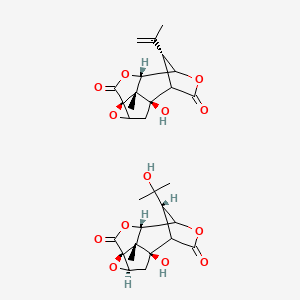
Picrotoxin
Cocculus appears as a poisonous berry, the dried fruit of Anamirta cocculus L. Contains several substances including about one percent picrotoxin. Pure picrotoxin occurs as shiny leaflets with an intensely bitter taste or as a microcrystalline powder. Very poisonous!. Used in medicine as a central nervous system stimulant and antidote for barbiturate poisoning. Not currently regarded as a useful therapeutic agent. — CAMEO Chemicals
- IUPAC name
- (1R,3R,5S,8S,13R,14S)-1-hydroxy-14-(2-hydroxypropan-2-yl)-13-methyl-4,7,10-trioxapentacyclo[6.4.1.19,12.03,5.05,13]tetradecane-6,11-dione;(1R,5S,8S,13R,14R)-1-hydroxy-13-methyl-14-prop-1-en-2-yl-4,7,10-trioxapentacyclo[6.4.1.19,12.03,5.05,13]tetradecane-6,11-dione
- Molecular formula
- C30H34O13
- Molecular weight
- 602.6 g/mol
- Exact mass
- 602.19994113 Da
- Topological polar surface area
- 191.0 Ų
- Hydrogen-bond donors
- 3
- Hydrogen-bond acceptors
- 13
- Covalent units
- 2
- Defined stereocentres
- 11
Also known as
16 more reported names
External database identifiers
Evidence from additional scientific databases
NIH PubChem PUG-View
Attributed physical-property, hazard, environmental and use annotations.
- Color/Form: Shiny rhomboid leaflets Source: Hazardous Substances Data Bank (HSDB)
- Color/Form: Colorless, shining, prismatic crystals or white or nearly white microcrystalline powder Source: Hazardous Substances Data Bank (HSDB)
- LogP: -2.229 Source: DrugBank
- Melting Point: 397 °F (EPA, 1998) Source: CAMEO Chemicals
- Melting Point: 203.5 °C Source: DrugBank
- Melting Point: 203 °C Source: Hazardous Substances Data Bank (HSDB)
- Odor: Odorless Source: Hazardous Substances Data Bank (HSDB)
- Physical Description: Cocculus appears as a poisonous berry, the dried fruit of Anamirta cocculus L. Contains several substances including about one percent picrotoxin. Pure picrotoxin occurs as shiny leaflets with an intensely bitter taste or as a microcrystalline powder. Very poisonous!. Used in medicine as a central nervous system stimulant and antidote for barbiturate poisoning. Not currently regarded as a useful therapeutic agent. Source: CAMEO Chemicals
- Solubility: 4100 mg/L Source: DrugBank
- Solubility: 1 g in 350 ml water Source: Hazardous Substances Data Bank (HSDB)
- Solubility: 1 g in 5 ml boiling water (approx) Source: Hazardous Substances Data Bank (HSDB)
- Solubility: 1 g in 13.5 ml 95% ethanol Source: Hazardous Substances Data Bank (HSDB)
- Solubility: 1 g in 3 ml boiling alcohol (approx) Source: Hazardous Substances Data Bank (HSDB)
- Solubility: For more Solubility (Complete) data for PICROTOXIN (7 total), please visit the HSDB record page. Source: Hazardous Substances Data Bank (HSDB)
- Vapor Pressure: 0.00001 [mm Hg] @25 °C Source: PAC Chemical Database, U.S. Department of Energy
- pH: A saturated solution in water is neutral to litmus Source: Hazardous Substances Data Bank (HSDB)
- First Aid: Warning: Picrotoxin is a powerful stimulant and affects all portions of the central nervous system. Picrotoxin is a highly toxic alkaloid convulsant poison. Epileptics may be more sensitive to picrotoxin.; Signs and Symptoms of Picrotoxin Exposure: Signs and symptoms of acute exposure to picrotoxin may include slowing of pulse followed by increased pulse rate, tachycardia, and arrhythmias. Headache, salivation, sweating, dilation of pupils, loss of vision, muscle rigidity, excitement, hyperactivity, delirium, hallucinations, and convulsions may be observed. Nausea, vomiting, diarrhea, hyperpnea (excessive respiration), pulmonary edema, respiratory failure, and coma may also be noted.; Emergency Life-Support Procedures: Acute exposure to picrotoxin may require decontamination and life support for the victims. Emergency personnel should wear protective clothing appropriate to the type and degree of contamination. Air-purifying or supplied-air respiratory equipment should also be worn, as necessary. Rescue vehicles should carry supplies such as plastic sheeting and disposable plastic bags to assist in preventing spread of contamination.; Inhalation Exposure:; 1. Move victims to fresh Source: CAMEO Chemicals
- Signal: Danger Source: European Chemicals Agency (ECHA)
- GHS Hazard Statements: H300 (100%): Fatal if swallowed [Danger Acute toxicity, oral] Source: European Chemicals Agency (ECHA)
- Precautionary Statement Codes: P264, P270, P301+P316, P321, P330, P405, and P501 (click each P-code to see the statement) Source: European Chemicals Agency (ECHA)
- ECHA C&L Notifications Summary: Aggregated GHS information provided per 43 reports by companies from 1 notifications to the ECHA C&L Inventory.; Information may vary between notifications depending on impurities, additives, and other factors. The percentage value in parenthesis indicates the notified classification ratio from companies that provide hazard codes. Only hazard codes with percentage values above 10% are shown. For more detailed information, please visit ECHA C&L website. Source: European Chemicals Agency (ECHA)
- Uses: MEDICATION (VET) Source: Hazardous Substances Data Bank (HSDB)
- Uses: MEDICATION Source: Hazardous Substances Data Bank (HSDB)
Mapped by: Existing checksum-valid CAS to unique PubChem CID match. Retrieved: 2026-08-31. Open source record
Scientific classifications and hazard annotations provide context and do not replace the market-specific regulatory decision shown above.
Additional source coverage and match status
| Source | Result | Checked |
|---|---|---|
| NIH PubChem PUG-View | Exact match | 2026-08-31 |
A recorded no-match is useful evidence that the source was checked; it is not a claim that the substance does not exist elsewhere.
Retrieved from NIH PubChem on 2026-09-02 by checksum-valid CAS matching. Chemical properties do not replace the regulatory decision on this page.