
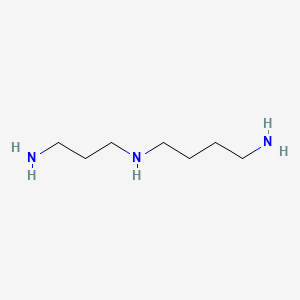
Spermidine
Spermidine is a triamine that is the 1,5,10-triaza derivative of decane. It has a role as an autophagy inducer, a geroprotector and a fundamental metabolite. It is a triamine and a polyazaalkane. It is a conjugate base of a spermidine(3+). — ChEBI
- IUPAC name
- N'-(3-aminopropyl)butane-1,4-diamine
- Molecular formula
- C7H19N3
- Molecular weight
- 145.25 g/mol
- Exact mass
- 145.157897619 Da
- XLogP3
- -1.0
- Topological polar surface area
- 64.1 Ų
- Hydrogen-bond donors
- 3
- Hydrogen-bond acceptors
- 3
- Covalent units
- 1
- Defined stereocentres
- 0
Also known as
16 more reported names
External database identifiers
- ChEBI:CHEBI:16610
- ChEMBL:CHEMBL19612
- EPA DTXSID:DTXSID4036645
- PubMed:25355561
- PubMed:24709313
- PubMed:23707493
- PubMed:23124758
- PubMed:23097746
- PubMed:23076119
- PubMed:23071598
- PubMed:23059820
- PubMed:23056524
- PubMed:23054439
- PubMed:23022686
- PubMed:23021806
Evidence from additional scientific databases
NIH PubChem PUG-View
Attributed physical-property, hazard, environmental and use annotations.
- Boiling Point: 129 °C at 1.40E+01 mm Hg Source: DrugBank
- Melting Point: < 25 °C Source: DrugBank
- Melting Point: < 25 °C Source: Human Metabolome Database (HMDB)
- Physical Description: Solid Source: Human Metabolome Database (HMDB)
- Carcinogen Classification: No indication of carcinogenicity to humans (not listed by IARC). Source: Toxin and Toxin Target Database (T3DB)
- Exposure Routes: Endogenous, Ingestion, Dermal (contact) Source: Toxin and Toxin Target Database (T3DB)
- Signal: Danger Source: European Chemicals Agency (ECHA)
- GHS Hazard Statements: H314 (100%): Causes severe skin burns and eye damage [Danger Skin corrosion/irritation]; H318 (81.9%): Causes serious eye damage [Danger Serious eye damage/eye irritation] Source: European Chemicals Agency (ECHA)
- Precautionary Statement Codes: P260, P264, P264+P265, P280, P301+P330+P331, P302+P361+P354, P304+P340, P305+P354+P338, P316, P317, P321, P363, P405, and P501 (click each P-code to see the statement) Source: European Chemicals Agency (ECHA)
- ECHA C&L Notifications Summary: Aggregated GHS information provided per 83 reports by companies from 4 notifications to the ECHA C&L Inventory. Each notification may be associated with multiple companies.; Information may vary between notifications depending on impurities, additives, and other factors. The percentage value in parenthesis indicates the notified classification ratio from companies that provide hazard codes. Only hazard codes with percentage values above 10% are shown. For more detailed information, please visit ECHA C&L website. Source: European Chemicals Agency (ECHA)
- Health Effects: Chronic exposure to uremic toxins can lead to a number of conditions including renal damage, chronic kidney disease and cardiovascular disease. Source: Toxin and Toxin Target Database (T3DB)
- Toxicity Summary: Uremic toxins such as spermidine are actively transported into the kidneys via organic ion transporters (especially OAT3). Increased levels of uremic toxins can stimulate the production of reactive oxygen species. This seems to be mediated by the direct binding or inhibition by uremic toxins of the enzyme NADPH oxidase (especially NOX4 which is abundant in the kidneys and heart) (A7868). Reactive oxygen species can induce several different DNA methyltransferases (DNMTs) which are involved in the silencing of a protein known as KLOTHO. KLOTHO has been identified as having important roles in anti-aging, mineral metabolism, and vitamin D metabolism. A number of studies have indicated that KLOTHO mRNA and protein levels are reduced during acute or chronic kidney diseases in response to high local levels of reactive oxygen species (A7869). Source: Toxin and Toxin Target Database (T3DB)
- Uses: Naturally produced by the body (endogenous). Source: Toxin and Toxin Target Database (T3DB)
Mapped by: Existing checksum-valid CAS to unique PubChem CID match. Retrieved: 2026-08-31. Open source record
Scientific classifications and hazard annotations provide context and do not replace the market-specific regulatory decision shown above.
Additional source coverage and match status
| Source | Result | Checked |
|---|---|---|
| NIH PubChem PUG-View | Exact match | 2026-08-31 |
A recorded no-match is useful evidence that the source was checked; it is not a claim that the substance does not exist elsewhere.
Retrieved from NIH PubChem on 2026-08-31 by checksum-valid CAS matching. Chemical properties do not replace the regulatory decision on this page.