
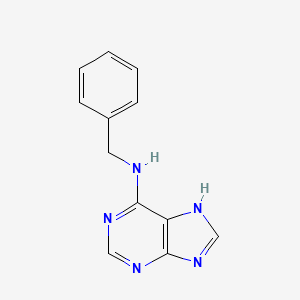
Benzylaminopurine
N-benzyladenine is a member of the class of 6-aminopurines that is adenine in which one of the hydrogens of the amino group is replaced by a benzyl group. It has a role as a cytokinin and a plant metabolite. It is functionally related to an adenine. — ChEBI
- IUPAC name
- N-benzyl-7H-purin-6-amine
- Molecular formula
- C12H11N5
- Molecular weight
- 225.25 g/mol
- Exact mass
- 225.10144537 Da
- XLogP3
- 2.1
- Topological polar surface area
- 66.5 Ų
- Hydrogen-bond donors
- 2
- Hydrogen-bond acceptors
- 4
- Covalent units
- 1
- Defined stereocentres
- 0
Also known as
16 more reported names
External database identifiers
- ChEBI:CHEBI:29022
- ChEMBL:CHEMBL228862
- EPA DTXSID:DTXSID7032630
- PubMed:23119167
- PubMed:23096356
- PubMed:23061288
- PubMed:23013724
- PubMed:22997547
- PubMed:22980641
- PubMed:22885546
- PubMed:22883630
- PubMed:22869078
- PubMed:22832308
- PubMed:22827069
- PubMed:22782631
Evidence from additional scientific databases
NIH PubChem PUG-View
Attributed physical-property, hazard, environmental and use annotations.
- Color/Form: Colorless, fine needles Source: Hazardous Substances Data Bank (HSDB)
- LogP: log Kow = 1.57 Source: Hazardous Substances Data Bank (HSDB)
- LogP: 1.57 Source: Human Metabolome Database (HMDB)
- Melting Point: 234-235 °C Source: Hazardous Substances Data Bank (HSDB)
- Melting Point: 229 °C Source: Human Metabolome Database (HMDB)
- Physical Description: Colorless solid; Technical product is off-white solid; [HSDB] White solid; Formulated as soluble concentrate/liquid; [Reference #1] Light yellow powder; [Alfa Aesar MSDS] Source: Haz-Map, Information on Hazardous Chemicals and Occupational Diseases
- Physical Description: Solid Source: Human Metabolome Database (HMDB)
- Solubility: Insoluble in most common organic solvents; Soluble in dimethylformamide, dimethyl sulfoxide Source: Hazardous Substances Data Bank (HSDB)
- Solubility: In water, 0.00044 g/cu cm at 15 °C Source: Hazardous Substances Data Bank (HSDB)
- Solubility: In water, 60 mg/L at 20 °C Source: Hazardous Substances Data Bank (HSDB)
- Solubility: 0.06 mg/mL at 20 °C Source: Human Metabolome Database (HMDB)
- Vapor Pressure: 2.373X10⁻⁶ mPa (1.79X10⁻¹¹ mm Hg) at 20 °C Source: Hazardous Substances Data Bank (HSDB)
- Note: This chemical does not meet GHS hazard criteria for 3% (3 of 100) of reports. Source: European Chemicals Agency (ECHA)
- Signal: Warning Source: European Chemicals Agency (ECHA)
- GHS Hazard Statements: H302 (51%): Harmful if swallowed [Warning Acute toxicity, oral]; H315 (52%): Causes skin irritation [Warning Skin corrosion/irritation]; H319 (52%): Causes serious eye irritation [Warning Serious eye damage/eye irritation]; H335 (51%): May cause respiratory irritation [Warning Specific target organ toxicity, single exposure; Respiratory tract irritation]; H361d (28%): Suspected of damaging the unborn child [Warning Reproductive toxicity]; H400 (33%): Very toxic to aquatic life [Warning Hazardous to the aquatic environment, acute hazard]; H410 (29%): Very toxic to aquatic life with long lasting effects [Warning Hazardous to the aquatic environment, long-term hazard]; H411 (29%): Toxic to aquatic life with long lasting effects [Hazardous to the aquatic environment, long-term hazard] Source: European Chemicals Agency (ECHA)
- Precautionary Statement Codes: P203, P261, P264, P264+P265, P270, P271, P273, P280, P301+P317, P302+P352, P304+P340, P305+P351+P338, P318, P319, P321, P330, P332+P317, P337+P317, P362+P364, P391, P403+P233, P405, and P501 (click each P-code to see the statement) Source: European Chemicals Agency (ECHA)
- ECHA C&L Notifications Summary: Aggregated GHS information provided per 100 reports by companies from 19 notifications to the ECHA C&L Inventory. Each notification may be associated with multiple companies.; Reported as not meeting GHS hazard criteria per 3 of 100 reports by companies.; There are 18 notifications provided by 97 of 100 reports by companies with hazard statement code(s).; Information may vary between notifications depending on impurities, additives, and other factors. The percentage value in parenthesis indicates the notified classification ratio from companies that provide hazard codes. Only hazard codes with percentage values above 10% are shown. For more detailed information, please visit ECHA C&L website. Source: European Chemicals Agency (ECHA)
- GHS Hazard Statements: H402: Harmful to aquatic life [Hazardous to the aquatic environment, acute hazard]; H412: Harmful to aquatic life with long lasting effects [Hazardous to the aquatic environment, long-term hazard] Source: NITE-CMC
- Precautionary Statement Codes: P273, and P501 (click each P-code to see the statement) Source: NITE-CMC
- Signal: Warning Source: NITE-CMC
- GHS Hazard Statements: H302: Harmful if swallowed [Warning Acute toxicity, oral]; H320: Causes eye irritation [Warning Serious eye damage/eye irritation]; H332: Harmful if inhaled [Warning Acute toxicity, inhalation]; H335: May cause respiratory irritation [Warning Specific target organ toxicity, single exposure; Respiratory tract irritation]; H361: Suspected of damaging fertility or the unborn child [Warning Reproductive toxicity] Source: NITE-CMC
- Precautionary Statement Codes: P203, P261, P264, P264+P265, P270, P271, P280, P301+P317, P304+P340, P305+P351+P338, P317, P318, P319, P330, P337+P317, P403+P233, P405, and P501 (click each P-code to see the statement) Source: NITE-CMC
- Environmental Bioconcentration: An estimated BCF of 3.2 was calculated for benzyladenine(SRC), using a log Kow of 1.57(1) and a regression-derived equation(2). According to a classification scheme(3), this BCF suggests the potential for bioconcentration in aquatic organisms is low(SRC). Source: Hazardous Substances Data Bank (HSDB)
- Environmental Fate: TERRESTRIAL FATE: Based on a classification scheme(1), an estimated Koc value of 170(SRC), determined from a log Kow of 1.57(2) and a regression-derived equation(3), indicates that benzyladenine is expected to have moderate mobility in soil(SRC). Volatilization of benzyladenine from moist soil surfaces is not expected to be an important fate process(SRC) given an estimated Henry's Law constant of 8.84X10⁻¹⁴ atm-cu m/mole(SRC), derived from its vapor pressure, 1.79X10⁻¹¹ mm Hg(4), and water solubility, 60 mg/L(4). Benzyladenine is not expected to volatilize from dry soil surfaces(SRC) based upon its vapor pressure(4). Sixteen days after application to soil at 22 °C, benzyladenine had degraded to 5.3% (sandy loam) and 7.85% (clay loam soil) of the applied dose(4). Other studies have indicated half-lives of 7 to 9 weeks(4). Source: Hazardous Substances Data Bank (HSDB)
- Environmental Fate: AQUATIC FATE: Based on a classification scheme(1), an estimated Koc value of 170(SRC), determined from a log Kow of 1.57(2) and a regression-derived equation(3), indicates that benzyladenine is not expected to adsorb to suspended solids and sediment(SRC). Volatilization from water surfaces is not expected(3) based upon an estimated Henry's Law constant of 8.84X10⁻¹⁴ atm-cu m/mole(SRC), derived from its vapor pressure, 1.79X10⁻¹¹ mm Hg(4), and water solubility, 60 mg/L(4). According to a classification scheme(5), an estimated BCF of 3.2(SRC), from its log Kow(2) and a regression-derived equation(6), suggests the potential for bioconcentration in aquatic organisms is low(SRC). Biodegradation may be an important fate process based on soil studies(4). Source: Hazardous Substances Data Bank (HSDB)
- Environmental Fate: ATMOSPHERIC FATE: According to a model of gas/particle partitioning of semivolatile organic compounds in the atmosphere(1), benzyladenine, which has a vapor pressure of 1.79X10⁻¹¹ mm Hg at 20 °C(2), is expected to exist solely in the particulate phase in the ambient atmosphere. Particulate-phase benzyladenine may be removed from the air by wet or dry deposition(SRC). Benzyladenine does contain chromophores that absorb at wavelengths >290 nm(3) and therefore may be susceptible to direct photolysis by sunlight(SRC). Source: Hazardous Substances Data Bank (HSDB)
- Sources/Uses: Used as plant growth regulator to stimulate growth in apples, melons, oranges, and roses; [HSDB] Used as plant growth regulator for apples, pears, and sweet cherries (improves branching and the size and shape of fruit), white pine trees (increased branching and fullness), calla lily tubers (increases number of flowers and decreases time between flowering), and spinach grown for seed (causes uniform bolting and higher seed production); Some end-use products also contain Gibberellins A4 and A7 as active ingredients; [Reference #1] Source: Haz-Map, Information on Hazardous Chemicals and Occupational Diseases
- Industrial Processes with risk of exposure: Farming (Pesticides) [Category: Industry] Source: Haz-Map, Information on Hazardous Chemicals and Occupational Diseases
- Uses: For benzyladenine (USEPA/OPP Pesticide Code: 116901) ACTIVE products with label matches. /SRP: Registered for use in the U.S. but approved pesticide uses may change periodically and so federal, state and local authorities must be consulted for currently approved uses./ Source: Hazardous Substances Data Bank (HSDB)
- Uses: Plant growth regulator Source: Hazardous Substances Data Bank (HSDB)
- Uses: Plant growth regulator; Stimulates growth in apples, grapes, melons, oranges, and roses. Source: Hazardous Substances Data Bank (HSDB)
Mapped by: Existing checksum-valid CAS to unique PubChem CID match. Retrieved: 2026-08-31. Open source record
Scientific classifications and hazard annotations provide context and do not replace the market-specific regulatory decision shown above.
Additional source coverage and match status
| Source | Result | Checked |
|---|---|---|
| NIH PubChem PUG-View | Exact match | 2026-08-31 |
A recorded no-match is useful evidence that the source was checked; it is not a claim that the substance does not exist elsewhere.
Retrieved from NIH PubChem on 2026-08-31 by checksum-valid CAS matching. Chemical properties do not replace the regulatory decision on this page.