
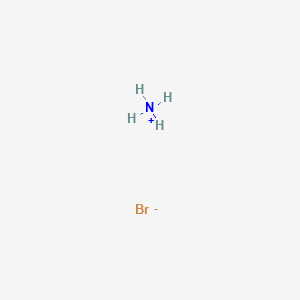
Ammonium Bromide
Ammonium bromide is an ammonium salt composed of ammonium and bromide ions in a 1:1 ratio. It is a bromide salt and an ammonium salt. — ChEBI
- IUPAC name
- azanium bromide
- Molecular formula
- BrH4N
- Molecular weight
- 97.94 g/mol
- Exact mass
- 96.95271 Da
- Topological polar surface area
- 1.0 Ų
- Hydrogen-bond donors
- 1
- Hydrogen-bond acceptors
- 1
- Covalent units
- 2
- Defined stereocentres
- 0
Also known as
16 more reported names
External database identifiers
- ChEBI:CHEBI:85364
- EPA DTXSID:DTXSID8035681
Evidence from additional scientific databases
NIH PubChem PUG-View
Attributed physical-property, hazard, environmental and use annotations.
- Autoignition Temperature: Not flammable (USCG, 1999) Source: CAMEO Chemicals
- Boiling Point: Sublimes 1007 °F (USCG, 1999) Source: CAMEO Chemicals
- Boiling Point: 396 °C (sublimation point) Source: Hazardous Substances Data Bank (HSDB)
- Boiling Point: BP: 235 °C (in vacuum) Source: Hazardous Substances Data Bank (HSDB)
- Boiling Point: 235 °C @760 [mm Hg] Source: PAC Chemical Database, U.S. Department of Energy
- Color/Form: White tetragonal crystals Source: Hazardous Substances Data Bank (HSDB)
- Color/Form: White crystals or granules Source: Hazardous Substances Data Bank (HSDB)
- Color/Form: Colorless crystals or yellowish white powder Source: Hazardous Substances Data Bank (HSDB)
- Density: 2.429 at 68 °F (USCG, 1999) - Denser than water; will sink Source: CAMEO Chemicals
- Density: 2.429 at 25 °C Source: Hazardous Substances Data Bank (HSDB)
- Density: 2.429 @25 °C Source: PAC Chemical Database, U.S. Department of Energy
- Melting Point: Sublimes without melting (USCG, 1999) Source: CAMEO Chemicals
- Melting Point: 542 °C (decomposes) Source: Hazardous Substances Data Bank (HSDB)
- Melting Point: 452 °C Source: PAC Chemical Database, U.S. Department of Energy
- Odor: Odorless Source: Hazardous Substances Data Bank (HSDB)
- Physical Description: Ammonium bromide appears as white odorless crystals or granules that become yellow upon exposure to air. Sinks and mixes in water. (USCG, 1999) Source: CAMEO Chemicals
- Physical Description: Dry Powder Source: EPA Chemical Data Reporting (CDR)
- Physical Description: White odorless solid; Slightly hygroscopic; Yellows slowly in air; [Merck Index] Colorless granules; [MSDSonline] Source: Haz-Map, Information on Hazardous Chemicals and Occupational Diseases
- Refractive Index: Index of refraction: 1.712 at 25 °C Source: Hazardous Substances Data Bank (HSDB)
- Solubility: In water, 78.3 g/100 g water at 25 °C Source: Hazardous Substances Data Bank (HSDB)
- Solubility: Soluble in acetone, ether, ammonia, in water, 97 g/100 cc at 25 °C, 145.6 g/100 cc at 100 °C; in alcohol, 10 g/100 cc at 78 °C Source: Hazardous Substances Data Bank (HSDB)
- Solubility: Freely soluble in methanol, ethanol, acetone; slightly soluble in ether; practically insoluble in ethyl acetate Source: Hazardous Substances Data Bank (HSDB)
- Vapor Pressure: VP: 1 mm Hg at 198.3 °C Source: Hazardous Substances Data Bank (HSDB)
- pH: Slightly acid to litmus Source: Hazardous Substances Data Bank (HSDB)
- Carcinogen Classification: No indication of carcinogenicity to humans (not listed by IARC). Source: Toxin and Toxin Target Database (T3DB)
- Exposure Routes: Oral (L626) ; inhalation (L626) ; dermal (L626) Source: Toxin and Toxin Target Database (T3DB)
- First Aid: EYES AND SKIN: Flush with large amounts of water.; INGESTION: Induce vomiting and call a doctor. (USCG, 1999) Source: CAMEO Chemicals
- Signal: Danger Source: Regulation (EC) No 1272/2008 of the European Parliament and of the Council
- GHS Hazard Statements: H319: Causes serious eye irritation [Warning Serious eye damage/eye irritation]; H336: May cause drowsiness or dizziness [Warning Specific target organ toxicity, single exposure; Narcotic effects]; H360FD: May damage fertility; May damage the unborn child [Danger Reproductive toxicity]; H362: May cause harm to breast-fed children [Reproductive toxicity, effects on or via lactation]; H372: Causes damage to organs through prolonged or repeated exposure [Danger Specific target organ toxicity, repeated exposure] Source: Regulation (EC) No 1272/2008 of the European Parliament and of the Council
- Precautionary Statement Codes: P203, P260, P261, P263, P264, P264+P265, P270, P271, P280, P304+P340, P305+P351+P338, P318, P319, P337+P317, P403+P233, P405, and P501 (click each P-code to see the statement) Source: Regulation (EC) No 1272/2008 of the European Parliament and of the Council
- Note: This chemical does not meet GHS hazard criteria for 0.4% (3 of 704) of reports. Source: European Chemicals Agency (ECHA)
- Signal: Danger Source: European Chemicals Agency (ECHA)
- GHS Hazard Statements: H319 (99.6%): Causes serious eye irritation [Warning Serious eye damage/eye irritation]; H336 (21%): May cause drowsiness or dizziness [Warning Specific target organ toxicity, single exposure; Narcotic effects]; H360FD (17.8%): May damage fertility; May damage the unborn child [Danger Reproductive toxicity]; H362 (20.9%): May cause harm to breast-fed children [Reproductive toxicity, effects on or via lactation]; H372 (20.9%): Causes damage to organs through prolonged or repeated exposure [Danger Specific target organ toxicity, repeated exposure] Source: European Chemicals Agency (ECHA)
- Precautionary Statement Codes: P203, P260, P261, P263, P264, P264+P265, P270, P271, P280, P304+P340, P305+P351+P338, P318, P319, P337+P317, P403+P233, P405, and P501 (click each P-code to see the statement) Source: European Chemicals Agency (ECHA)
- ECHA C&L Notifications Summary: Aggregated GHS information provided per 704 reports by companies from 12 notifications to the ECHA C&L Inventory. Each notification may be associated with multiple companies.; Reported as not meeting GHS hazard criteria per 3 of 704 reports by companies.; There are 11 notifications provided by 701 of 704 reports by companies with hazard statement code(s).; Information may vary between notifications depending on impurities, additives, and other factors. The percentage value in parenthesis indicates the notified classification ratio from companies that provide hazard codes. Only hazard codes with percentage values above 10% are shown. For more detailed information, please visit ECHA C&L website. Source: European Chemicals Agency (ECHA)
- Signal: Danger Source: NITE-CMC
- GHS Hazard Statements: H320: Causes eye irritation [Warning Serious eye damage/eye irritation]; H336: May cause drowsiness or dizziness [Warning Specific target organ toxicity, single exposure; Narcotic effects]; H360: May damage fertility or the unborn child [Danger Reproductive toxicity]; H371: May cause damage to organs [Warning Specific target organ toxicity, single exposure]; H372: Causes damage to organs through prolonged or repeated exposure [Danger Specific target organ toxicity, repeated exposure]; H400: Very toxic to aquatic life [Warning Hazardous to the aquatic environment, acute hazard]; H410: Very toxic to aquatic life with long lasting effects [Warning Hazardous to the aquatic environment, long-term hazard] Source: NITE-CMC
- Precautionary Statement Codes: P203, P260, P261, P264, P264+P265, P270, P271, P273, P280, P304+P340, P305+P351+P338, P308+P316, P318, P319, P337+P317, P391, P403+P233, P405, and P501 (click each P-code to see the statement) Source: NITE-CMC
- Health Effects: Bromine vapour causes irritation and direct damage to the mucous membranes. Elemental bromine also burns the skin. The bromide ion is a central nervous system depressant and chronic exposure produces neuronal effects. This is called bromism and can result in central reactions reaching from somnolence to coma, cachexia, exicosis, loss of reflexes or pathologic reflexes, clonic seizures, tremor, ataxia, loss of neural sensitivity, paresis, papillar edema of the eyes, abnormal speech, cerebral edema, delirium, aggressiveness, and psychoses. (L625, L626, L627) Source: Toxin and Toxin Target Database (T3DB)
- Toxicity Summary: IDENTIFICATION AND USE: Ammonium bromide exists as white crystals or granules. It is used in process engraving and lithography, fireproofing of wood, and as a corrosion inhibitor. Bromide- containing medications is a prominent former use. HUMAN EXPOSURE AND TOXICITY: The warning symptoms of bromide intoxication, bromism, include mental dullness, slurred speech, weakened memory, apathy, anorexia, constipation, drowsiness and loss of sensitivity to touch and pain. These symptoms disappear on discontinuing the drug, but continued use leads to more serious symptoms including restlessness, disorientation, ocular disturbances, ataxia, hallucinations, delirium, stupor and coma. Bromide rash, of an acneform, nodular, or sometimes erythematous type, is of fairly common occurrence but may be absent even in patients who have developed severe mental symptoms. Transplacental bromism had been described in the literature. ANIMAL STUDIES: Ammonium bromide was not irritating to skin, but slightly irritating to eyes in rabbits. Ames test conducted in Salmonella typhimurium strains TA1535,TA100,TA1538,TA98,TA1537 with and without metabolic activation was negative. Source: Hazardous Substances Data Bank (HSDB)
- Toxicity Summary: Bromine is a powerful oxidizing agent and is able to release oxygen free radicals from the water in mucous membranes. These free radicals are also potent oxidizers and produce tissue damage. In additon, the formation of hydrobromic and bromic acids will result in secondary irritation. The bromide ion is also known to affect the central nervous system, causing bromism. This is believed to be a result of bromide ions substituting for chloride ions in the in actions of neurotransmitters and transport systems, thus affecting numerous synaptic processes. (L626, L627, A543) Source: Toxin and Toxin Target Database (T3DB)
- Industry Uses: Processing aids not otherwise specified; Flux agent; Flame retardant Source: EPA Chemical Data Reporting (CDR)
- Sources/Uses: Used in process engraving and lithography, fireproofing wood, textile finishing, manufacturing photographic emulsions, and metal treatment, Also used as a corrosion inhibitor and as a catalyst in the production of diphenylamine; [HSDB] Used as a sedative; [Merck Index] Source: Haz-Map, Information on Hazardous Chemicals and Occupational Diseases
- Industrial Processes with risk of exposure: Textiles (Printing, Dyeing, or Finishing) [Category: Industry] Source: Haz-Map, Information on Hazardous Chemicals and Occupational Diseases
- Activities with risk of exposure: Lithography printing [Category: Hobbies] Source: Haz-Map, Information on Hazardous Chemicals and Occupational Diseases
- Uses: For ammonium bromide (USEPA/OPP Pesticide Code: 000352) ACTIVE products with label matches. /SRP: Registered for use in the USA but approved pesticide uses may change periodically and so federal, state and local authorities must be consulted for currently approved uses./ Source: Hazardous Substances Data Bank (HSDB)
- Uses: Manufacturing of photographic films, plates, and papers; in process engraving and lithography; fireproofing of wood; in corrosion inhibitors; in photochemical reactions; precipitation of silver salts. Source: Hazardous Substances Data Bank (HSDB)
- Uses: Analytical chemistry, ... textile finishing, fire retardant, anticorrosive agent. Source: Hazardous Substances Data Bank (HSDB)
- Uses: MFR OF PHOTOGRAPHIC EMULSIONS; IN METAL TREATMENT; CATALYST IN PRODN OF DIPHENYLAMINE Source: Hazardous Substances Data Bank (HSDB)
- Uses: For more Uses (Complete) data for AMMONIUM BROMIDE (6 total), please visit the HSDB record page. Source: Hazardous Substances Data Bank (HSDB)
- Uses: Ammonium bromide is used for photography in films, plates and papers, for fireproofing wood, in lithography and process engraving, in corrosion inhibitors, and in pharmaceutical preparations. (L640) Source: Toxin and Toxin Target Database (T3DB)
Mapped by: Existing checksum-valid CAS to unique PubChem CID match. Retrieved: 2026-08-31. Open source record
Scientific classifications and hazard annotations provide context and do not replace the market-specific regulatory decision shown above.
Additional source coverage and match status
| Source | Result | Checked |
|---|---|---|
| NIH PubChem PUG-View | Exact match | 2026-08-31 |
A recorded no-match is useful evidence that the source was checked; it is not a claim that the substance does not exist elsewhere.
Retrieved from NIH PubChem on 2026-08-31 by checksum-valid CAS matching. Chemical properties do not replace the regulatory decision on this page.