
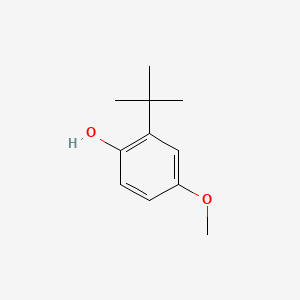
Butylated Hydroxyanisole
Butylated Hydroxyanisole is a white, waxy solid mixture of 2- and 3-Tert-butyl-4-hydroxyanisole with a faint aromatic odor. Butylated Hydroxyanisole is a widely used synthetic antioxidant in foods, cosmetics and pharmaceuticals mainly to preserve fats and oils. Butylated Hydroxyanisole is reasonably anticipated to be a human carcinogen. (NCI05) — NCI Thesaurus (NCIt)
- IUPAC name
- 2-tert-butyl-4-methoxyphenol
- Molecular formula
- C11H16O2
- Molecular weight
- 180.24 g/mol
- Exact mass
- 180.115029749 Da
- XLogP3
- 3.2
- Topological polar surface area
- 29.5 Ų
- Hydrogen-bond donors
- 1
- Hydrogen-bond acceptors
- 2
- Covalent units
- 1
- Defined stereocentres
- 0
Also known as
16 more reported names
External database identifiers
- ChEBI:CHEBI:76358
- ChEMBL:CHEMBL192451
- EPA DTXSID:DTXSID7040788
- PubMed:40228673
- PubMed:23063794
- PubMed:22919511
- PubMed:22289578
- PubMed:22067529
- PubMed:22028932
- PubMed:21833168
- PubMed:21480807
- PubMed:20938768
- PubMed:20738149
- PubMed:20335966
- PubMed:20107899
Evidence from additional scientific databases
NIH PubChem PUG-View
Attributed physical-property, hazard, environmental and use annotations.
- Boiling Point: 507 to 518 °F at 733 mmHg (NTP, 1992) Source: CAMEO Chemicals
- Boiling Point: 268 °C Source: Hazardous Substances Data Bank (HSDB)
- Color/Form: White or slightly yellow waxy solid Source: Hazardous Substances Data Bank (HSDB)
- Flash Point: 313 °F (NTP, 1992) Source: CAMEO Chemicals
- Flash Point: 156 °C Source: Haz-Map, Information on Hazardous Chemicals and Occupational Diseases
- Flash Point: 113 °C (235 °F) - closed cup Source: Hazardous Substances Data Bank (HSDB)
- Flash Point: 156 °C Source: Hazardous Substances Data Bank (HSDB)
- Melting Point: 118 to 131 °F (NTP, 1992) Source: CAMEO Chemicals
- Melting Point: Between 48 °C and 63 °C Source: EU Food Improvement Agents
- Melting Point: 51 °C Source: Hazardous Substances Data Bank (HSDB)
- Odor: Faint characteristic odor Source: Hazardous Substances Data Bank (HSDB)
- Physical Description: Butylated hydroxyanisole appears as white, beige or slightly yellow waxy solid with an aromatic odor and a slightly bitter burning taste. (NTP, 1992) Source: CAMEO Chemicals
- Physical Description: Large Crystals Source: EPA Chemical Data Reporting (CDR)
- Physical Description: White or slightly yellow flakes or waxy solid with a slight aromatic smell Source: EU Food Improvement Agents
- Physical Description: White, beige or slightly yellow waxy solid with an aromatic odor and a slightly bitter burning taste; [CAMEO] Source: Haz-Map, Information on Hazardous Chemicals and Occupational Diseases
- Physical Description: Faintly beige fine plates; [MSDSonline] Source: Haz-Map, Information on Hazardous Chemicals and Occupational Diseases
- Solubility: less than 1 mg/mL at 65.3 °F (NTP, 1992) Source: CAMEO Chemicals
- Solubility: Insoluble in water, freely soluble in ethanol Source: EU Food Improvement Agents
- Solubility: Insoluble in water Source: Hazardous Substances Data Bank (HSDB)
- Solubility: Soluble in petroleum ether, ethanol Source: Hazardous Substances Data Bank (HSDB)
- Solubility: Freely soluble in alcohol, propylene glycol, chloroform, ether; soluble in petroleum ether (Shellysolve H), fats, oils. Source: Hazardous Substances Data Bank (HSDB)
- Solubility: 1% in glycerine at 100 °C Source: Hazardous Substances Data Bank (HSDB)
- Solubility: For more Solubility (Complete) data for Butylated hydroxyanisole (6 total), please visit the HSDB record page. Source: Hazardous Substances Data Bank (HSDB)
- Vapor Pressure: 0.00248 [mmHg] Source: Haz-Map, Information on Hazardous Chemicals and Occupational Diseases
- IARC Carcinogenic Agent: Butylated hydroxyanisole (BHA) Source: International Agency for Research on Cancer (IARC)
- IARC Carcinogenic Classes: Group 2B: Possibly carcinogenic to humans Source: International Agency for Research on Cancer (IARC)
- IARC Monographs: Volume 40: (1986) Some Naturally Occurring and Synthetic Food Components, Furocoumarins and Ultraviolet Radiation; Volume Sup 7: Overall Evaluations of Carcinogenicity: An Updating of IARC Monographs Volumes 1 to 42, 1987; 440 pages; ISBN 92-832-1411-0 (out of print) Source: International Agency for Research on Cancer (IARC)
- Publication Year: 1987 Source: International Agency for Research on Cancer (IARC)
- Evaluation Year: 1987 Source: International Agency for Research on Cancer (IARC)
- First Aid: EYES: First check the victim for contact lenses and remove if present. Flush victim's eyes with water or normal saline solution for 20 to 30 minutes while simultaneously calling a hospital or poison control center. Do not put any ointments, oils, or medication in the victim's eyes without specific instructions from a physician. IMMEDIATELY transport the victim after flushing eyes to a hospital even if no symptoms (such as redness or irritation) develop.; SKIN: IMMEDIATELY flood affected skin with water while removing and isolating all contaminated clothing. Gently wash all affected skin areas thoroughly with soap and water. IMMEDIATELY call a hospital or poison control center even if no symptoms (such as redness or irritation) develop. IMMEDIATELY transport the victim to a hospital for treatment after washing the affected areas.; INHALATION: IMMEDIATELY leave the contaminated area; take deep breaths of fresh air. IMMEDIATELY call a physician and be prepared to transport the victim to a hospital even if no symptoms (such as wheezing, coughing, shortness of breath, or burning in the mouth, throat, or chest) develop. Provide proper respiratory protection to rescuers entering an unknow Source: CAMEO Chemicals
- Note: This chemical does not meet GHS hazard criteria for 5.5% (47 of 847) of reports. Source: European Chemicals Agency (ECHA)
- Signal: Warning Source: European Chemicals Agency (ECHA)
- GHS Hazard Statements: H302 (34%): Harmful if swallowed [Warning Acute toxicity, oral]; H315 (52.5%): Causes skin irritation [Warning Skin corrosion/irritation]; H319 (76.2%): Causes serious eye irritation [Warning Serious eye damage/eye irritation]; H335 (19.8%): May cause respiratory irritation [Warning Specific target organ toxicity, single exposure; Respiratory tract irritation]; H351 (68.9%): Suspected of causing cancer [Warning Carcinogenicity]; H361 (18.3%): Suspected of damaging fertility or the unborn child [Warning Reproductive toxicity]; H361f (12.3%): Suspected of damaging fertility [Warning Reproductive toxicity]; H411 (42%): Toxic to aquatic life with long lasting effects [Hazardous to the aquatic environment, long-term hazard] Source: European Chemicals Agency (ECHA)
- Precautionary Statement Codes: P203, P261, P264, P264+P265, P270, P271, P273, P280, P301+P317, P302+P352, P304+P340, P305+P351+P338, P318, P319, P321, P330, P332+P317, P337+P317, P362+P364, P391, P403+P233, P405, and P501 (click each P-code to see the statement) Source: European Chemicals Agency (ECHA)
- ECHA C&L Notifications Summary: Aggregated GHS information provided per 847 reports by companies from 52 notifications to the ECHA C&L Inventory. Each notification may be associated with multiple companies.; Reported as not meeting GHS hazard criteria per 47 of 847 reports by companies.; There are 51 notifications provided by 800 of 847 reports by companies with hazard statement code(s).; Information may vary between notifications depending on impurities, additives, and other factors. The percentage value in parenthesis indicates the notified classification ratio from companies that provide hazard codes. Only hazard codes with percentage values above 10% are shown. For more detailed information, please visit ECHA C&L website. Source: European Chemicals Agency (ECHA)
- Note: This chemical does not meet GHS hazard criteria for 84.4% (151 of 179) of all reports. Source: European Chemicals Agency (ECHA)
- GHS Hazard Statements: H315 (14%): Causes skin irritation [Warning Skin corrosion/irritation]; H319 (15.1%): Causes serious eye irritation [Warning Serious eye damage/eye irritation]; H351 (12.8%): Suspected of causing cancer [Warning Carcinogenicity]; H361 (11.7%): Suspected of damaging fertility or the unborn child [Warning Reproductive toxicity]; H411 (11.7%): Toxic to aquatic life with long lasting effects [Hazardous to the aquatic environment, long-term hazard] Source: European Chemicals Agency (ECHA)
- Precautionary Statement Codes: P203, P264, P264+P265, P273, P280, P302+P352, P305+P351+P338, P318, P321, P332+P317, P337+P317, P362+P364, P391, P405, and P501 (click each P-code to see the statement) Source: European Chemicals Agency (ECHA)
- ECHA C&L Notifications Summary: Aggregated GHS information provided per 179 reports by companies from 9 notifications to the ECHA C&L Inventory. Each notification may be associated with multiple companies.; Reported as not meeting GHS hazard criteria per 151 of 179 reports by companies.; There are 7 notifications provided by 28 of 179 reports by companies with hazard statement code(s).; Information may vary between notifications depending on impurities, additives, and other factors. The percentage value in parenthesis indicates the notified classification ratio from companies that provide hazard codes. Only hazard codes with percentage values above 10% are shown. For more detailed information, please visit ECHA C&L website. Source: European Chemicals Agency (ECHA)
- Signal: Warning Source: NITE-CMC
- GHS Hazard Statements: H317: May cause an allergic skin reaction [Warning Sensitization, Skin]; H361: Suspected of damaging fertility or the unborn child [Warning Reproductive toxicity]; H371: May cause damage to organs [Warning Specific target organ toxicity, single exposure]; H401: Toxic to aquatic life [Hazardous to the aquatic environment, acute hazard]; H411: Toxic to aquatic life with long lasting effects [Hazardous to the aquatic environment, long-term hazard] Source: NITE-CMC
- Precautionary Statement Codes: P203, P260, P261, P264, P270, P272, P273, P280, P302+P352, P308+P316, P318, P321, P333+P317, P362+P364, P391, P405, and P501 (click each P-code to see the statement) Source: NITE-CMC
- Toxicity Summary: IDENTIFICATION AND USE: 3-tert-Butyl-4-hydroxyanisole is a component of Butylated Hydroxyanisole which is a commonly used food preservative. This material is an oxidation inhibitor and has been accepted for the use in foods where Butylated hydroxytoluene is restricted. This chemical is used as a food preservative for human consumption. HUMAN EXPOSURE AND TOXICITY: There is no human studies concerning.3-tert-Butyl-4-hydroxyanisole ANIMAL STUDIES: The mutagenicity of 3-tert-butyl-4-hydroxyanisole and its metabolites was determined in the reverse mutation assay using Salmonella typhimurium, strains and in the chromosomal aberration test in vitro using the Chinese hamster fibroblast cell line, the chemical did not show any mutagenic activity. 3-tert-Butyl-4-hydroxyanisole induced chromosomal aberrations only in the presence of S9 mix. Source: Hazardous Substances Data Bank (HSDB)
- Toxicity Summary: IDENTIFICATION AND USE: Butylated hydroxyanisole (BHA) is white or slightly yellow, waxy solid. The primary use for BHA is as an antioxidant and preservative in food, food packaging, animal feed, and cosmetics, and rubber and petroleum products as well. BHA is particularly useful in protecting the flavors and color of essential oils and is considered the most effective of all food-approved antioxidants for this application. BHA is effective in controlling the oxidation of short-chain fatty acids, such as those found in coconut and palm kernel oils that are used typically in cereal and confectionary products. HUMAN EXPOSURE AND TOXICITY: BHA produced allergic contact dermatitis. Although BHA is not an irritant, it can cause skin reactions owing to its weak allergic sensitization potential. BHA was able to reduce DNA damage and micronucleus formed in peripheral lymphocytes exposed to other genotoxic agents. ANIMAL STUDIES: Dietary exposure to BHA caused benign and malignant tumors of the forestomach (papilloma and squamous-cell carcinoma) in rats of both sexes and in male mice and hamsters due to increased lifespan of the animals compared to control. Rats could tolerate BHA up to 120 Source: Hazardous Substances Data Bank (HSDB)
- Environmental Bioconcentration: An estimated BCF of 57 was calculated in fish for butylated hydroxyanisole(SRC), using an estimated log Kow of 3.50(1) and a regression-derived equation(1). According to a classification scheme(2), this BCF suggests the potential for bioconcentration in aquatic organisms is moderate(SRC). Source: Hazardous Substances Data Bank (HSDB)
- Environmental Fate: TERRESTRIAL FATE: Based on a classification scheme(1), an estimated Koc value of 840(SRC), determined from a structure estimation method(2), indicates that butylated hydroxyanisole is expected to have very low mobility in soil(SRC). Volatilization of butylated hydroxyanisole from moist soil surfaces is expected to be a slow environmental fate process(SRC) given an estimated Henry's Law constant of 1.2X10⁻⁶ atm-cu m/mole(SRC), using a fragment constant estimation method(3). Butylated hydroxyanisole is not expected to volatilize from dry soil surfaces(SRC) based upon an estimated vapor pressure of 2.3X10⁻³ mm Hg at 25 °C(SRC), determined from a fragment constant method(2). A calculated 0% Theoretical BOD using a model based on the Japanese MITI test(6) suggests that biodegradation is not an important environmental fate process in soil(SRC). Source: Hazardous Substances Data Bank (HSDB)
- Environmental Fate: AQUATIC FATE: Based on a classification scheme(1), an estimated Koc value of 840(SRC), determined from a structure estimation method(2), indicates that butylated hydroxyanisole is expected to adsorb to suspended solids and sediment(SRC). Volatilization from water surfaces is expected(3) based upon an estimated Henry's Law constant of 1.2X10⁻⁶ atm-cu m/mole(SRC), developed using a fragment constant estimation method(4). Using this Henry's Law constant and an estimation method(3), volatilization half-lives for a model river and model lake are 42 and 310 days, respectively(SRC). According to a classification scheme(5), an estimated BCF of 57(SRC), from an estimated log Kow of 3.50(2) and a regression-derived equation(2), suggests the potential for bioconcentration in aquatic organisms is moderate(SRC). A calculated 0% Theoretical BOD using a model based on the Japanese MITI test(6) suggests that biodegradation is not an important environmental fate process in water(SRC). Source: Hazardous Substances Data Bank (HSDB)
- Environmental Fate: ATMOSPHERIC FATE: According to a model of gas/particle partitioning of semivolatile organic compounds in the atmosphere(1), butylated hydroxyanisole, which has an estimated vapor pressure of 2.34X10⁻³ mm Hg at 25 °C(SRC), determined from a fragment constant method(2), is expected to exist solely as a vapor in the ambient atmosphere. Vapor-phase butylated hydroxyanisole is degraded in the atmosphere by reaction with photochemically-produced hydroxyl radicals(SRC); the half-life for this reaction in air is estimated to be 0.3 days(SRC), calculated from its rate constant of 3.6X10⁻¹¹ cu cm/molecule-sec at 25 °C(SRC) that was derived using a structure estimation method(3). Butylated hydroxyanisole does not contain chromophores that absorb at wavelengths >290 nm(4) and, therefore, is not expected to be susceptible to direct photolysis by sunlight(SRC). Source: Hazardous Substances Data Bank (HSDB)
- Consumer Uses: Antioxidant Source: EPA Chemical Data Reporting (CDR)
- Industry Uses: Antioxidant Source: EPA Chemical Data Reporting (CDR)
- Cosmetic Ingredient Review Link: CIR ingredient: Butylated Hydroxyanisole Source: Cosmetic Ingredient Review (CIR)
- Sources/Uses: Used as a food and cosmetic preservative; [Kanerva, p. 1758] Used as an antioxidant in many foods since 1947; Also used in cosmetics such as lipstick and eye shadow; [IARC] Source: Haz-Map, Information on Hazardous Chemicals and Occupational Diseases
- Industrial Processes with risk of exposure: Using Disinfectants or Biocides [Category: Clean] Source: Haz-Map, Information on Hazardous Chemicals and Occupational Diseases
- Sources/Uses: Used as a food additive (oxidation inhibitor); [HSDB] Used as preservative in foods, cosmetics, topical medications, animal feeds, rubber, plastics, pints, and glues; [Marks, p. 139] Source: Haz-Map, Information on Hazardous Chemicals and Occupational Diseases
- Industrial Processes with risk of exposure: Farming (Feed Additives) [Category: Industry] Source: Haz-Map, Information on Hazardous Chemicals and Occupational Diseases
- Uses: COMPONENT OF BHA (A COMMONLY USED FOOD ADDITIVE) Source: Hazardous Substances Data Bank (HSDB)
- Uses: This material is an oxidation inhibitor and has been accepted for use in foods where the use of butylated hydroxytoluene (BHT) is restricted /BHA/ Source: Hazardous Substances Data Bank (HSDB)
- Uses: BHA is particularly useful in protecting the flavors and color of essential oils and is considered the most effective of all food-approved antioxidants for this application. BHA is particularly effective in controlling the oxidation of short-chain fatty acids, such as those found in coconut and palm kernel oils that are used typically in cereal and confectionary products. Source: Hazardous Substances Data Bank (HSDB)
- Uses: Reported uses (ppm):; Table: Reported uses (ppm): (Flavor and Extract Manufacturers' Association, 1994) [Table#4664] Source: Hazardous Substances Data Bank (HSDB)
- Uses: Commercial stabilizers (antioxidants) for food fortification or animal feeds. Source: Hazardous Substances Data Bank (HSDB)
- Uses: BHA is one of the primary antioxidants used in feeds, because it retards the oxidation of vitamin A, fats, and vegetable oils. It is an effective stabilizer for essential oils, paraffin, and polyethylenes. Source: Hazardous Substances Data Bank (HSDB)
- Uses: For more Uses (Complete) data for Butylated hydroxyanisole (6 total), please visit the HSDB record page. Source: Hazardous Substances Data Bank (HSDB)
Mapped by: Existing checksum-valid CAS to unique PubChem CID match. Retrieved: 2026-08-31. Open source record
Scientific classifications and hazard annotations provide context and do not replace the market-specific regulatory decision shown above.
Additional source coverage and match status
| Source | Result | Checked |
|---|---|---|
| NIH PubChem PUG-View | Exact match | 2026-08-31 |
A recorded no-match is useful evidence that the source was checked; it is not a claim that the substance does not exist elsewhere.
Retrieved from NIH PubChem on 2026-08-31 by checksum-valid CAS matching. Chemical properties do not replace the regulatory decision on this page.