
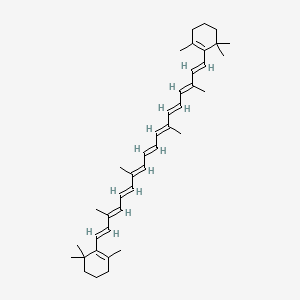
Beta-Carotene
Beta-Carotene is a naturally-occurring retinol (vitamin A) precursor obtained from certain fruits and vegetables with potential antineoplastic and chemopreventive activities. As an anti-oxidant, beta carotene inhibits free-radical damage to DNA. This agent also induces cell differentiation and apoptosis of some tumor cell types, particularly in early stages of tumorigenesis, and enhances immune system activity by stimulating the release of natural killer cells, lymphocytes, and monocytes. (NCI04) — NCI Thesaurus (NCIt)
- IUPAC name
- 1,3,3-trimethyl-2-[(1E,3E,5E,7E,9E,11E,13E,15E,17E)-3,7,12,16-tetramethyl-18-(2,6,6-trimethylcyclohexen-1-yl)octadeca-1,3,5,7,9,11,13,15,17-nonaenyl]cyclohexene
- Molecular formula
- C40H56
- Molecular weight
- 536.9 g/mol
- Exact mass
- 536.438201786 Da
- XLogP3
- 13.5
- Topological polar surface area
- 0.0 Ų
- Hydrogen-bond donors
- 0
- Hydrogen-bond acceptors
- 0
- Covalent units
- 1
- Defined stereocentres
- 0
Also known as
16 more reported names
External database identifiers
- ChEBI:CHEBI:17579
- ChEMBL:CHEMBL1293
- EPA DTXSID:DTXSID3020253
- PubMed:36819991
- PubMed:32535096
- PubMed:31022331
- PubMed:27154496
- PubMed:26733226
- PubMed:25542264
- PubMed:25344780
- PubMed:24657404
- PubMed:23859036
- PubMed:22542753
- PubMed:21569430
- PubMed:21447443
Evidence from additional scientific databases
NIH PubChem PUG-View
Attributed physical-property, hazard, environmental and use annotations.
- Boiling Point: 633-577ºC Source: DrugBank
- Boiling Point: 654.00 to 657.00 °C. @ 760.00 mm Hg Source: Human Metabolome Database (HMDB)
- Color/Form: Deep purple, hexagonal prisms from benzene and methanol Source: Hazardous Substances Data Bank (HSDB)
- Color/Form: Red, rhombic, almost square leaflets from petroleum ether; dil soln are yellow Source: Hazardous Substances Data Bank (HSDB)
- Color/Form: CRYSTALLINE FORM APPEARS DEEP ORANGE OR COPPER-COLORED Source: Hazardous Substances Data Bank (HSDB)
- Color/Form: Red-brown hexagonal prisms from benzene and methanol Source: Hazardous Substances Data Bank (HSDB)
- Density: 1.00 at 20 °C/20 °C Source: Hazardous Substances Data Bank (HSDB)
- LogP: 17.62 Source: DrugBank
- Melting Point: 176-184ºC Source: DrugBank
- Melting Point: 183 °C (evacuated tube) Source: Hazardous Substances Data Bank (HSDB)
- Melting Point: 183 °C Source: Human Metabolome Database (HMDB)
- Physical Description: Red to brownish-red crystals or crystalline powder Source: EU Food Improvement Agents
- Physical Description: Red, brownish-red or purple-violet crystals or crystalline powder (colour varies according to extraction solvent used and conditions of crystallisation) Source: EU Food Improvement Agents
- Physical Description: Deep purple or red solid; [Merck Index] Source: Haz-Map, Information on Hazardous Chemicals and Occupational Diseases
- Physical Description: Solid Source: Human Metabolome Database (HMDB)
- Solubility: 0.0006 g/l at 25ºC Source: DrugBank
- Solubility: Sol in benzene, chloroform, carbon disulfide; moderately sol in ether, petroleum ether, oils; 100 ml hexane dissolve 109 mg at 0 °C; very sparingly sol in methanol and ethanol; practically insol in water, acids, alkalies Source: Hazardous Substances Data Bank (HSDB)
- Solubility: SOL IN FAT SOLVENTS Source: Hazardous Substances Data Bank (HSDB)
- Solubility: Soluble in acetone Source: Hazardous Substances Data Bank (HSDB)
- Solubility: Soluble in vegetable oils Source: Hazardous Substances Data Bank (HSDB)
- Solubility: For more Solubility (Complete) data for BETA-CAROTENE (7 total), please visit the HSDB record page. Source: Hazardous Substances Data Bank (HSDB)
- Solubility: 0.6 mg/mL Source: Human Metabolome Database (HMDB)
- GHS Hazard Statements: Not Classified; Reported as not meeting GHS hazard criteria by 311 of 368 companies Source: European Chemicals Agency (ECHA)
- ECHA C&L Notifications Summary: Aggregated GHS information provided per 368 reports by companies from 7 notifications to the ECHA C&L Inventory.; Reported as not meeting GHS hazard criteria per 311 of 368 reports by companies.; There are 6 notifications provided by 57 of 368 reports by companies with hazard statement code(s).; Information may vary between notifications depending on impurities, additives, and other factors. The percentage value in parenthesis indicates the notified classification ratio from companies that provide hazard codes. Only hazard codes with percentage values above 10% are shown. For more detailed information, please visit ECHA C&L website. Source: European Chemicals Agency (ECHA)
- Sources/Uses: The most important provitamin A; Found in plants and animals and used to color foods yellow, as an ultraviolet screen, and as a vitamin A precursor; [Merck Index] Used as flavoring agent, antioxidant, color, nutritional supplement, processing aid, and surface-finishing agent for foods; [FDA] Source: Haz-Map, Information on Hazardous Chemicals and Occupational Diseases
- Uses: Yellow coloring agent for foods. Source: Hazardous Substances Data Bank (HSDB)
- Uses: MEDICATION Source: Hazardous Substances Data Bank (HSDB)
- Uses: Therapeutic Category: Vitamine A precursor. Ultraviolet screen. Source: Hazardous Substances Data Bank (HSDB)
- Uses: Therapeutic Category (Vet): Vitamin A precursor for all species except cats. Source: Hazardous Substances Data Bank (HSDB)
- Uses: Use (kg; approx.) in Germany (2009): >50; Consumption (g per capita; approx.) in Germany (2009): 0.000611; Calculated removal (%): 94 Source: NORMAN Suspect List Exchange
Mapped by: Existing checksum-valid CAS to unique PubChem CID match. Retrieved: 2026-08-31. Open source record
Scientific classifications and hazard annotations provide context and do not replace the market-specific regulatory decision shown above.
Additional source coverage and match status
| Source | Result | Checked |
|---|---|---|
| NIH PubChem PUG-View | Exact match | 2026-08-31 |
A recorded no-match is useful evidence that the source was checked; it is not a claim that the substance does not exist elsewhere.
Retrieved from NIH PubChem on 2026-09-02 by checksum-valid CAS matching. Chemical properties do not replace the regulatory decision on this page.