
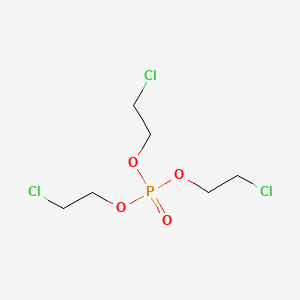
Tris(2-chloroethyl) phosphate
Tris(2-chloroethyl) phosphate is a trialkyl phosphate that is the tris(2-chloroethyl) ester of phosphoric acid. It is an organochlorine compound and a trialkyl phosphate. — ChEBI
- IUPAC name
- tris(2-chloroethyl) phosphate
- Molecular formula
- C6H12Cl3O4P
- Molecular weight
- 285.5 g/mol
- Exact mass
- 283.953879 Da
- XLogP3
- 1.3
- Topological polar surface area
- 44.8 Ų
- Hydrogen-bond donors
- 0
- Hydrogen-bond acceptors
- 4
- Covalent units
- 1
- Defined stereocentres
- 0
Also known as
16 more reported names
External database identifiers
- ChEBI:CHEBI:35037
- ChEMBL:CHEMBL1413786
- EPA DTXSID:DTXSID5021411
- PubMed:23062789
- PubMed:23017583
- PubMed:22633078
- PubMed:22578591
- PubMed:22553152
- PubMed:22551874
- PubMed:22537891
- PubMed:22446829
- PubMed:22411272
- PubMed:22332897
- PubMed:22189380
- PubMed:22186491
Evidence from additional scientific databases
NIH PubChem PUG-View
Attributed physical-property, hazard, environmental and use annotations.
- Autoignition Temperature: 1115 °F (NTP, 1992) Source: CAMEO Chemicals
- Autoignition Temperature: 1115 °F Source: Hazardous Substances Data Bank (HSDB)
- Autoignition Temperature: 480 °C Source: ILO-WHO International Chemical Safety Cards (ICSCs)
- Boiling Point: 626 °F at 760 mmHg (NTP, 1992) Source: CAMEO Chemicals
- Boiling Point: 330 °C Source: Hazardous Substances Data Bank (HSDB)
- Boiling Point: BP: 210-220 °C Source: Hazardous Substances Data Bank (HSDB)
- Boiling Point: 330 °C @760 [mm Hg] Source: PAC Chemical Database, U.S. Department of Energy
- Color/Form: Clear, transparent liquid Source: Hazardous Substances Data Bank (HSDB)
- Color/Form: Low viscosity liquid Source: Hazardous Substances Data Bank (HSDB)
- Density: 1.425 at 68 °F (NTP, 1992) - Denser than water; will sink Source: CAMEO Chemicals
- Density: 1.39 g/cu cm at 25 °C Source: Hazardous Substances Data Bank (HSDB)
- Density: Relative density (water = 1): 1.4 Source: ILO-WHO International Chemical Safety Cards (ICSCs)
- Density: 1.39 @25 °C Source: PAC Chemical Database, U.S. Department of Energy
- Flash Point: 450 °F (NTP, 1992) Source: CAMEO Chemicals
- Flash Point: 216 °C (Cleveland open cup) Source: Hazardous Substances Data Bank (HSDB)
- Flash Point: 232 °C (450 °F) (Closed cup) Source: Hazardous Substances Data Bank (HSDB)
- Flash Point: 202 °C c.c. Source: ILO-WHO International Chemical Safety Cards (ICSCs)
- LogP: log Kow = 1.78 Source: Hazardous Substances Data Bank (HSDB)
- LogP: log Kow = 1.43 Source: Hazardous Substances Data Bank (HSDB)
- LogP: 1.78 Source: ILO-WHO International Chemical Safety Cards (ICSCs)
- Melting Point: less than -76 °F (NTP, 1992) Source: CAMEO Chemicals
- Melting Point: -55 °C Source: Hazardous Substances Data Bank (HSDB)
- Melting Point: -51 °C Source: ILO-WHO International Chemical Safety Cards (ICSCs)
- Melting Point: -55 °C Source: PAC Chemical Database, U.S. Department of Energy
- Odor: Low odor Source: Hazardous Substances Data Bank (HSDB)
- Physical Description: Tris(2-chloroethyl) phosphate is an odorless clear liquid. Neutral pH. (NTP, 1992) Source: CAMEO Chemicals
- Physical Description: A clear liquid with a slight odor; [HSDB] Source: Haz-Map, Information on Hazardous Chemicals and Occupational Diseases
- Physical Description: COLOURLESS-TO-YELLOW LIQUID. Source: ILO-WHO International Chemical Safety Cards (ICSCs)
- Refractive Index: Index of refraction: 1.4721 at 20 °C/D Source: Hazardous Substances Data Bank (HSDB)
- Solubility: 1 to 5 mg/mL at 68 °F (NTP, 1992) Source: CAMEO Chemicals
- Solubility: In water, 7.82X10+3 mg/L at 20 °C Source: Hazardous Substances Data Bank (HSDB)
- Solubility: In water, 7,000 mg/L, temp not specified. Source: Hazardous Substances Data Bank (HSDB)
- Solubility: Insoluble in benzene. Soluble in most organic solvents. Source: Hazardous Substances Data Bank (HSDB)
- Solubility: Slightly soluble in carbon tetrachloride Source: Hazardous Substances Data Bank (HSDB)
- Solubility: Very slightly soluble in aliphatic hydrocarbons; soluble in alcohols, esters, ketones and aromatic hydrocarbons. Source: Hazardous Substances Data Bank (HSDB)
- Solubility: Solubility in water, g/100ml at 20 °C: 0.78 (very poor) Source: ILO-WHO International Chemical Safety Cards (ICSCs)
- Vapor Pressure: 0.5 mmHg at 293 °F (NTP, 1992) Source: CAMEO Chemicals
- Vapor Pressure: 0.06 [mmHg] Source: Haz-Map, Information on Hazardous Chemicals and Occupational Diseases
- Vapor Pressure: VP: 1.60X10⁻⁵ mm Hg at 25 °C (extrapolated from a reduced BP value) Source: Hazardous Substances Data Bank (HSDB)
- Vapor Pressure: VP: 0.5 mm Hg at 145 °C Source: Hazardous Substances Data Bank (HSDB)
- Vapor Pressure: 6.13X10⁻² mm Hg at 25 °C Source: Hazardous Substances Data Bank (HSDB)
- Vapor Pressure: negligible Source: ILO-WHO International Chemical Safety Cards (ICSCs)
- Viscosity: 45 cP at 20 °C Source: Hazardous Substances Data Bank (HSDB)
- IARC Carcinogenic Agent: Tris(2-chloroethyl) phosphate Source: International Agency for Research on Cancer (IARC)
- IARC Carcinogenic Classes: Group 3: Not classifiable as to its carcinogenicity to humans Source: International Agency for Research on Cancer (IARC)
- IARC Monographs: Volume 48: (1990) Some Flame Retardants and Textile Chemicals, and Exposures in the Textile Manufacturing Industry; Volume 71: (1999) Re-evaluation of Some Organic Chemicals, Hydrazine and Hydrogen Peroxide (Part 1, Part 2, Part 3) Source: International Agency for Research on Cancer (IARC)
- Publication Year: 1999 Source: International Agency for Research on Cancer (IARC)
- Evaluation Year: 1998 Source: International Agency for Research on Cancer (IARC)
- Substance: Tris(2-Chloroethyl) Phosphate Source: NTP Technical Reports
- NTP Technical Report: TR-391: Toxicology and Carcinogenesis Studies of Tris(2-chloroethyl) Phosphate (CASRN 115-96-8) in F344/N Rats and B6C3F1 Mice (Gavage Studies) (1991 ) Source: NTP Technical Reports
- Peer Review Date: 04/25/90 Source: NTP Technical Reports
- Conclusion for Male Rat: Clear Evidence Source: NTP Technical Reports
- Conclusion for Female Rat: Clear Evidence Source: NTP Technical Reports
- Conclusion for Male Mice: Equivocal Evidence Source: NTP Technical Reports
- Conclusion for Female Mice: Equivocal Evidence Source: NTP Technical Reports
- Exposure Routes: The substance can be absorbed into the body in hazardous amounts by ingestion. Source: ILO-WHO International Chemical Safety Cards (ICSCs)
- First Aid: EYES: First check the victim for contact lenses and remove if present. Flush victim's eyes with water or normal saline solution for 20 to 30 minutes while simultaneously calling a hospital or poison control center. Do not put any ointments, oils, or medication in the victim's eyes without specific instructions from a physician. IMMEDIATELY transport the victim after flushing eyes to a hospital even if no symptoms (such as redness or irritation) develop.; SKIN: IMMEDIATELY flood affected skin with water while removing and isolating all contaminated clothing. Gently wash all affected skin areas thoroughly with soap and water. If symptoms such as redness or irritation develop, IMMEDIATELY call a physician and be prepared to transport the victim to a hospital for treatment.; INHALATION: IMMEDIATELY leave the contaminated area; take deep breaths of fresh air. If symptoms (such as wheezing, coughing, shortness of breath, or burning in the mouth, throat, or chest) develop, call a physician and be prepared to transport the victim to a hospital. Provide proper respiratory protection to rescuers entering an unknown atmosphere. Whenever possible, Self-Contained Breathing Apparatus (SCBA) shou Source: CAMEO Chemicals
- Signal: Danger Source: Regulation (EC) No 1272/2008 of the European Parliament and of the Council
- GHS Hazard Statements: H302: Harmful if swallowed [Warning Acute toxicity, oral]; H351: Suspected of causing cancer [Warning Carcinogenicity]; H360F ***: May damage fertility [Danger Reproductive toxicity]; H411: Toxic to aquatic life with long lasting effects [Hazardous to the aquatic environment, long-term hazard] Source: Regulation (EC) No 1272/2008 of the European Parliament and of the Council
- Precautionary Statement Codes: P203, P264, P270, P273, P280, P301+P317, P318, P330, P391, P405, and P501 (click each P-code to see the statement) Source: Regulation (EC) No 1272/2008 of the European Parliament and of the Council
- Signal: Danger Source: European Chemicals Agency (ECHA)
- GHS Hazard Statements: H302 (97.3%): Harmful if swallowed [Warning Acute toxicity, oral]; H351 (100%): Suspected of causing cancer [Warning Carcinogenicity]; H360 (86.5%): May damage fertility or the unborn child [Danger Reproductive toxicity]; H360F (13%): May damage fertility [Danger Reproductive toxicity]; H411 (99.9%): Toxic to aquatic life with long lasting effects [Hazardous to the aquatic environment, long-term hazard] Source: European Chemicals Agency (ECHA)
- Precautionary Statement Codes: P203, P264, P270, P273, P280, P301+P317, P318, P330, P391, P405, and P501 (click each P-code to see the statement) Source: European Chemicals Agency (ECHA)
- ECHA C&L Notifications Summary: Aggregated GHS information provided per 801 reports by companies from 13 notifications to the ECHA C&L Inventory. Each notification may be associated with multiple companies.; Information may vary between notifications depending on impurities, additives, and other factors. The percentage value in parenthesis indicates the notified classification ratio from companies that provide hazard codes. Only hazard codes with percentage values above 10% are shown. For more detailed information, please visit ECHA C&L website. Source: European Chemicals Agency (ECHA)
- Signal: Danger Source: NITE-CMC
- GHS Hazard Statements: H302: Harmful if swallowed [Warning Acute toxicity, oral]; H320: Causes eye irritation [Warning Serious eye damage/eye irritation]; H351: Suspected of causing cancer [Warning Carcinogenicity]; H360: May damage fertility or the unborn child [Danger Reproductive toxicity]; H370: Causes damage to organs [Danger Specific target organ toxicity, single exposure]; H373: May causes damage to organs through prolonged or repeated exposure [Warning Specific target organ toxicity, repeated exposure]; H401: Toxic to aquatic life [Hazardous to the aquatic environment, acute hazard]; H411: Toxic to aquatic life with long lasting effects [Hazardous to the aquatic environment, long-term hazard] Source: NITE-CMC
- Precautionary Statement Codes: P203, P260, P264, P264+P265, P270, P273, P280, P301+P317, P305+P351+P338, P308+P316, P318, P319, P321, P330, P337+P317, P391, P405, and P501 (click each P-code to see the statement) Source: NITE-CMC
- GHS Hazard Statements: H302: Harmful if swallowed [Warning Acute toxicity, oral]; H316: Causes mild skin irritation [Warning Skin corrosion/irritation]; H320: Causes eye irritation [Warning Serious eye damage/eye irritation]; H336: May cause drowsiness or dizziness [Warning Specific target organ toxicity, single exposure; Narcotic effects]; H340: May cause genetic defects [Danger Germ cell mutagenicity]; H361: Suspected of damaging fertility or the unborn child [Warning Reproductive toxicity]; H370: Causes damage to organs [Danger Specific target organ toxicity, single exposure]; H372: Causes damage to organs through prolonged or repeated exposure [Danger Specific target organ toxicity, repeated exposure]; H373: May causes damage to organs through prolonged or repeated exposure [Warning Specific target organ toxicity, repeated exposure] Source: NITE-CMC
- Precautionary Statement Codes: P203, P260, P261, P264, P264+P265, P270, P271, P280, P301+P317, P304+P340, P305+P351+P338, P308+P316, P318, P319, P321, P330, P332+P317, P337+P317, P403+P233, P405, and P501 (click each P-code to see the statement) Source: NITE-CMC
- Toxicity Summary: IDENTIFICATION AND USE: (Tris(2-chloroethyl) phosphate is a Clear, transparent liquid. It is used primarily as an additive plasticizer and viscosity regulator with flame-retarding properties for polyurethane, polyesters, polyvinyl chloride and other polymers. HUMAN EXPOSURE AND TOXICITY: Tris(2-chloroethyl) phosphate did not consistently demonstrate detectable unscheduled DNA synthesis with and without metabolic activation and failed to show a dose-response relationship in human WI-38 cells. ANIMAL STUDIES: In repeat dose studies Tris(2-chloroethyl) phosphate caused adverse effects on the brain (hippocampal lesions in rats), liver and kidneys. Non-irritant to eyes, but conflicting reports in the literature on skin irritation, has not been tested for sensitization potential. Not teratogenic. It adversely affects the fertility of male rats and mice. In vitro mutagenicity test results were inconsistent and an in vivo micronucleus test gave equivocal results. Tris(2-chloroethyl) phosphate causes benign and malignant tumors at various organ sites in rats and mice. A very high oral dose caused some inhibition of plasma cholinesterase and brain neuropathy target esterase, but did not caus Source: Hazardous Substances Data Bank (HSDB)
- Environmental Bioconcentration: A BCF of 2.2 was determined for tris(2-chloroethyl) phosphate using killifish (Oryzias latipes) exposed to the chemical in static water for 72 hr(1). A BCF of 0.9 was obtained for goldfish (Carassius auratus) under identical conditions(1). BCFs of 1.1 and 1.3 were determined using killifish exposed to 12.7 ppm of tris(2-chloroethyl) phosphate for 5 days and 2.3 ppm for 11 days, respectively, in a continuous flow water system(2). BCFs of <1.2-5.1 and 0.6-0.8 were reported in carp (Cyprinus carpio) which were exposed to tris(2-chloroethyl) phosphate at 0.1 and 1 ppm, respectively, over a 6-week period(3). According to a classification scheme(4), these BCF values suggest bioconcentration in aquatic organisms is low(SRC). Source: Hazardous Substances Data Bank (HSDB)
- Environmental Fate: TERRESTRIAL FATE: Based on a classification scheme(1), an estimated Koc value of 390(SRC), determined from a structure estimation method(2), indicates that tris(2-chloroethyl) phosphate is expected to have moderate mobility in soil(SRC). Volatilization of tris(2-chloroethyl) phosphate from moist soil surfaces is expected to be an important fate process(SRC) given an estimated Henry's Law constant of 3.3X10⁻⁶ atm-cu m/mole(SRC), based upon its vapor pressure, 6.13X10⁻² mm Hg(3), and water solubility, 7000 mg/L(4). Tris(2-chloroethyl) phosphate is not expected to volatilize from dry soil surfaces(SRC) based upon its vapor pressure(3). A 4% of theoretical BOD using activated sludge in the Japanese MITI test(5) suggests that biodegradation is not an important environmental fate process in soil(SRC). Source: Hazardous Substances Data Bank (HSDB)
- Environmental Fate: AQUATIC FATE: Based on a classification scheme(1), an estimated Koc value of 390(SRC), determined from a structure estimation method(2), indicates that tris(2-chloroethyl) phosphate is expected to adsorb to suspended solids and sediment(SRC). Volatilization from water surfaces is expected(3) based upon an estimated Henry's Law constant of 3.3X10⁻⁶ atm-cu m/mole(SRC), derived from its vapor pressure, 6.13X10⁻² mm Hg(4), and water solubility, 7000 mg/L(5). Using this Henry's Law constant and an estimation method(3), volatilization half-lives for a model river and model lake are 19 and 140 days, respectively(SRC). Tris(2-chloroethyl) phosphate may undergo hydrolysis in the environment based on an estimated hydrolysis half-life of 20 days at pH 5 to 9(2). According to a classification scheme(6), measured BCF values of 0.6-5.1 in fish(7-9), suggest bioconcentration in aquatic organisms is low(SRC). A 4% of theoretical BOD using activated sludge in the Japanese MITI test(7) suggests that biodegradation is not an important environmental fate process in water(SRC). Source: Hazardous Substances Data Bank (HSDB)
- Environmental Fate: ATMOSPHERIC FATE: According to a model of gas/particle partitioning of semivolatile organic compounds in the atmosphere(1), tris(2-chloroethyl) phosphate, which has a vapor pressure of 6.13X10⁻² mm Hg at 25 °C(2), is expected to exist solely as a vapor in the ambient atmosphere. Vapor-phase tris(2-chloroethyl) phosphate is degraded in the atmosphere by reaction with photochemically-produced hydroxyl radicals(SRC); the half-life for this reaction in air is estimated to be 16 hours(SRC), calculated from its rate constant of 2.2X10⁻¹¹ cu cm/molecule-sec at 25 °C(SRC) that was derived using a structure estimation method(3). Tris(2-chloroethyl) phosphate does not contain chromophores that absorb at wavelengths >290 nm(4) and, therefore, is not expected to be susceptible to direct photolysis by sunlight(SRC). Source: Hazardous Substances Data Bank (HSDB)
- Sources/Uses: Flame retardant in plastics, especially in flexible foams used in automobiles and furniture, and in rigid foams used for building insulation. [IARC] Source: Haz-Map, Information on Hazardous Chemicals and Occupational Diseases
- Industrial Processes with risk of exposure: Plastic Composites Manufacturing [Category: Industry] Source: Haz-Map, Information on Hazardous Chemicals and Occupational Diseases
- Uses: ... Used primarily as an additive plasticiser and viscosity regulator with flame-retarding properties for polyurethane, polyesters, polyvinyl chloride and other polymers. Source: Hazardous Substances Data Bank (HSDB)
- Uses: Flame-retardant plasticizer Source: Hazardous Substances Data Bank (HSDB)
- Uses: Used in rigid polyurethane and polyisocyanurate foams, carpet backing, flame-laminated and rebonded flexible foam, flame-retardant coatings, most classes of thermosets, adhesives (gv), cast acrylic sheet, and wood-resin composites such as particle board. Source: Hazardous Substances Data Bank (HSDB)
- Uses: Emulsions of tris(2-chloroethyl) phosphate, blended with a binder such as a vinyl or acrylic emulsion, can be used for applications such as the backcoating of upholstery. It can be used as a secondary plasticizer in polyvinyl chloride to suppress the flammability resulting from plasticizers such as phthalates. Where a particularly high degree of flame retardancy is required, it can be used in combination with the aromatic phosphate plasticizers. Such formulations can serve as an alternative to the use of antimony oxide in plasticized vinyl polymers. Source: Hazardous Substances Data Bank (HSDB)
- Uses: For more Uses (Complete) data for TRIS(2-CHLOROETHYL) PHOSPHATE (7 total), please visit the HSDB record page. Source: Hazardous Substances Data Bank (HSDB)
- Uses: Tris(2-chloroethyl) phosphate is used as a flame retardant, plasticizer, and viscosity regulator in various types of polymers including polyurethanes, polyester resins, and polyacrylates. Source: Toxin and Toxin Target Database (T3DB)
Mapped by: Existing checksum-valid CAS to unique PubChem CID match. Retrieved: 2026-08-31. Open source record
Scientific classifications and hazard annotations provide context and do not replace the market-specific regulatory decision shown above.
Additional source coverage and match status
| Source | Result | Checked |
|---|---|---|
| NIH PubChem PUG-View | Exact match | 2026-08-31 |
A recorded no-match is useful evidence that the source was checked; it is not a claim that the substance does not exist elsewhere.
Retrieved from NIH PubChem on 2026-09-02 by checksum-valid CAS matching. Chemical properties do not replace the regulatory decision on this page.