
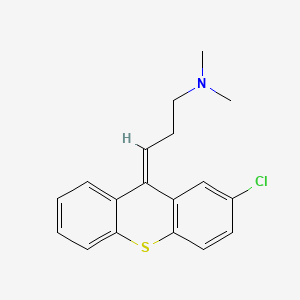
Chlorprothixene
(Z)-chlorprothixene is a chlorprothixene in which the double bond adopts a (Z)-configuration. It is an enantiomer of an (E)-chlorprothixene. — ChEBI
- IUPAC name
- (3Z)-3-(2-chlorothioxanthen-9-ylidene)-N,N-dimethylpropan-1-amine
- Molecular formula
- C18H18ClNS
- Molecular weight
- 315.9 g/mol
- Exact mass
- 315.0848484 Da
- XLogP3
- 5.2
- Topological polar surface area
- 28.5 Ų
- Hydrogen-bond donors
- 0
- Hydrogen-bond acceptors
- 2
- Covalent units
- 1
- Defined stereocentres
- 0
Also known as
16 more reported names
External database identifiers
Evidence from additional scientific databases
NIH PubChem PUG-View
Attributed physical-property, hazard, environmental and use annotations.
- Color/Form: Pale yellow crystals. Source: Hazardous Substances Data Bank (HSDB)
- LogP: 5.18 Source: DrugBank
- LogP: Log Kow = 5.18 Source: Hazardous Substances Data Bank (HSDB)
- Melting Point: 153-154 Source: DrugBank
- Melting Point: 97-98 °C Source: Hazardous Substances Data Bank (HSDB)
- Melting Point: CRYSTALS; MP: 221 °C /CHLORPROTHIXENE HYDROCHLORIDE/ Source: Hazardous Substances Data Bank (HSDB)
- Odor: SLIGHT AMINE-LIKE ODOR Source: Hazardous Substances Data Bank (HSDB)
- Solubility: 0.295 mg/L Source: DrugBank
- Solubility: FREELY SOL IN WATER @ PH 6-6.5 /HYDROCHLORIDE/ Source: Hazardous Substances Data Bank (HSDB)
- Solubility: PRACTICALLY INSOL IN WATER; 1 G SOL IN 25 ML ALCOHOL, 10 ML ETHER, 2 ML CHLOROFORM Source: Hazardous Substances Data Bank (HSDB)
- Solubility: SOL IN PETROLEUM ETHER Source: Hazardous Substances Data Bank (HSDB)
- Solubility: 14 [ug/mL] (The mean of the results at pH 7.4) Source: Sanford-Burnham Center for Chemical Genomics
- Carcinogen Classification: No indication of carcinogenicity to humans (not listed by IARC). Source: Toxin and Toxin Target Database (T3DB)
- Exposure Routes: Oral; intramuscular injection. Incomplete bioavailability. Source: Toxin and Toxin Target Database (T3DB)
- Signal: Danger Source: European Chemicals Agency (ECHA)
- GHS Hazard Statements: H301 (100%): Toxic if swallowed [Danger Acute toxicity, oral]; H336 (14.3%): May cause drowsiness or dizziness [Warning Specific target organ toxicity, single exposure; Narcotic effects] Source: European Chemicals Agency (ECHA)
- Precautionary Statement Codes: P261, P264, P270, P271, P301+P316, P304+P340, P319, P321, P330, P403+P233, P405, and P501 (click each P-code to see the statement) Source: European Chemicals Agency (ECHA)
- ECHA C&L Notifications Summary: Aggregated GHS information provided per 7 reports by companies from 2 notifications to the ECHA C&L Inventory. Each notification may be associated with multiple companies.; Information may vary between notifications depending on impurities, additives, and other factors. The percentage value in parenthesis indicates the notified classification ratio from companies that provide hazard codes. Only hazard codes with percentage values above 10% are shown. For more detailed information, please visit ECHA C&L website. Source: European Chemicals Agency (ECHA)
- Toxicity Summary: Chlorprothixene blocks postsynaptic mesolimbic dopaminergic D1 and D2 receptors in the brain; depresses the release of hypothalamic and hypophyseal hormones and is believed to depress the reticular activating system thus affecting basal metabolism, body temperature, wakefulness, vasomotor tone, and emesis. Source: Toxin and Toxin Target Database (T3DB)
- Uses: MEDICATION Source: Hazardous Substances Data Bank (HSDB)
- Uses: Use (kg) in Switzerland (2009): >75; Use (kg; approx.) in Germany (2009): >1000; Consumption (g per capita) in Switzerland (2009): 0.0096; Consumption (g per capita; approx.) in Germany (2009): 0.012; Excretion rate: 0.8; Calculated removal (%): 92 Source: NORMAN Suspect List Exchange
- Uses: For treatment of psychotic disorders (e.g. schizophrenia) and of acute mania occuring as part of bipolar disorders. Source: Toxin and Toxin Target Database (T3DB)
Mapped by: Existing checksum-valid CAS to unique PubChem CID match. Retrieved: 2026-08-31. Open source record
Scientific classifications and hazard annotations provide context and do not replace the market-specific regulatory decision shown above.
Additional source coverage and match status
| Source | Result | Checked |
|---|---|---|
| NIH PubChem PUG-View | Exact match | 2026-08-31 |
A recorded no-match is useful evidence that the source was checked; it is not a claim that the substance does not exist elsewhere.
Retrieved from NIH PubChem on 2026-08-31 by checksum-valid CAS matching. Chemical properties do not replace the regulatory decision on this page.