
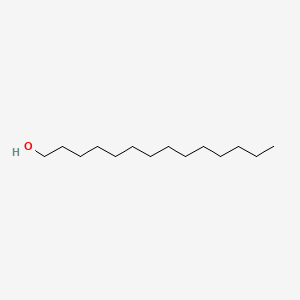
1-Tetradecanol
Tetradecan-1-ol is a long-chain fatty alcohol that is tetradecane substituted by a hydroxy group at position 1. It has a role as a pheromone, a volatile oil component and a plant metabolite. It is a tetradecanol and a long-chain primary fatty alcohol. — ChEBI
- IUPAC name
- tetradecan-1-ol
- Molecular formula
- C14H30O
- Molecular weight
- 214.39 g/mol
- Exact mass
- 214.229665576 Da
- XLogP3
- 6.2
- Topological polar surface area
- 20.2 Ų
- Hydrogen-bond donors
- 1
- Hydrogen-bond acceptors
- 1
- Covalent units
- 1
- Defined stereocentres
- 0
Also known as
16 more reported names
External database identifiers
- ChEBI:CHEBI:77417
- ChEMBL:CHEMBL24022
- EPA DTXSID:DTXSID9026926
- PubMed:22446094
- PubMed:22305293
- PubMed:22291900
- PubMed:22276998
- PubMed:22172692
- PubMed:22160552
- PubMed:22151413
- PubMed:22077331
- PubMed:22039603
- PubMed:21872054
- PubMed:21772979
- PubMed:21660258
Evidence from additional scientific databases
NIH PubChem PUG-View
Attributed physical-property, hazard, environmental and use annotations.
- Boiling Point: 505.8 °F at 760 mmHg (USCG, 1999) Source: CAMEO Chemicals
- Boiling Point: 295.8 °C Source: Hazardous Substances Data Bank (HSDB)
- Color/Form: White solid Source: Hazardous Substances Data Bank (HSDB)
- Color/Form: White crystals Source: Hazardous Substances Data Bank (HSDB)
- Color/Form: Leaflets Source: Hazardous Substances Data Bank (HSDB)
- Density: 0.824 at 100.4 °F (USCG, 1999) - Less dense than water; will float Source: CAMEO Chemicals
- Density: 0.823 at 40 °C Source: Hazardous Substances Data Bank (HSDB)
- Density: Bulk density = 7.0 lb/gal; specific gravity: 0.8355 at 20 °C/20 °C Source: Hazardous Substances Data Bank (HSDB)
- Density: Density: 0.8236 g/cu cm at 38 °C Source: Hazardous Substances Data Bank (HSDB)
- Flash Point: 285 °F (USCG, 1999) Source: CAMEO Chemicals
- Flash Point: 140.5 °C Source: Haz-Map, Information on Hazardous Chemicals and Occupational Diseases
- Flash Point: 285 °F (141 °C) (Open cup) Source: Hazardous Substances Data Bank (HSDB)
- LogP: log Kow = 6.03 Source: Hazardous Substances Data Bank (HSDB)
- LogP: 6.03 Source: Human Metabolome Database (HMDB)
- Melting Point: 99.7 °F (USCG, 1999) Source: CAMEO Chemicals
- Melting Point: 37.7 °C Source: Hazardous Substances Data Bank (HSDB)
- Melting Point: Liquid Molar Volume = 0.2604 cu m/kmol (determined at the triple point); IG Heat of Formation = -4.8409X10+8 J/kmol; Heat of Fusion at Melting Point = 4.9510X10+7 J/kmol (determined for the beta form) Source: Hazardous Substances Data Bank (HSDB)
- Melting Point: 39.5 °C Source: Human Metabolome Database (HMDB)
- Physical Description: Tetradecanol is a colorless thick liquid (heated) with a faint alcohol odor. Solidifies and floats on water. (USCG, 1999) Source: CAMEO Chemicals
- Physical Description: Liquid; Liquid; Wet Solid Source: EPA Chemical Data Reporting (CDR)
- Physical Description: White solid; [Merck Index] Source: Haz-Map, Information on Hazardous Chemicals and Occupational Diseases
- Physical Description: Solid Source: Human Metabolome Database (HMDB)
- Refractive Index: Index of refraction = 1.4358 at 50 °C Source: Hazardous Substances Data Bank (HSDB)
- Solubility: In water, 1.91X10⁻¹ mg/L at 25 °C Source: Hazardous Substances Data Bank (HSDB)
- Solubility: In water, 0.30 mg/L at 25 °C Source: Hazardous Substances Data Bank (HSDB)
- Solubility: Very soluble in ethanol, ether, acetone, benzene, chloroform Source: Hazardous Substances Data Bank (HSDB)
- Solubility: Soluble in ether, slightly soluble in alcohol Source: Hazardous Substances Data Bank (HSDB)
- Vapor Pressure: 0.00011 [mmHg] Source: Haz-Map, Information on Hazardous Chemicals and Occupational Diseases
- Vapor Pressure: 1.1X10⁻⁴ mm Hg at 25 °C Source: Hazardous Substances Data Bank (HSDB)
- First Aid: INGESTION: induce vomiting and call a doctor; if necessary, support respiration.; EYES AND SKIN: flush with copious amounts of water. (USCG, 1999) Source: CAMEO Chemicals
- Note: This chemical does not meet GHS hazard criteria for 15% (312 of 2077) of reports. Source: European Chemicals Agency (ECHA)
- Signal: Warning Source: European Chemicals Agency (ECHA)
- GHS Hazard Statements: H315 (33.1%): Causes skin irritation [Warning Skin corrosion/irritation]; H319 (46.6%): Causes serious eye irritation [Warning Serious eye damage/eye irritation]; H400 (13.5%): Very toxic to aquatic life [Warning Hazardous to the aquatic environment, acute hazard]; H410 (29%): Very toxic to aquatic life with long lasting effects [Warning Hazardous to the aquatic environment, long-term hazard]; H411 (13%): Toxic to aquatic life with long lasting effects [Hazardous to the aquatic environment, long-term hazard]; H412 (26.9%): Harmful to aquatic life with long lasting effects [Hazardous to the aquatic environment, long-term hazard] Source: European Chemicals Agency (ECHA)
- Precautionary Statement Codes: P264, P264+P265, P273, P280, P302+P352, P305+P351+P338, P321, P332+P317, P337+P317, P362+P364, P391, and P501 (click each P-code to see the statement) Source: European Chemicals Agency (ECHA)
- ECHA C&L Notifications Summary: Aggregated GHS information provided per 2077 reports by companies from 20 notifications to the ECHA C&L Inventory. Each notification may be associated with multiple companies.; Reported as not meeting GHS hazard criteria per 312 of 2077 reports by companies.; There are 19 notifications provided by 1765 of 2077 reports by companies with hazard statement code(s).; Information may vary between notifications depending on impurities, additives, and other factors. The percentage value in parenthesis indicates the notified classification ratio from companies that provide hazard codes. Only hazard codes with percentage values above 10% are shown. For more detailed information, please visit ECHA C&L website. Source: European Chemicals Agency (ECHA)
- Signal: Warning Source: NITE-CMC
- GHS Hazard Statements: H410: Very toxic to aquatic life with long lasting effects [Warning Hazardous to the aquatic environment, long-term hazard] Source: NITE-CMC
- Precautionary Statement Codes: P273, P391, and P501 (click each P-code to see the statement) Source: NITE-CMC
- GHS Hazard Statements: H315: Causes skin irritation [Warning Skin corrosion/irritation]; H320: Causes eye irritation [Warning Serious eye damage/eye irritation]; H410: Very toxic to aquatic life with long lasting effects [Warning Hazardous to the aquatic environment, long-term hazard] Source: NITE-CMC
- Precautionary Statement Codes: P264, P264+P265, P273, P280, P302+P352, P305+P351+P338, P321, P332+P317, P337+P317, P362+P364, P391, and P501 (click each P-code to see the statement) Source: NITE-CMC
- Signal: Warning Source: Hazardous Substances Data Bank (HSDB)
- GHS Hazard Statements: H319: Causes serious eye irritation [Warning Serious eye damage/eye irritation]; H401: Toxic to aquatic life [Hazardous to the aquatic environment, acute hazard]; H410: Very toxic to aquatic life with long lasting effects [Warning Hazardous to the aquatic environment, long-term hazard] Source: Hazardous Substances Data Bank (HSDB)
- NFPA Health Rating: 0 - Materials that, under emergency conditions, would offer no hazard beyond that of ordinary combustible materials. Source: Hazardous Substances Data Bank (HSDB)
- NFPA Fire Rating: 1 - Materials that must be preheated before ignition can occur. Materials require considerable preheating, under all ambient temperature conditions, before ignition and combustion can occur. Source: Hazardous Substances Data Bank (HSDB)
- NFPA Instability Rating: 0 - Materials that in themselves are normally stable, even under fire conditions. Source: Hazardous Substances Data Bank (HSDB)
- Cosmetic Ingredient Review Finding(s): Safe in the present practices of use and concentration. Ingredient, concentration, and use information are available in documents discoverable at https://cir-reports.cir-safety.org Source: Cosmetic Ingredient Review (CIR)
- Toxicity Summary: IDENTIFICATION AND USE: 1-Tetradecanol is a white solid or crystal used in organic synthesis, plasticizers, antifoaming agent, intermediate, perfume fixative for soaps and cosmetics, wetting agents and detergents, ointments and suppositories, shampoos, toothpaste, cold creams, and specialty cleaning preparations. 1-tetradecanol and 1-dodecanol are also used in combination with the (E, E) -8, 10-dodecadiene-1-ol, (Z)-11-tetradecene-1-yl acetate, and (Z)-9-tetradecene-1-yl acetate as a pheromone confusion mixture for controlling pests on plants, e.g., codling moths and leaf wrappers. In Denmark, the product is used for insect control in apples and pears. It is registered for pesticide use in the U.S. but approved pesticide uses may change periodically and so federal, state and local authorities must be consulted for currently approved uses. 1-Tetradecanol has been tested as experimental medication in controlling the progression of chronic periodontal disease. HUMAN EXPOSURE AND TOXICITY: Thirty-one patients allergic to Hirudoid cream were patch tested with the ingredients. 29 were allergic to the cream base and 16 to one or more components. The most common allergens were for 1-tetrad Source: Hazardous Substances Data Bank (HSDB)
- Environmental Bioconcentration: An estimated BCF of 190 was calculated in fish for 1-tetradecanol(SRC), using a log Kow of 6.03(1) and a regression-derived equation(2). According to a classification scheme(3), this BCF suggests the potential for bioconcentration in aquatic organisms is high(SRC). Source: Hazardous Substances Data Bank (HSDB)
- Environmental Fate: TERRESTRIAL FATE: Based on a classification scheme(1), Koc values of 18,197-26,303 in humic acid(2), indicate that 1-tetradecanol is expected to be immobile in soil(SRC). Volatilization of 1-tetradecanol from moist soil surfaces is expected given a Henry's Law constant of 1.04X10⁻⁴ atm-cu m/mole(3). However, adsorption to soil is expected to attenuate volatilization(SRC). 1-Tetradecanol is not expected to volatilize from dry soil surfaces(SRC) based upon a vapor pressure of 1.1X10⁻⁴ mm Hg at 25 °C(4). A biodegradation rate constant of 52.5 1/hr in sludge was reported for 1-tetradecanol(5), indicating that biodegradation may be an important environmental fate process in soil(SRC). Source: Hazardous Substances Data Bank (HSDB)
- Environmental Fate: AQUATIC FATE: Based on a classification scheme(1), reported Koc values of 23,320-64,060 in suspended solids(2), indicate that 1-tetradecanol is expected to adsorb to suspended solids and sediment(SRC). Volatilization from water surfaces is expected(3) based upon a Henry's Law constant of 1.04X10⁻⁴ atm-cu m/mole(4). Using this Henry's Law constant and an estimation method(3), volatilization half-lives for a model river and model lake are 17 hours and 10 days, respectively(SRC). However, volatilization from water surfaces is expected to be attenuated by adsorption to suspended solids and sediment in the water column. The estimated volatilization half-life from a model pond is 20-55 months if adsorption is considered(5). 1-Tetradecanol is not expected to undergo hydrolysis in the environment due to the lack of functional groups that hydrolyze under environmental conditions(3). According to a classification scheme(6), an estimated BCF of 190(SRC), from its log Kow of 6.03(7) and a regression-derived equation(8), suggests the potential for bioconcentration in aquatic organisms is high(SRC). A biodegradation rate constant of 52.5 1/hr was reported in sludge(9), indicating that biodegrada Source: Hazardous Substances Data Bank (HSDB)
- Environmental Fate: ATMOSPHERIC FATE: According to a model of gas/particle partitioning of semivolatile organic compounds in the atmosphere(1), 1-tetradecanol, which has a vapor pressure of 1.1X10⁻⁴ mm Hg at 25 °C(2), is expected to exist solely as a vapor in the ambient atmosphere. Vapor-phase 1-tetradecanol is degraded in the atmosphere by reaction with photochemically-produced hydroxyl radicals(SRC); the half-life for this reaction in air is estimated to be 18 hours(SRC), calculated from its rate constant of 2.1X10⁻¹¹ cu cm/molecule-sec at 25 °C(SRC) that was derived using a structure estimation method(3). 1-Tetradecanol does not contain chromophores that absorb at wavelengths >290 nm(4) and, therefore, is not expected to be susceptible to direct photolysis by sunlight(SRC). Source: Hazardous Substances Data Bank (HSDB)
- Consumer Uses: Not Known or Reasonably Ascertainable; Cleaning agent; Lubricating agent; Solvent Source: EPA Chemical Data Reporting (CDR)
- Industry Uses: Surfactant (surface active agent); Solvent; Lubricating agent; Intermediate; Cleaning agent; Stabilizing agent; Emulsifier; Not Known or Reasonably Ascertainable Source: EPA Chemical Data Reporting (CDR)
- Cosmetic Ingredient Review Link: CIR ingredient: Myristyl Alcohol Source: Cosmetic Ingredient Review (CIR)
- Sources/Uses: Used as a chemical intermediate, emulsion stabilizer, fragrance, and viscosity increasing agent; Used in plasticizers, anti-foam agents, soaps, perfumes, detergents, suppositories, creams, shampoos, toothpaste, and cleaning preparations; [HSDB] Source: Haz-Map, Information on Hazardous Chemicals and Occupational Diseases
- Uses: For 1-tetradecanol (USEPA/OPP Pesticide Code: 001510) ACTIVE products with label matches. /SRP: Registered for use in the U.S. but approved pesticide uses may change periodically and so federal, state and local authorities must be consulted for currently approved uses./ Source: Hazardous Substances Data Bank (HSDB)
- Uses: 1-dodecanol and 1-tetradecanol are used in combination with the (E, E) -8, 10-dodecadiene-1-ol, (Z)-11-tetradecene-1-yl acetate, and (Z)-9-tetradecene-1-yl acetate as pheromone confusion mixture for controlling pests on plants, e.g., codling moths and leaf wrappers. In Denmark, the product is used for insect control in apples and pears. Mode of action is to prevent mating of codling moths and several species of leaf wrappers, whereby propagation is prevented. That results in a reduced moth (leaf rollers) population and therefore less damage to the ... /crops/. The product has not previously been selected by the Danish EPA for control of content of active substances. Source: Hazardous Substances Data Bank (HSDB)
- Uses: Organic synthesis, plasticizers, antifoam agent, intermediate, perfume fixative for soaps and cosmetics, wetting agents and detergents, ointments and suppositories, shampoos, toothpaste, cold creams, specialty cleaning preparations. Source: Hazardous Substances Data Bank (HSDB)
- Uses: As emollient for cold creams, etc., also for making the sulfated alcohol whose sodium salt is applicable as a "wetter" in textiles. Source: Hazardous Substances Data Bank (HSDB)
- Uses: For more Uses (Complete) data for 1-TETRADECANOL (7 total), please visit the HSDB record page. Source: Hazardous Substances Data Bank (HSDB)
Mapped by: Existing checksum-valid CAS to unique PubChem CID match. Retrieved: 2026-08-31. Open source record
Scientific classifications and hazard annotations provide context and do not replace the market-specific regulatory decision shown above.
Additional source coverage and match status
| Source | Result | Checked |
|---|---|---|
| NIH PubChem PUG-View | Exact match | 2026-08-31 |
A recorded no-match is useful evidence that the source was checked; it is not a claim that the substance does not exist elsewhere.
Retrieved from NIH PubChem on 2026-08-31 by checksum-valid CAS matching. Chemical properties do not replace the regulatory decision on this page.