
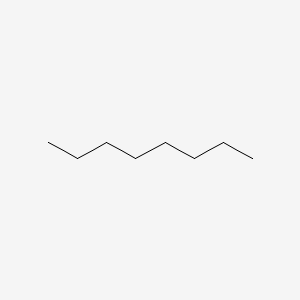
CAS 111-65-9PubChem CID 356
Octane
Octane is a straight chain alkane composed of 8 carbon atoms. It has a role as a xenobiotic. — ChEBI
- IUPAC name
- octane
- Molecular formula
- C8H18
- Molecular weight
- 114.23 g/mol
- Exact mass
- 114.140850574 Da
- XLogP3
- 3.9
- Topological polar surface area
- 0.0 Ų
- Hydrogen-bond donors
- 0
- Hydrogen-bond acceptors
- 0
- Covalent units
- 1
- Defined stereocentres
- 0
Also known as
n-octaneOktanOktanenOttaniX1RV0B2FJVNSC-9822CHEBI:17590normal-Octane
16 more reported names
RefChem:6664203-892-1608-610-4Oktanen [Dutch]Oktan [Polish]Ottani [Italian]n-OktanCH3-[CH2]6-CH3Heptane, methyl-Normal octaneOctane, all isomersOctane; NSC 9822; n-Octaneoctano9065-92-3HSDB 108NSC 9822
External database identifiers
- ChEBI:CHEBI:17590
- ChEMBL:CHEMBL134886
- EPA DTXSID:DTXSID0026882
- PubMed:28003437
- PubMed:23026910
- PubMed:23023783
- PubMed:22998760
- PubMed:22992132
- PubMed:22967205
- PubMed:22958854
- PubMed:22957589
- PubMed:22953180
- PubMed:22950356
- PubMed:22927018
- PubMed:22919730
Evidence from additional scientific databases
NIH PubChem PUG-View
Exact identifier match356
Attributed physical-property, hazard, environmental and use annotations.
- Autoignition Temperature: 428 °F (USCG, 1999) Source: CAMEO Chemicals
- Autoignition Temperature: 403 °F (206 °C) Source: Hazardous Substances Data Bank (HSDB)
- Autoignition Temperature: 220 °C Source: ILO-WHO International Chemical Safety Cards (ICSCs)
- Boiling Point: 258.1 °F at 760 mmHg (USCG, 1999) Source: CAMEO Chemicals
- Boiling Point: 125.62 °C Source: Hazardous Substances Data Bank (HSDB)
- Boiling Point: 125.00 to 126.00 °C. @ 760.00 mm Hg Source: Human Metabolome Database (HMDB)
- Boiling Point: 126 °C Source: ILO-WHO International Chemical Safety Cards (ICSCs)
- Boiling Point: 258 °F Source: Occupational Safety and Health Administration (OSHA)
- Boiling Point: 125.8 °C @760 [mm Hg] Source: PAC Chemical Database, U.S. Department of Energy
- Boiling Point: 258 °F Source: The National Institute for Occupational Safety and Health (NIOSH)
- Color/Form: Colorless liquid Source: Hazardous Substances Data Bank (HSDB)
- Color/Form: Clear liquid Source: Hazardous Substances Data Bank (HSDB)
- Density: 0.703 at 68 °F (USCG, 1999) - Less dense than water; will float Source: CAMEO Chemicals
- Density: 0.6986 g/cu cm at 25 °C Source: Hazardous Substances Data Bank (HSDB)
- Density: Relative density (water = 1): 0.70 Source: ILO-WHO International Chemical Safety Cards (ICSCs)
- Density: 0.7 Source: Occupational Safety and Health Administration (OSHA)
- Density: 0.7036 @25 °C Source: PAC Chemical Database, U.S. Department of Energy
- Density: 0.70 Source: The National Institute for Occupational Safety and Health (NIOSH)
- Flash Point: 56 °F (USCG, 1999) Source: CAMEO Chemicals
- Flash Point: 56 °F (13 °C) (Closed cup) Source: Hazardous Substances Data Bank (HSDB)
- Flash Point: 72 °F (22 °C) (Open cup) Source: Hazardous Substances Data Bank (HSDB)
- Flash Point: 13 °C c.c. Source: ILO-WHO International Chemical Safety Cards (ICSCs)
- Flash Point: 56 °F Source: Occupational Safety and Health Administration (OSHA)
- Flash Point: 56 °F Source: The National Institute for Occupational Safety and Health (NIOSH)
- LogP: log Kow = 5.18 Source: Hazardous Substances Data Bank (HSDB)
- LogP: 5.18 Source: Human Metabolome Database (HMDB)
- LogP: 4.00/5.18 Source: ILO-WHO International Chemical Safety Cards (ICSCs)
- Melting Point: -70.2 °F (USCG, 1999) Source: CAMEO Chemicals
- Melting Point: -56.73 °C Source: Hazardous Substances Data Bank (HSDB)
- Melting Point: -56.8 °C Source: Human Metabolome Database (HMDB)
- Melting Point: -56.8 °C Source: ILO-WHO International Chemical Safety Cards (ICSCs)
- Melting Point: -70 °F Source: Occupational Safety and Health Administration (OSHA)
- Melting Point: -70 °F Source: The National Institute for Occupational Safety and Health (NIOSH)
- Odor: Gasoline-like Source: Hazardous Substances Data Bank (HSDB)
- Physical Description: N-octane is a colorless liquid with an odor of gasoline. Less dense than water and insoluble in water. Hence floats on water. Produces irritating vapor. Source: CAMEO Chemicals
- Physical Description: Liquid Source: EPA Chemical Data Reporting (CDR)
- Physical Description: Colorless liquid with a gasoline-like odor; [NIOSH] Source: Haz-Map, Information on Hazardous Chemicals and Occupational Diseases
- Physical Description: Liquid Source: Human Metabolome Database (HMDB)
- Physical Description: COLOURLESS LIQUID WITH CHARACTERISTIC ODOUR. Source: ILO-WHO International Chemical Safety Cards (ICSCs)
- Physical Description: Colorless liquid with a gasoline-like odor. Source: Occupational Safety and Health Administration (OSHA)
- Physical Description: Colorless liquid with a gasoline-like odor. Source: The National Institute for Occupational Safety and Health (NIOSH)
- Refractive Index: Index of refraction: 1.3944 at 25 °C/D Source: Hazardous Substances Data Bank (HSDB)
- Refractive Index: Index of refraction: 1.3974 at 20 °C Source: Hazardous Substances Data Bank (HSDB)
- Solubility: 7e-05 % at 77 °F (NIOSH, 2024) Source: CAMEO Chemicals
- Solubility: In water, 0.66 mg/L at 25 °C Source: Hazardous Substances Data Bank (HSDB)
- Solubility: Soluble in ethyl ether; miscible with ethanol, acetone, benzene Source: Hazardous Substances Data Bank (HSDB)
- Solubility: Miscible with benzene, petroleum ether, gasoline; soluble in ether; slightly soluble in alcohol Source: Hazardous Substances Data Bank (HSDB)
- Solubility: 0.00066 mg/mL Source: Human Metabolome Database (HMDB)
- Solubility: Solubility in water: none Source: ILO-WHO International Chemical Safety Cards (ICSCs)
- Solubility: (77 °F): 0.00007% Source: The National Institute for Occupational Safety and Health (NIOSH)
- Vapor Pressure: 10 mmHg (NIOSH, 2024) Source: CAMEO Chemicals
- Vapor Pressure: 14.1 [mmHg] Source: Haz-Map, Information on Hazardous Chemicals and Occupational Diseases
- Vapor Pressure: 14.1 mm Hg at 25 °C Source: Hazardous Substances Data Bank (HSDB)
- Vapor Pressure: Vapor pressure, kPa at 20 °C: 1.33 Source: ILO-WHO International Chemical Safety Cards (ICSCs)
- Vapor Pressure: 10 mmHg Source: Occupational Safety and Health Administration (OSHA)
- Vapor Pressure: 10 [mm Hg] @19.2 °C Source: PAC Chemical Database, U.S. Department of Energy
- Vapor Pressure: 10 mmHg Source: The National Institute for Occupational Safety and Health (NIOSH)
- Viscosity: 0.5151 cP at 25 °C Source: Hazardous Substances Data Bank (HSDB)
- Carcinogen Classification: No indication of carcinogenicity to humans (not listed by IARC). Source: Toxin and Toxin Target Database (T3DB)
- Exposure Routes: The substance can be absorbed into the body by inhalation and by ingestion. Source: ILO-WHO International Chemical Safety Cards (ICSCs)
- Exposure Routes: inhalation, ingestion, skin and/or eye contact Source: The National Institute for Occupational Safety and Health (NIOSH)
- Exposure Routes: Oral (L400) ; inhalation (L400) ; dermal (L400) Source: Toxin and Toxin Target Database (T3DB)
- First Aid: Excerpt from NIOSH Pocket Guide for Octane:; Eye: IRRIGATE IMMEDIATELY - If this chemical contacts the eyes, immediately wash (irrigate) the eyes with large amounts of water, occasionally lifting the lower and upper lids. Get medical attention immediately.; Skin: SOAP WASH PROMPTLY - If this chemical contacts the skin, promptly wash the contaminated skin with soap and water. If this chemical penetrates the clothing, promptly remove the clothing and wash the skin with soap and water. Get medical attention promptly.; Breathing: RESPIRATORY SUPPORT - If a person breathes large amounts of this chemical, move the exposed person to fresh air at once. If breathing has stopped, perform artificial respiration. Keep the affected person warm and at rest. Get medical attention as soon as possible.; Swallow: MEDICAL ATTENTION IMMEDIATELY - If this chemical has been swallowed, get medical attention immediately. (NIOSH, 2024) Source: CAMEO Chemicals
- First Aid: (General first aid procedures); Eye: Irrigate immediately - If this chemical contacts the eyes, immediately wash (irrigate) the eyes with large amounts of water, occasionally lifting the lower and upper lids. Get medical attention immediately.; Skin: Soap wash promptly - If this chemical contacts the skin, promptly wash the contaminated skin with soap and water. If this chemical penetrates the clothing, promptly remove the clothing and wash the skin with soap and water. Get medical attention promptly.; Breathing: Respiratory support; Swallow: Medical attention immediately - If this chemical has been swallowed, get medical attention immediately. Source: The National Institute for Occupational Safety and Health (NIOSH)
- Signal: Danger Source: Regulation (EC) No 1272/2008 of the European Parliament and of the Council
- GHS Hazard Statements: H225: Highly Flammable liquid and vapor [Danger Flammable liquids]; H304: May be fatal if swallowed and enters airways [Danger Aspiration hazard]; H315: Causes skin irritation [Warning Skin corrosion/irritation]; H336: May cause drowsiness or dizziness [Warning Specific target organ toxicity, single exposure; Narcotic effects]; H400: Very toxic to aquatic life [Warning Hazardous to the aquatic environment, acute hazard]; H410: Very toxic to aquatic life with long lasting effects [Warning Hazardous to the aquatic environment, long-term hazard] Source: Regulation (EC) No 1272/2008 of the European Parliament and of the Council
- Precautionary Statement Codes: P210, P233, P240, P241, P242, P243, P261, P264, P271, P273, P280, P301+P316, P302+P352, P303+P361+P353, P304+P340, P319, P321, P331, P332+P317, P362+P364, P370+P378, P391, P403+P233, P403+P235, P405, and P501 (click each P-code to see the statement) Source: Regulation (EC) No 1272/2008 of the European Parliament and of the Council
- Signal: Danger Source: European Chemicals Agency (ECHA)
- GHS Hazard Statements: H225 (100%): Highly Flammable liquid and vapor [Danger Flammable liquids]; H302 (28.3%): Harmful if swallowed [Warning Acute toxicity, oral]; H304 (100%): May be fatal if swallowed and enters airways [Danger Aspiration hazard]; H312 (28.3%): Harmful in contact with skin [Warning Acute toxicity, dermal]; H315 (100%): Causes skin irritation [Warning Skin corrosion/irritation]; H319 (31.6%): Causes serious eye irritation [Warning Serious eye damage/eye irritation]; H336 (99.9%): May cause drowsiness or dizziness [Warning Specific target organ toxicity, single exposure; Narcotic effects]; H400 (96.2%): Very toxic to aquatic life [Warning Hazardous to the aquatic environment, acute hazard]; H410 (98.6%): Very toxic to aquatic life with long lasting effects [Warning Hazardous to the aquatic environment, long-term hazard] Source: European Chemicals Agency (ECHA)
- Precautionary Statement Codes: P210, P233, P240, P241, P242, P243, P261, P264, P264+P265, P270, P271, P273, P280, P301+P316, P301+P317, P302+P352, P303+P361+P353, P304+P340, P305+P351+P338, P317, P319, P321, P330, P331, P332+P317, P337+P317, P362+P364, P370+P378, P391, P403+P233, P403+P235, P405, and P501 (click each P-code to see the statement) Source: European Chemicals Agency (ECHA)
- ECHA C&L Notifications Summary: Aggregated GHS information provided per 1560 reports by companies from 40 notifications to the ECHA C&L Inventory. Each notification may be associated with multiple companies.; Information may vary between notifications depending on impurities, additives, and other factors. The percentage value in parenthesis indicates the notified classification ratio from companies that provide hazard codes. Only hazard codes with percentage values above 10% are shown. For more detailed information, please visit ECHA C&L website. Source: European Chemicals Agency (ECHA)
- Signal: Danger Source: NITE-CMC
- GHS Hazard Statements: H225: Highly Flammable liquid and vapor [Danger Flammable liquids]; H304: May be fatal if swallowed and enters airways [Danger Aspiration hazard]; H315: Causes skin irritation [Warning Skin corrosion/irritation]; H319: Causes serious eye irritation [Warning Serious eye damage/eye irritation]; H335: May cause respiratory irritation [Warning Specific target organ toxicity, single exposure; Respiratory tract irritation]; H336: May cause drowsiness or dizziness [Warning Specific target organ toxicity, single exposure; Narcotic effects]; H400: Very toxic to aquatic life [Warning Hazardous to the aquatic environment, acute hazard]; H411: Toxic to aquatic life with long lasting effects [Hazardous to the aquatic environment, long-term hazard] Source: NITE-CMC
- Precautionary Statement Codes: P210, P233, P240, P241, P242, P243, P261, P264, P264+P265, P271, P273, P280, P301+P316, P302+P352, P303+P361+P353, P304+P340, P305+P351+P338, P319, P321, P331, P332+P317, P337+P317, P362+P364, P370+P378, P391, P403+P233, P403+P235, P405, and P501 (click each P-code to see the statement) Source: NITE-CMC
- GHS Hazard Statements: H225: Highly Flammable liquid and vapor [Danger Flammable liquids]; H304: May be fatal if swallowed and enters airways [Danger Aspiration hazard]; H315: Causes skin irritation [Warning Skin corrosion/irritation]; H319: Causes serious eye irritation [Warning Serious eye damage/eye irritation]; H335: May cause respiratory irritation [Warning Specific target organ toxicity, single exposure; Respiratory tract irritation]; H336: May cause drowsiness or dizziness [Warning Specific target organ toxicity, single exposure; Narcotic effects]; H370: Causes damage to organs [Danger Specific target organ toxicity, single exposure] Source: NITE-CMC
- Precautionary Statement Codes: P210, P233, P240, P241, P242, P243, P260, P261, P264, P264+P265, P270, P271, P280, P301+P316, P302+P352, P303+P361+P353, P304+P340, P305+P351+P338, P308+P316, P319, P321, P331, P332+P317, P337+P317, P362+P364, P370+P378, P403+P233, P403+P235, P405, and P501 (click each P-code to see the statement) Source: NITE-CMC
- Health Effects: Petroleum distillates are aspiration hazards and may cause pulmonary damage, central nervous system depression, and cardiac effects such as cardiac arrhythmias. They may also affect the blood, immune system, liver, and kidney. (A600, L1297) Source: Toxin and Toxin Target Database (T3DB)
- NFPA Health Rating: 1 - Materials that, under emergency conditions, can cause significant irritation. Source: Hazardous Substances Data Bank (HSDB)
- NFPA Fire Rating: 3 - Liquids and solids that can be ignited under almost all ambient temperature conditions. Materials produce hazardous atmospheres with air under almost all ambient temperatures or, though unaffected by ambient temperatures, are readily ignited under almost all conditions. Source: Hazardous Substances Data Bank (HSDB)
- NFPA Instability Rating: 0 - Materials that in themselves are normally stable, even under fire conditions. Source: Hazardous Substances Data Bank (HSDB)
- Target Organs: Eyes, skin, respiratory system, central nervous system Source: The National Institute for Occupational Safety and Health (NIOSH)
- Toxicity Summary: Petroleum distillates are central nervous system depressants and cause pulmonary damage. (A600) Source: Toxin and Toxin Target Database (T3DB)
- Environmental Bioconcentration: An estimated BCF of 1200 was calculated in fish for n-octane(SRC), using a log Kow of 5.18(1) and a regression-derived equation(2). According to a classification scheme(3), this BCF suggests the potential for bioconcentration in aquatic organisms is very high(SRC). Source: Hazardous Substances Data Bank (HSDB)
- Environmental Fate: TERRESTRIAL FATE: Based on a classification scheme(1), an estimated Koc value of 3.1X10+4(SRC), determined from a log Kow of 5.18(2) and a regression-derived equation(3), indicates that n-octane is expected to be immobile in soil(SRC). Volatilization of n-octane from moist soil surfaces is expected to be an important fate process(SRC) given an estimated Henry's Law constant of 3.21 atm-cu m/mole(SRC), derived from its vapor pressure, 14.1 mm Hg(4), and water solubility, 0.66 mg/L(5). However, adsorption to soil is expected to attenuate volatilization(SRC). n-Octane is expected to volatilize from dry soil surfaces(SRC) based upon its vapor pressure(4). n-Octane, present at one mg/mL silt loam soil suspension, exhibited average Theoretical biological oxygen demands of 13, 58, 70 and 69% after 2, 5, 10 and 20 days, respectively(6), suggesting that biodegradation may be an important environmental fate process in soil(SRC). Source: Hazardous Substances Data Bank (HSDB)
- Environmental Fate: AQUATIC FATE: Based on a classification scheme(1), an estimated Koc value of 3.1X10+4(SRC), determined from a log Kow of 5.18(2) and a regression-derived equation(3), indicates that n-octane is expected to adsorb to suspended solids and sediment(SRC). Volatilization from water surfaces is expected(4) based upon an estimated Henry's Law constant of 3.2 atm-cu m/mole(SRC), derived from its vapor pressure, 41.1 mm Hg(5), and water solubility, 0.66 mg/L(6). Using this Henry's Law constant and an estimation method(4), volatilization half-lives for a model river and model lake are 3 hrs and 4 days, respectively(SRC). However, volatilization from water surfaces is expected to be attenuated by adsorption to suspended solids and sediment in the water column(SRC). The estimated volatilization half-life from a model pond is 11 months if adsorption is considered(7). According to a classification scheme(8), an estimated BCF of 1200(SRC), from its log Kow(2) and a regression-derived equation(3), suggests the potential for bioconcentration in aquatic organisms is very high(SRC). When evaporation rates are low, biodegradation of n-octane under aerobic conditions may be important in water(SRC). For Source: Hazardous Substances Data Bank (HSDB)
- Environmental Fate: ATMOSPHERIC FATE: According to a model of gas/particle partitioning of semivolatile organic compounds in the atmosphere(1), n-octane, which has a vapor pressure of 14.1 mm Hg at 25 °C(2), is expected to exist solely as a vapor in the ambient atmosphere. Vapor-phase n-octane is degraded in the atmosphere by reaction with photochemically-produced hydroxyl radicals(SRC); the half-life for this reaction in air is estimated to be 44 hrs(SRC), calculated from its rate constant of 8.68X10⁻¹² cu cm/molecule-sec at 25 °C(3). Experimental data also showed that 33.2% of the n-octane fraction in a dark chamber reacted with nitrate radicals to form the corresponding alkyl nitrate(4,5), suggesting nighttime reactions with nitrate radicals may contribute to the atmospheric transformation of n-octane, especially in urban environments(SRC). n-Octane does not contain chromophores that absorb at wavelengths >290 nm(6) and, therefore, is not expected to be susceptible to direct photolysis by sunlight(SRC). Source: Hazardous Substances Data Bank (HSDB)
- Consumer Uses: Not Known or Reasonably Ascertainable; Fuel; UV stabilizer; Solvent Source: EPA Chemical Data Reporting (CDR)
- Industry Uses: Not Known or Reasonably Ascertainable; Intermediate; Solvent; Fuel agents; Fuel Source: EPA Chemical Data Reporting (CDR)
- Sources/Uses: Used as a solvent, chemical raw material, antiknock agent for high compression engine fuels, lacquer diluent, carrier solvent in polymer manufacturing, blowing agent for foam rubber used in rocket propellants, for calibrations, and azeotropic distillations; [HSDB] Source: Haz-Map, Information on Hazardous Chemicals and Occupational Diseases
- Industrial Processes with risk of exposure: Painting (Solvents) [Category: Paint] Source: Haz-Map, Information on Hazardous Chemicals and Occupational Diseases
- Uses: It is used as a solvent, a chemical raw material, and an important chemical agent in the petroleum industry. Octane offers desirable blending values that achieve certain antiknock and combustion qualities for high compression engine fuels. Source: Hazardous Substances Data Bank (HSDB)
- Uses: As an industrial solvent, lacquer diluent, and carrier solvent in the manufacturing of polymers; as a blowing agent for foam rubber used in rocket propellants Source: Hazardous Substances Data Bank (HSDB)
- Uses: Organic synthesis, calibrations, azeotropic distillations Source: Hazardous Substances Data Bank (HSDB)
- Uses: Octanes may be found in gasoline. (L1296) Source: Toxin and Toxin Target Database (T3DB)
Mapped by: Existing checksum-valid CAS to unique PubChem CID match. Retrieved: 2026-08-31. Open source record
Scientific classifications and hazard annotations provide context and do not replace the market-specific regulatory decision shown above.
Additional source coverage and match status
| Source | Result | Checked |
|---|---|---|
| NIH PubChem PUG-View | Exact match | 2026-08-31 |
A recorded no-match is useful evidence that the source was checked; it is not a claim that the substance does not exist elsewhere.
Retrieved from NIH PubChem on 2026-08-31 by checksum-valid CAS matching. Chemical properties do not replace the regulatory decision on this page.