
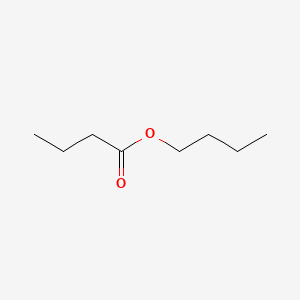
Butyl butyrate
Butyl butanoate is a butanoate ester of butan-1-ol. It has a role as a metabolite. It is functionally related to a butan-1-ol. — ChEBI
- IUPAC name
- butyl butanoate
- Molecular formula
- C8H16O2
- Molecular weight
- 144.21 g/mol
- Exact mass
- 144.115029749 Da
- XLogP3
- 2.2
- Topological polar surface area
- 26.3 Ų
- Hydrogen-bond donors
- 0
- Hydrogen-bond acceptors
- 2
- Covalent units
- 1
- Defined stereocentres
- 0
Also known as
16 more reported names
External database identifiers
Evidence from additional scientific databases
NIH PubChem PUG-View
Attributed physical-property, hazard, environmental and use annotations.
- Boiling Point: 332 °F at 760 mmHg (USCG, 1999) Source: CAMEO Chemicals
- Boiling Point: 166.00 °C. @ 760.00 mm Hg Source: Human Metabolome Database (HMDB)
- Boiling Point: 165 °C Source: Joint FAO/WHO Expert Committee on Food Additives (JECFA)
- Boiling Point: 332 °F Source: Occupational Safety and Health Administration (OSHA)
- Boiling Point: 166 °C @760 [mm Hg] Source: PAC Chemical Database, U.S. Department of Energy
- Density: 0.872 at 68 °F (USCG, 1999) - Less dense than water; will float Source: CAMEO Chemicals
- Density: 0.867-0.871 Source: Joint FAO/WHO Expert Committee on Food Additives (JECFA)
- Density: 0.872 Source: Occupational Safety and Health Administration (OSHA)
- Density: 0.872 @ 20°C Source: PAC Chemical Database, U.S. Department of Energy
- Flash Point: 128 °F (USCG, 1999) Source: CAMEO Chemicals
- Flash Point: 128 °F Source: Occupational Safety and Health Administration (OSHA)
- Melting Point: -133 °F (USCG, 1999) Source: CAMEO Chemicals
- Melting Point: -91.5 °C Source: Human Metabolome Database (HMDB)
- Melting Point: -133 °F Source: Occupational Safety and Health Administration (OSHA)
- Physical Description: Butyl butyrate appears as a colorless liquid. Insoluble in water. A marine pollutant. Poses a threat to the aquatic environment. Immediate steps should be taken to prevent spread to the environment. May penetrate soils and contaminate groundwater and nearby waterways. Mildly irritates the eyes and skin. Source: CAMEO Chemicals
- Physical Description: Liquid Source: EPA Chemical Data Reporting (CDR)
- Physical Description: Liquid; [Merck Index] Colorless liquid with an ester-like odor; [CHRIS] Colorless liquid with an odor like pineapple; [Acros Organics MSDS] Source: Haz-Map, Information on Hazardous Chemicals and Occupational Diseases
- Physical Description: Liquid Source: Human Metabolome Database (HMDB)
- Physical Description: colourless liquid with a fruity, pineapple-like odour on dilution Source: Joint FAO/WHO Expert Committee on Food Additives (JECFA)
- Physical Description: A colorless liquid. Source: Occupational Safety and Health Administration (OSHA)
- Refractive Index: 1.405-1.407 Source: Joint FAO/WHO Expert Committee on Food Additives (JECFA)
- Solubility: 0.5 mg/mL at 20 °C Source: Human Metabolome Database (HMDB)
- Solubility: miscible with alcohol, ether, most vegetable oils; slightly soluble in propylene glycol, water Source: Joint FAO/WHO Expert Committee on Food Additives (JECFA)
- Solubility: 1 ml in 3 ml 70% alcohol (in ethanol) Source: Joint FAO/WHO Expert Committee on Food Additives (JECFA)
- Vapor Pressure: 10.34 mmHg (USCG, 1999) Source: CAMEO Chemicals
- Vapor Pressure: 1.81 [mmHg] Source: Haz-Map, Information on Hazardous Chemicals and Occupational Diseases
- Vapor Pressure: 10.34 mmHg Source: Occupational Safety and Health Administration (OSHA)
- First Aid: INHALATION: Move victim to fresh air and call a physician; give artificial respiration if necessary.; INGESTION: Induce vomiting and call a physician.; EYES: Flush with water for at least 15 minutes.; SKIN: Flush with water; wash with soap and water. (USCG, 1999) Source: CAMEO Chemicals
- Signal: Warning Source: Regulation (EC) No 1272/2008 of the European Parliament and of the Council
- GHS Hazard Statements: H226: Flammable liquid and vapor [Warning Flammable liquids] Source: Regulation (EC) No 1272/2008 of the European Parliament and of the Council
- Precautionary Statement Codes: P210, P233, P240, P241, P242, P243, P280, P303+P361+P353, P370+P378, P403+P235, and P501 (click each P-code to see the statement) Source: Regulation (EC) No 1272/2008 of the European Parliament and of the Council
- Signal: Warning Source: European Chemicals Agency (ECHA)
- GHS Hazard Statements: H226 (100%): Flammable liquid and vapor [Warning Flammable liquids] Source: European Chemicals Agency (ECHA)
- Precautionary Statement Codes: P210, P233, P240, P241, P242, P243, P280, P303+P361+P353, P370+P378, P403+P235, and P501 (click each P-code to see the statement) Source: European Chemicals Agency (ECHA)
- ECHA C&L Notifications Summary: Aggregated GHS information provided per 1786 reports by companies from 6 notifications to the ECHA C&L Inventory.; Information may vary between notifications depending on impurities, additives, and other factors. The percentage value in parenthesis indicates the notified classification ratio from companies that provide hazard codes. Only hazard codes with percentage values above 10% are shown. For more detailed information, please visit ECHA C&L website. Source: European Chemicals Agency (ECHA)
- Signal: Warning Source: NITE-CMC
- GHS Hazard Statements: H226: Flammable liquid and vapor [Warning Flammable liquids] Source: NITE-CMC
- Precautionary Statement Codes: P210, P233, P240, P241, P242, P243, P280, P303+P361+P353, P370+P378, P403+P235, and P501 (click each P-code to see the statement) Source: NITE-CMC
- Signal: Warning Source: Hazardous Chemical Information System (HCIS), Safe Work Australia
- GHS Hazard Statements: H226: Flammable liquid and vapor [Warning Flammable liquids] Source: Hazardous Chemical Information System (HCIS), Safe Work Australia
- Industry Uses: Intermediate Source: EPA Chemical Data Reporting (CDR)
- Sources/Uses: Permitted for use as an inert ingredient in non-food pesticide products; [EPA] Used as flavoring agent or adjuvant; [FDA] Used to make printed circuit boards and in the flavoring and fragrance industries; [OSHA] Source: Haz-Map, Information on Hazardous Chemicals and Occupational Diseases
Mapped by: Existing checksum-valid CAS to unique PubChem CID match. Retrieved: 2026-08-31. Open source record
Scientific classifications and hazard annotations provide context and do not replace the market-specific regulatory decision shown above.
Additional source coverage and match status
| Source | Result | Checked |
|---|---|---|
| NIH PubChem PUG-View | Exact match | 2026-08-31 |
A recorded no-match is useful evidence that the source was checked; it is not a claim that the substance does not exist elsewhere.
Retrieved from NIH PubChem on 2026-08-31 by checksum-valid CAS matching. Chemical properties do not replace the regulatory decision on this page.