
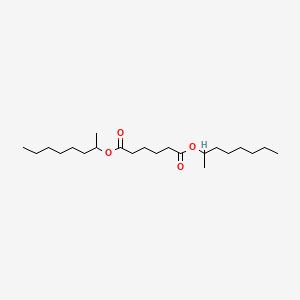
CAS 108-63-4PubChem CID 61022
Diisooctyl Adipate
- IUPAC name
- dioctan-2-yl hexanedioate
- Molecular formula
- C22H42O4
- Molecular weight
- 370.6 g/mol
- Exact mass
- 370.30830982 Da
- XLogP3
- 7.2
- Topological polar surface area
- 52.6 Ų
- Hydrogen-bond donors
- 0
- Hydrogen-bond acceptors
- 4
- Covalent units
- 1
- Defined stereocentres
- 0
Also known as
HEXANEDIOIC ACID, BIS(1-METHYLHEPTYL) ESTERBis(1-methylheptyl) adipate2TLQ9O0CWBAdipic acid, bis(1-methylheptyl) esterCASMATE DCAHALLSTAR DCANSC 6197NSC-6197
16 more reported names
EINECS 203-601-8Hexanedioic acid, 1,6-bis(1-methylheptyl) esterRefChem:587841DIISOOCTYL ADIPATE [INCI]Adipic acid, bis(1-methylheptyl) ester (8CI)203-601-81330-86-5Adipic acid, diisooctyl esterAdipol 10ADB 32 (ester)DI-ISO-OCTYL ADIPATEDiiosoctyl adipateDIMETHYL HEPTYLADIPATEEC 215-553-5EINECS 215-553-5Hatcol 2906
External database identifiers
- EPA DTXSID:DTXSID6026795
Evidence from additional scientific databases
NIH PubChem PUG-View
Exact identifier match61022
Attributed physical-property, hazard, environmental and use annotations.
- Boiling Point: 205-220 °C @ 4 mm HG Source: Hazardous Substances Data Bank (HSDB)
- Color/Form: COLORLESS OR VERY PALE AMBER LIQ Source: Hazardous Substances Data Bank (HSDB)
- Density: 0.930 @ 20 °C Source: Hazardous Substances Data Bank (HSDB)
- Flash Point: 210 °C (410 °F) Source: Hazardous Substances Data Bank (HSDB)
- Melting Point: -70 °C Source: Hazardous Substances Data Bank (HSDB)
- Odor: SLIGHT AROMATIC SMELL Source: Hazardous Substances Data Bank (HSDB)
- Physical Description: Liquid Source: EPA Chemical Data Reporting (CDR)
- Physical Description: Light straw-colored liquid; [Hawley] Colorless or very pale amber liquid; [HSDB] Clear liquid; [MSDSonline] Source: Haz-Map, Information on Hazardous Chemicals and Occupational Diseases
- Vapor Pressure: 0.0000265 [mmHg] Source: Haz-Map, Information on Hazardous Chemicals and Occupational Diseases
- Vapor Pressure: VP: Less than 0.12 mm Hg @ 150 °C Source: Hazardous Substances Data Bank (HSDB)
- Note: This chemical does not meet GHS hazard criteria for 100% (116 of 116) of all reports. Source: European Chemicals Agency (ECHA)
- GHS Hazard Statements: Not Classified; Reported as not meeting GHS hazard criteria by 116 of 116 companies. For more detailed information, please visit ECHA C&L website. Source: European Chemicals Agency (ECHA)
- ECHA C&L Notifications Summary: Aggregated GHS information provided per 116 reports by companies from 1 notifications to the ECHA C&L Inventory.; Reported as not meeting GHS hazard criteria per 116 of 116 reports by companies.; There are 0 notifications provided by 0 of 116 reports by companies with hazard statement code(s).; Information may vary between notifications depending on impurities, additives, and other factors. The percentage value in parenthesis indicates the notified classification ratio from companies that provide hazard codes. Only hazard codes with percentage values above 10% are shown. For more detailed information, please visit ECHA C&L website. Source: European Chemicals Agency (ECHA)
- Note: This chemical does not meet GHS hazard criteria for 100% (5 of 5) of all reports. Source: European Chemicals Agency (ECHA)
- GHS Hazard Statements: Not Classified; Reported as not meeting GHS hazard criteria by 5 of 5 companies. For more detailed information, please visit ECHA C&L website. Source: European Chemicals Agency (ECHA)
- ECHA C&L Notifications Summary: Aggregated GHS information provided per 5 reports by companies from 1 notifications to the ECHA C&L Inventory.; Reported as not meeting GHS hazard criteria per 5 of 5 reports by companies.; There are 0 notifications provided by 0 of 5 reports by companies with hazard statement code(s).; Information may vary between notifications depending on impurities, additives, and other factors. The percentage value in parenthesis indicates the notified classification ratio from companies that provide hazard codes. Only hazard codes with percentage values above 10% are shown. For more detailed information, please visit ECHA C&L website. Source: European Chemicals Agency (ECHA)
- Cosmetic Ingredient Review Finding(s): Safe in the present practices of use and concentration. Ingredient, concentration, and use information are available in documents discoverable at https://cir-reports.cir-safety.org Source: Cosmetic Ingredient Review (CIR)
- Environmental Bioconcentration: An estimated BCF of 60 was calculated for diisooctyl adipate(SRC), using an estimated log Kow of 8.1(1,SRC) and a regression-derived equation(2). According to a classification scheme(3), this BCF suggests the potential for bioconcentration in aquatic organisms is moderate(SRC). Source: Hazardous Substances Data Bank (HSDB)
- Environmental Fate: TERRESTRIAL FATE: Based on a classification scheme(1), an estimated Koc value of 5X10+5(SRC), determined from an estimated log Kow of 8.1(2,SRC) and a regression-derived equation(3), indicates that diisooctyl adipate is expected to be immobile in soil(SRC). Volatilization of diisooctyl adipate from moist soil surfaces is expected to be an important fate process(SRC) given an estimated Henry's Law constant of 5.2X10⁻⁵ atm-cu m/mole(SRC), using a fragment constant estimation method(4); however, adsorption may attenuate this process(SRC). Diisooctyl adipate is not expected to volatilize from dry soil surfaces(SRC) based upon an estimated vapor pressure of 2.6X10⁻⁵ mm Hg(SRC), determined from a fragment constant method(5). In a single pure culture study, diisooctyl adipate was degraded by pure bacterial and fungi cultures over 1 to 4 week incubation periods in shake flask experiments(6) but it is unknown if these microorganisms will be effective in biodegrading diisooctyl adipate in soil(SRC). Source: Hazardous Substances Data Bank (HSDB)
- Environmental Fate: AQUATIC FATE: Based on a classification scheme(1), an estimated Koc value of 5X10+5(SRC), determined from an estimated log Kow of 8.1(2,SRC) and a regression-derived equation(3), indicates that diisooctyl adipate is expected to adsorb to suspended solids and sediment in water(SRC). Volatilization from water surfaces is expected(3) based upon an estimated Henry's Law constant of 5.2X10⁻⁵ atm-cu m/mole(SRC), developed using a fragment constant estimation method(4). However, volatilization from water surfaces is expected to be attenuated by adsorption to suspended solids and sediment in the water column(SRC). Using this Henry's Law constant and an estimation method(3), volatilization half-lives for a model river and model lake are 2 and 32 days, respectively if adsorption is neglected(SRC). The estimated volatilization half-life from a model pond is 96 years considering adsorption(5). A base-catalyzed second-order hydrolysis rate constant of 0.11 L/mole-sec(SRC) was estimated using a structure estimation method(6); this corresponds to half-lives of 75 days and 2 years at pH values of 7 and 8, respectively(6). According to a classification scheme(7), an estimated BCF of 60(SRC), from a Source: Hazardous Substances Data Bank (HSDB)
- Environmental Fate: ATMOSPHERIC FATE: According to a model of gas/particle partitioning of semivolatile organic compounds in the atmosphere(1), diisooctyl adipate, which has an estimated vapor pressure of 2.6X10⁻⁵ mm Hg at 25 °C(2), is expected to exist in both the vapor and particulate phases in the ambient atmosphere. Vapor-phase diisooctyl adipate is degraded in the atmosphere by reaction with photochemically-produced hydroxyl radicals(SRC); the half-life for this reaction in air is estimated to be 16 hours(SRC), calculated from its estimated rate constant of 2.4X10⁻¹¹ cu cm/molecule-sec at 25 °C(SRC) determined using a structure estimation method(3). Particulate-phase diisooctyl adipate may be removed from the air by wet and dry deposition(SRC). Diisooctyl adipate may also undergo direct photolysis in the environment since this compound contains a functional group that can absorb light greater than 290 nm(4). Source: Hazardous Substances Data Bank (HSDB)
- Cosmetic Ingredient Review Link: CIR ingredient: Diisooctyl Adipate Source: Cosmetic Ingredient Review (CIR)
- Sources/Uses: Used as low temperature plasticizer for cellulose acetate butyrate resin, cellulose nitrate, ethyl cellulose, polymethyl methacrylate resins, polystyrene resins, and polyvinyl chloride; [HSDB] Source: Haz-Map, Information on Hazardous Chemicals and Occupational Diseases
- Uses: Plasticizer Source: Hazardous Substances Data Bank (HSDB)
- Uses: LOW TEMP PLASTICIZER FOR CELLULOSE ACETATE BUTYRATE RESIN Source: Hazardous Substances Data Bank (HSDB)
- Uses: LOW TEMP PLASTICIZER FOR CELLULOSE NITRATE Source: Hazardous Substances Data Bank (HSDB)
- Uses: LOW TEMP PLASTICIZER FOR ETHYL CELLULOSE Source: Hazardous Substances Data Bank (HSDB)
- Uses: For more Uses (Complete) data for DIISOOCTYL ADIPATE (7 total), please visit the HSDB record page. Source: Hazardous Substances Data Bank (HSDB)
Mapped by: Existing checksum-valid CAS to unique PubChem CID match. Retrieved: 2026-08-31. Open source record
Scientific classifications and hazard annotations provide context and do not replace the market-specific regulatory decision shown above.
Additional source coverage and match status
| Source | Result | Checked |
|---|---|---|
| NIH PubChem PUG-View | Exact match | 2026-08-31 |
A recorded no-match is useful evidence that the source was checked; it is not a claim that the substance does not exist elsewhere.
Retrieved from NIH PubChem on 2026-08-31 by checksum-valid CAS matching. Chemical properties do not replace the regulatory decision on this page.