
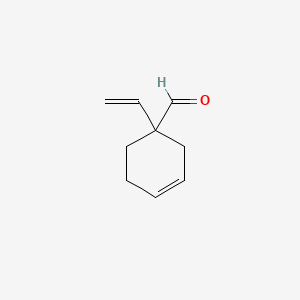
CAS 1049017-63-1PubChem CID 89525526
1-Vinyl-3-cyclohexenecarbaldehyde
- IUPAC name
- 1-ethenylcyclohex-3-ene-1-carbaldehyde
- Molecular formula
- C9H12O
- Molecular weight
- 136.19 g/mol
- Exact mass
- 136.088815002 Da
- XLogP3
- 1.8
- Topological polar surface area
- 17.1 Ų
- Hydrogen-bond donors
- 0
- Hydrogen-bond acceptors
- 1
- Covalent units
- 1
- Defined stereocentres
- 0
Also known as
3GE3UVI0MT1-vinylcyclohex-3-enecarbaldehyde3-CYCLOHEXENE-1-CARBOXALDEHYDE, 1-ETHENYL-1-Ethenyl-3-cyclohexene-1-carboxaldehydeFEMA NO. 4783, 1-RefChem:436891UNII-3GE3UVI0MT1-vinylcyclohex-3-ene carbaldehyde
External database identifiers
- EPA DTXSID:DTXSID10889262
Evidence from additional scientific databases
NIH PubChem PUG-View
Exact identifier match89525526
Attributed physical-property, hazard, environmental and use annotations.
- Signal: Warning Source: European Chemicals Agency (ECHA)
- GHS Hazard Statements: H226 (100%): Flammable liquid and vapor [Warning Flammable liquids]; H315 (100%): Causes skin irritation [Warning Skin corrosion/irritation]; H317 (100%): May cause an allergic skin reaction [Warning Sensitization, Skin]; H319 (100%): Causes serious eye irritation [Warning Serious eye damage/eye irritation]; H411 (100%): Toxic to aquatic life with long lasting effects [Hazardous to the aquatic environment, long-term hazard] Source: European Chemicals Agency (ECHA)
- Precautionary Statement Codes: P210, P233, P240, P241, P242, P243, P261, P264, P264+P265, P272, P273, P280, P302+P352, P303+P361+P353, P305+P351+P338, P321, P332+P317, P333+P317, P337+P317, P362+P364, P370+P378, P391, P403+P235, and P501 (click each P-code to see the statement) Source: European Chemicals Agency (ECHA)
- ECHA C&L Notifications Summary: Aggregated GHS information provided per 1286 reports by companies from 1 notifications to the ECHA C&L Inventory. Each notification may be associated with multiple companies.; Information may vary between notifications depending on impurities, additives, and other factors. The percentage value in parenthesis indicates the notified classification ratio from companies that provide hazard codes. Only hazard codes with percentage values above 10% are shown. For more detailed information, please visit ECHA C&L website. Source: European Chemicals Agency (ECHA)
- Toxicity Summary: The existing information was reviewed by the independent Expert Panel for Fragrance Safety and supports the use of 3-Cyclohexene-1-carboxaldehyde, 1-ethenyl- as described in this safety assessment. Data show that 3-cyclohexene-1-carboxaldehyde, 1-ethenyl- is not genotoxic and provide a calculated Margin of Exposure (MOE) > 100 for the repeated dose toxicity endpoint. The reproductive and local respiratory toxicity endpoints were evaluated using The Threshold of Toxicological Concern (TTC) for a Cramer Class I material, and the exposure is below the TTC (0.03 mg/kg/day and 1.4 mg/day, respectively). Data provided a No Expected Sensitization Induction Level (NESIL) of 1000 μg/cm2 for the skin sensitization endpoint. 3-cyclohexene-1-carboxaldehyde, 1-ethenyl- is not expected to be phototoxic/photoallergenic based on the ultraviolet/visible (UV/Vis) spectra. Source: Pertti (Bert) Hakkinen's Toxicology and Other Annotations
Mapped by: Existing checksum-valid CAS to unique PubChem CID match. Retrieved: 2026-08-31. Open source record
Scientific classifications and hazard annotations provide context and do not replace the market-specific regulatory decision shown above.
Additional source coverage and match status
| Source | Result | Checked |
|---|---|---|
| EMBL-EBI ChEBI | No exact record | 2026-08-31 |
| NIH PubChem PUG-View | Exact match | 2026-08-31 |
A recorded no-match is useful evidence that the source was checked; it is not a claim that the substance does not exist elsewhere.
Retrieved from NIH PubChem on 2026-08-31 by checksum-valid CAS matching. Chemical properties do not replace the regulatory decision on this page.