
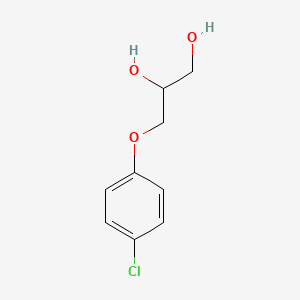
Chlorphenesin
Chlorphenesin is glycerol in which the hydrogen of one of the primary hydroxy groups is substituted by a 4-chlorophenyl group. It has antifungal and antibacterial properties, and is used for treatment of cutaneous and vaginal infections. Its 1-carbamate is used as a skeletal muscle relaxant for the treatment of painful muscle spasm. It has a role as an antibacterial drug, a muscle relaxant and an antifungal drug. It is a glycol, a member of propane-1,2-diols and a member of monochlorobenzenes. — ChEBI
- IUPAC name
- 3-(4-chlorophenoxy)propane-1,2-diol
- Molecular formula
- C9H11ClO3
- Molecular weight
- 202.63 g/mol
- Exact mass
- 202.0396719 Da
- XLogP3
- 1.2
- Topological polar surface area
- 49.7 Ų
- Hydrogen-bond donors
- 2
- Hydrogen-bond acceptors
- 3
- Covalent units
- 1
- Defined stereocentres
- 0
Also known as
16 more reported names
External database identifiers
- ChEBI:CHEBI:3642
- ChEMBL:CHEMBL388751
- EPA DTXSID:DTXSID0049028
- PubMed:6503049
- PubMed:4105542
- PubMed:3074423
Evidence from additional scientific databases
EMBL-EBI ChEBI
chlorphenesin
Glycerol in which the hydrogen of one of the primary hydroxy groups is substituted by a 4-chlorophenyl group. It has antifungal and antibacterial properties, and is used for treatment of cutaneous and vaginal infections. Its 1-carbamate is used as a skeletal muscle relaxant for the treatment of painful muscle spasm.
- Formula
- C9H11ClO3
- Average mass
- 202.637 g/mol
- Monoisotopic mass
- 202.03967 Da
- Formal charge
- 0
- monochlorobenzenes — is a (CHEBI:83403)
- glycol — is a (CHEBI:13643)
- propane-1,2-diols — is a (CHEBI:26284)
- antifungal drug — has role (CHEBI:86327)
- muscle relaxant — has role (CHEBI:51371)
- antibacterial drug — has role (CHEBI:36047)
- antifungal drug — has role (CHEBI:86327)
- muscle relaxant — has role (CHEBI:51371)
- antibacterial drug — has role (CHEBI:36047)
- monochlorobenzenes — is a (CHEBI:83403)
- glycol — is a (CHEBI:13643)
- propane-1,2-diols — is a (CHEBI:26284)
- 17178228 Source: PubMed
Additional curated names
Cross-references from this source
Mapped by: Exact CAS cross-reference in the ChEBI compound record. Source updated: 2015-07-09. Retrieved: 2026-08-31. Open source record
NIH PubChem PUG-View
Attributed physical-property, hazard, environmental and use annotations.
- LogP: 1.2 Source: DrugBank
- LogP: 1.2 Source: Human Metabolome Database (HMDB)
- Melting Point: 86–92 Source: DrugBank
- Melting Point: 78 °C Source: Human Metabolome Database (HMDB)
- Physical Description: Solid Source: Human Metabolome Database (HMDB)
- Solubility: 10000 mg/L Source: DrugBank
- Solubility: 1.04e+01 g/L Source: Human Metabolome Database (HMDB)
- Signal: Danger Source: European Chemicals Agency (ECHA)
- GHS Hazard Statements: H302 (30.6%): Harmful if swallowed [Warning Acute toxicity, oral]; H315 (84.1%): Causes skin irritation [Warning Skin corrosion/irritation]; H318 (13.3%): Causes serious eye damage [Danger Serious eye damage/eye irritation]; H319 (69.7%): Causes serious eye irritation [Warning Serious eye damage/eye irritation]; H332 (10.8%): Harmful if inhaled [Warning Acute toxicity, inhalation]; H335 (35.1%): May cause respiratory irritation [Warning Specific target organ toxicity, single exposure; Respiratory tract irritation] Source: European Chemicals Agency (ECHA)
- Precautionary Statement Codes: P261, P264, P264+P265, P270, P271, P280, P301+P317, P302+P352, P304+P340, P305+P351+P338, P305+P354+P338, P317, P319, P321, P330, P332+P317, P337+P317, P362+P364, P403+P233, P405, and P501 (click each P-code to see the statement) Source: European Chemicals Agency (ECHA)
- ECHA C&L Notifications Summary: Aggregated GHS information provided per 353 reports by companies from 14 notifications to the ECHA C&L Inventory. Each notification may be associated with multiple companies.; Information may vary between notifications depending on impurities, additives, and other factors. The percentage value in parenthesis indicates the notified classification ratio from companies that provide hazard codes. Only hazard codes with percentage values above 10% are shown. For more detailed information, please visit ECHA C&L website. Source: European Chemicals Agency (ECHA)
- Cosmetic Ingredient Review Finding(s): Safe in the present practices of use and concentration. Ingredient, concentration, and use information are available in documents discoverable at https://cir-reports.cir-safety.org Source: Cosmetic Ingredient Review (CIR)
- Cosmetic Ingredient Review Link: CIR ingredient: Chlorphenesin Source: Cosmetic Ingredient Review (CIR)
Mapped by: Existing checksum-valid CAS to unique PubChem CID match. Retrieved: 2026-08-31. Open source record
Scientific classifications and hazard annotations provide context and do not replace the market-specific regulatory decision shown above.
Additional source coverage and match status
| Source | Result | Checked |
|---|---|---|
| EMBL-EBI ChEBI | Exact match | 2026-08-31 |
| NIH PubChem PUG-View | Exact match | 2026-08-31 |
A recorded no-match is useful evidence that the source was checked; it is not a claim that the substance does not exist elsewhere.
Retrieved from NIH PubChem on 2026-09-02 by checksum-valid CAS matching. Chemical properties do not replace the regulatory decision on this page.