
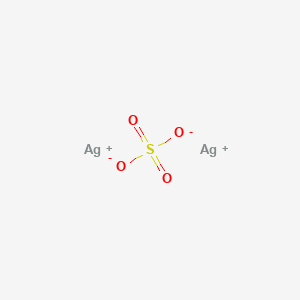
Silver sulfate
Silver sulfate is an odorless white to gray solid. Sinks and mixes with water. (USCG, 1999) — CAMEO Chemicals
- IUPAC name
- disilver;sulfate
- Molecular formula
- Ag2O4S
- Molecular weight
- 311.80 g/mol
- Exact mass
- 311.76158 Da
- Topological polar surface area
- 88.6 Ų
- Hydrogen-bond donors
- 0
- Hydrogen-bond acceptors
- 4
- Covalent units
- 3
- Defined stereocentres
- 0
Also known as
16 more reported names
External database identifiers
- EPA DTXSID:DTXSID70172884
Evidence from additional scientific databases
NIH PubChem PUG-View
Attributed physical-property, hazard, environmental and use annotations.
- Density: 5.45 at 68 °F (USCG, 1999) - Denser than water; will sink Source: CAMEO Chemicals
- Physical Description: Silver sulfate is an odorless white to gray solid. Sinks and mixes with water. (USCG, 1999) Source: CAMEO Chemicals
- Physical Description: Colorless lustrous solid; Turns gray on light exposure; [Hawley] White to gray odorless solid; [CAMEO] Fine white crystals; [MSDSonline] Fairly soluble in water; [Ullmann] Source: Haz-Map, Information on Hazardous Chemicals and Occupational Diseases
- Carcinogen Classification: No indication of carcinogenicity to humans (not listed by IARC). Source: Toxin and Toxin Target Database (T3DB)
- Exposure Routes: Oral (L808) ; inhalation (L808) ; dermal (L808) Source: Toxin and Toxin Target Database (T3DB)
- First Aid: INHALATION: move to fresh air.; INGESTION: give large amount of water; induce vomiting;; EYES: flush with water for at least 15 min.; SKIN: flush with water; wash with soap and water. (USCG, 1999) Source: CAMEO Chemicals
- Note: This chemical does not meet GHS hazard criteria for 1.3% (3 of 231) of reports. Source: European Chemicals Agency (ECHA)
- Signal: Danger Source: European Chemicals Agency (ECHA)
- GHS Hazard Statements: H318 (98.3%): Causes serious eye damage [Danger Serious eye damage/eye irritation]; H400 (91.8%): Very toxic to aquatic life [Warning Hazardous to the aquatic environment, acute hazard]; H410 (91.8%): Very toxic to aquatic life with long lasting effects [Warning Hazardous to the aquatic environment, long-term hazard] Source: European Chemicals Agency (ECHA)
- Precautionary Statement Codes: P264+P265, P273, P280, P305+P354+P338, P317, P391, and P501 (click each P-code to see the statement) Source: European Chemicals Agency (ECHA)
- ECHA C&L Notifications Summary: Aggregated GHS information provided per 231 reports by companies from 15 notifications to the ECHA C&L Inventory. Each notification may be associated with multiple companies.; Reported as not meeting GHS hazard criteria per 3 of 231 reports by companies.; There are 14 notifications provided by 228 of 231 reports by companies with hazard statement code(s).; Information may vary between notifications depending on impurities, additives, and other factors. The percentage value in parenthesis indicates the notified classification ratio from companies that provide hazard codes. Only hazard codes with percentage values above 10% are shown. For more detailed information, please visit ECHA C&L website. Source: European Chemicals Agency (ECHA)
- GHS Hazard Statements: Not Classified Source: NITE-CMC
- Health Effects: Silver itself is not toxic to humans, but most silver salts are. In large doses, silver and compounds containing it can be absorbed into the circulatory system and become deposited in various body tissues, leading to argyria, which results in a blue-grayish pigmentation of the skin, eyes, and mucous membranes. Argyria is rare, and although, so far as known, this condition does not otherwise harm a person's health, it is disfiguring and usually permanent. Mild forms of argyria are sometimes mistaken for cyanosis. (L809) Source: Toxin and Toxin Target Database (T3DB)
- Toxicity Summary: Metallic silver is oxidized and may deposit in the tissues, causing arygria. The silver ion is known to inhibit glutathione peroxidase and NA+,K+-ATPase activity, disrupting selenium-catalyzed sulfhydryl oxidation-reduction reactions and intracellular ion concentrations, respectively. Silver nanoparticles are believed to disrupt the mitochondrial respiratory chain, causing oxidative stress, reduced ATP synthesis, and DNA damage. (L808, A243, A244, A245, A246) Source: Toxin and Toxin Target Database (T3DB)
- Sources/Uses: Used as lab reagent; [Hawley] Source: Haz-Map, Information on Hazardous Chemicals and Occupational Diseases
- Uses: Silver sulfate is used in silver plating. (L828) Source: Toxin and Toxin Target Database (T3DB)
Mapped by: Existing checksum-valid CAS to unique PubChem CID match. Retrieved: 2026-08-31. Open source record
Scientific classifications and hazard annotations provide context and do not replace the market-specific regulatory decision shown above.
Additional source coverage and match status
| Source | Result | Checked |
|---|---|---|
| EMBL-EBI ChEBI | No exact record | 2026-08-31 |
| NIH PubChem PUG-View | Exact match | 2026-08-31 |
A recorded no-match is useful evidence that the source was checked; it is not a claim that the substance does not exist elsewhere.
Retrieved from NIH PubChem on 2026-09-02 by checksum-valid CAS matching. Chemical properties do not replace the regulatory decision on this page.