
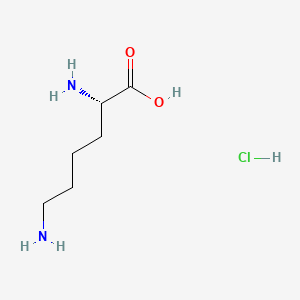
CAS 10098-89-2PubChem CID 69568
L-Lysine monohydrochloride
L-lysine hydrochloride is the hydrochloride salt of L-lysine. It contains a L-lysine. — ChEBI
- IUPAC name
- (2S)-2,6-diaminohexanoic acid;hydrochloride
- Molecular formula
- C6H15ClN2O2
- Molecular weight
- 182.65 g/mol
- Exact mass
- 182.0822054 Da
- Topological polar surface area
- 89.3 Ų
- Hydrogen-bond donors
- 4
- Hydrogen-bond acceptors
- 4
- Covalent units
- 2
- Defined stereocentres
- 1
Also known as
L-Lysine hydrochloride657-27-2lysine hydrochlorideL-Lysine, monohydrochlorideL-(+)-Lysine MonohydrochlorideLysine hcl, l-JNJ23Q2COMLysine, l-, monohydrochloride
16 more reported names
NSC-9253CHEBI:53633TrulysineVIRALYSENISYL-FRefChem:55525(2S)-2,6-Diaminohexanoic acid monohydrochloride211-519-9L-lysine HClH-Lys-OH.HCl(S)-2,6-Diaminohexanoic acid hydrochlorideLysine HClL-Lysine monohydrocholorideLysine monohydrochlorideLyamine(2S)-2,6-diaminohexanoic acid hydrochloride
External database identifiers
- ChEBI:CHEBI:53633
- ChEMBL:CHEMBL2105886
- EPA DTXSID:DTXSID9029198
- PubMed:5780
Evidence from additional scientific databases
NIH PubChem PUG-View
Exact identifier match69568
Attributed physical-property, hazard, environmental and use annotations.
- Physical Description: Dry Powder Source: EPA Chemical Data Reporting (CDR)
- Physical Description: Solid; [Merck Index] White powder; [Sigma-Aldrich MSDS] Source: Haz-Map, Information on Hazardous Chemicals and Occupational Diseases
- Note: This chemical does not meet GHS hazard criteria for 100% (343 of 343) of all reports. Source: European Chemicals Agency (ECHA)
- GHS Hazard Statements: Not Classified; Reported as not meeting GHS hazard criteria by 343 of 343 companies. For more detailed information, please visit ECHA C&L website. Source: European Chemicals Agency (ECHA)
- ECHA C&L Notifications Summary: Aggregated GHS information provided per 343 reports by companies from 2 notifications to the ECHA C&L Inventory.; Reported as not meeting GHS hazard criteria per 343 of 343 reports by companies.; There are 0 notifications provided by 0 of 343 reports by companies with hazard statement code(s).; Information may vary between notifications depending on impurities, additives, and other factors. The percentage value in parenthesis indicates the notified classification ratio from companies that provide hazard codes. Only hazard codes with percentage values above 10% are shown. For more detailed information, please visit ECHA C&L website. Source: European Chemicals Agency (ECHA)
- Cosmetic Ingredient Review Finding(s): Safe in the present practices of use and concentration. Ingredient, concentration, and use information are available in documents discoverable at https://cir-reports.cir-safety.org Source: Cosmetic Ingredient Review (CIR)
- Consumer Uses: Catalyst Source: EPA Chemical Data Reporting (CDR)
- Industry Uses: Catalyst Source: EPA Chemical Data Reporting (CDR)
- Cosmetic Ingredient Review Link: CIR ingredient: Lysine HCl Source: Cosmetic Ingredient Review (CIR)
- Sources/Uses: An essential amino acid; Added to cereals and feeds; [Merck Index] Source: Haz-Map, Information on Hazardous Chemicals and Occupational Diseases
- Industrial Processes with risk of exposure: Farming (Feed Additives) [Category: Industry] Source: Haz-Map, Information on Hazardous Chemicals and Occupational Diseases
Mapped by: Existing checksum-valid CAS to unique PubChem CID match. Retrieved: 2026-08-31. Open source record
Scientific classifications and hazard annotations provide context and do not replace the market-specific regulatory decision shown above.
Additional source coverage and match status
| Source | Result | Checked |
|---|---|---|
| EMBL-EBI ChEBI | No exact record | 2026-08-31 |
| NIH PubChem PUG-View | Exact match | 2026-08-31 |
A recorded no-match is useful evidence that the source was checked; it is not a claim that the substance does not exist elsewhere.
Retrieved from NIH PubChem on 2026-08-31 by checksum-valid CAS matching. Chemical properties do not replace the regulatory decision on this page.