
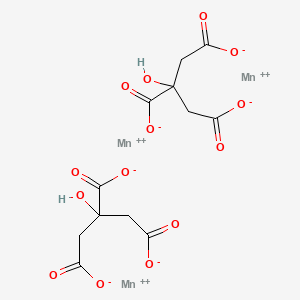
Manganese Citrate
Manganese citrate is a chemical compound of manganese. Manganese is a naturally occurring metal with the symbol Mn and the atomic number 25. It does not occur naturally in its pure form, but is found in many types of rocks in combination with other substances such as oxygen, sulfur, or chlorine. Manganese occurs naturally in most foods and small amounts are needed to stay healthy, as manganese ions act as cofactors for a number of enzymes. (L228, L229) — Toxin and Toxin Target Database (T3DB)
- IUPAC name
- bis(2-hydroxypropane-1,2,3-tricarboxylate);tris(manganese(2+))
- Molecular formula
- C12H10Mn3O14
- Molecular weight
- 543.01 g/mol
- Exact mass
- 542.821184 Da
- Topological polar surface area
- 281.0 Ų
- Hydrogen-bond donors
- 2
- Hydrogen-bond acceptors
- 14
- Covalent units
- 5
- Defined stereocentres
- 0
Also known as
16 more reported names
External database identifiers
- EPA DTXSID:DTXSID301360797
- EPA DTXSID:DTXSID6047496
Evidence from additional scientific databases
NIH PubChem PUG-View
Attributed physical-property, hazard, environmental and use annotations.
- Color/Form: White powder Source: Hazardous Substances Data Bank (HSDB)
- Physical Description: White solid; [Hawley] Source: Haz-Map, Information on Hazardous Chemicals and Occupational Diseases
- Solubility: Soluble in water in presence of sodium citrate Source: Hazardous Substances Data Bank (HSDB)
- Carcinogen Classification: No indication of carcinogenicity to humans (not listed by IARC). Source: Toxin and Toxin Target Database (T3DB)
- Exposure Routes: Oral (L228) ; inhalation (L228) Source: Toxin and Toxin Target Database (T3DB)
- GHS Hazard Statements: Not Classified; Reported as not meeting GHS hazard criteria by 1 of 1 companies. For more detailed information, please visit ECHA C&L website. Source: European Chemicals Agency (ECHA)
- Health Effects: Manganese mainly affects the nervous system and may cause behavioral changes and other nervous system effects, which include movements that may become slow and clumsy. This combination of symptoms when sufficiently severe is referred to as Source: Toxin and Toxin Target Database (T3DB)
- Cosmetic Ingredient Review Finding(s): Safe in the present practices of use and concentration. Ingredient, concentration, and use information are available in documents discoverable at https://cir-reports.cir-safety.org Source: Cosmetic Ingredient Review (CIR)
- Toxicity Summary: Manganese is a cellular toxicant that can impair transport systems, enzyme activities, and receptor functions. It primarily targets the central nervous system, particularily the globus pallidus of the basal ganglia. It is believed that the manganese ion, Mn(II), enhances the autoxidation or turnover of various intracellular catecholamines, leading to increased production of free radicals, reactive oxygen species, and other cytotoxic metabolites, along with a depletion of cellular antioxidant defense mechanisms, leading to oxidative damage and selective destruction of dopaminergic neurons. In addition to dopamine, manganese is thought to perturbations other neurotransmitters, such as GABA and glutamate. In order to produce oxidative damage, manganese must first overwhelm the antioxidant enzyme manganese superoxide dismutase. The neurotoxicity of Mn(II) has also been linked to its ability to substitute for Ca(II) under physiological conditions. It can enter mitochondria via the calcium uniporter and inhibit mitochondrial oxidative phosphorylation. It may also inhibit the efflux of Ca(II), which can result in a loss of mitochondrial membrane integrity. Mn(II) has been shown to inhibit Source: Toxin and Toxin Target Database (T3DB)
- Cosmetic Ingredient Review Link: CIR ingredient: Manganese Citrate Source: Cosmetic Ingredient Review (CIR)
- Sources/Uses: Used as feed and food additive and dietary supplement; [Hawley] Source: Haz-Map, Information on Hazardous Chemicals and Occupational Diseases
- Industrial Processes with risk of exposure: Farming (Feed Additives) [Category: Industry] Source: Haz-Map, Information on Hazardous Chemicals and Occupational Diseases
- Uses: Feed additive, food additive, and dietary supplement Source: Hazardous Substances Data Bank (HSDB)
Mapped by: Existing checksum-valid CAS to unique PubChem CID match. Retrieved: 2026-08-31. Open source record
Scientific classifications and hazard annotations provide context and do not replace the market-specific regulatory decision shown above.
Additional source coverage and match status
| Source | Result | Checked |
|---|---|---|
| EMBL-EBI ChEBI | No exact record | 2026-08-31 |
| NIH PubChem PUG-View | Exact match | 2026-08-31 |
A recorded no-match is useful evidence that the source was checked; it is not a claim that the substance does not exist elsewhere.
Retrieved from NIH PubChem on 2026-08-31 by checksum-valid CAS matching. Chemical properties do not replace the regulatory decision on this page.