
Cadmium nitrate; cadmium dinitrate
Cadmium nitrate; cadmium dinitrate is listed in Annex II as a prohibited substance for cosmetic products placed on the EU market.
Chemical identity and properties
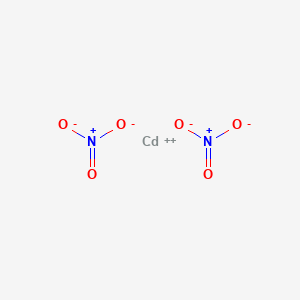
Cadmium Nitrate
Cadmium nitrate is an inorganic nitrate salt having Cd(2+) as the counterion. It has a role as a genotoxin, a carcinogenic agent and a hepatotoxic agent. It is a cadmium salt and an inorganic nitrate salt. It contains a cadmium(2+). — ChEBI
- IUPAC name
- cadmium(2+) dinitrate
- Molecular formula
- CdN2O6
- Molecular weight
- 236.42 g/mol
- Exact mass
- 237.879001 Da
- Topological polar surface area
- 126.0 Ų
- Hydrogen-bond donors
- 0
- Hydrogen-bond acceptors
- 6
- Covalent units
- 3
- Defined stereocentres
- 0
Also known as
14 more reported names
External database identifiers
- ChEBI:CHEBI:77732
Evidence from additional scientific databases
EMBL-EBI ChEBI
cadmium nitrate
An inorganic nitrate salt having Cd(2+) as the counterion.
- Formula
- Cd.2NO3
- Average mass
- 236.420 g/mol
- Monoisotopic mass
- 237.87899 Da
- Formal charge
- 0
- cadmium salt — is a (CHEBI:50293)
- inorganic nitrate salt — is a (CHEBI:51084)
- carcinogenic agent — has role (CHEBI:50903)
- hepatotoxic agent — has role (CHEBI:50908)
- genotoxin — has role (CHEBI:50902)
- cadmium(2+) — has part (CHEBI:48775)
- carcinogenic agent — has role (CHEBI:50903)
- hepatotoxic agent — has role (CHEBI:50908)
- genotoxin — has role (CHEBI:50902)
- cadmium salt — is a (CHEBI:50293)
- inorganic nitrate salt — is a (CHEBI:51084)
Additional curated names
Cross-references from this source
- CAS: 10325-94-7 — ChemIDplus
- REGISTRY_NUMBER: 8156730 — Reaxys
- MANUAL_X_REF: Cadmium_nitrate — Wikipedia
Mapped by: Exact CAS cross-reference in the ChEBI compound record. Source updated: 2015-06-24. Retrieved: 2026-08-31. Open source record
NIH PubChem PUG-View
Attributed physical-property, hazard, environmental and use annotations.
- Boiling Point: 132 °C @760 [mm Hg] Source: PAC Chemical Database, U.S. Department of Energy
- Color/Form: White cubic crystals Source: Hazardous Substances Data Bank (HSDB)
- Color/Form: White, amorphous pieces or hygroscopic needles Source: Hazardous Substances Data Bank (HSDB)
- Color/Form: White, prismatic needles Source: Hazardous Substances Data Bank (HSDB)
- Density: 2.45 at 68 °F (USCG, 1999) - Denser than water; will sink Source: CAMEO Chemicals
- Density: 3.6 g/cu cm Source: Hazardous Substances Data Bank (HSDB)
- Density: 3.6 @25 °C Source: PAC Chemical Database, U.S. Department of Energy
- Melting Point: 138 °F (USCG, 1999) Source: CAMEO Chemicals
- Melting Point: 360 °C Source: Hazardous Substances Data Bank (HSDB)
- Melting Point: 360 °C Source: PAC Chemical Database, U.S. Department of Energy
- Physical Description: Cadmium nitrate is an odorless white solid. Sinks in water. (USCG, 1999) Source: CAMEO Chemicals
- Physical Description: White solid; [HSDB] White odorless crystals; [MSDSonline] There are 3 hydrates that form at temperatures <56 deg C; [Ullmann] Source: Haz-Map, Information on Hazardous Chemicals and Occupational Diseases
- Solubility: Soluble in ammonia, alcohol Source: Hazardous Substances Data Bank (HSDB)
- Solubility: Sol in ethanol Source: Hazardous Substances Data Bank (HSDB)
- Solubility: Soluble in ether, acetone Source: Hazardous Substances Data Bank (HSDB)
- Solubility: In water, 156 g/100 g water at 25 °C Source: Hazardous Substances Data Bank (HSDB)
- Carcinogen Classification: 1, carcinogenic to humans. (L135) Source: Toxin and Toxin Target Database (T3DB)
- Exposure Routes: Oral (L6) ; inhalation (L6) ; dermal (L6) Source: Toxin and Toxin Target Database (T3DB)
- First Aid: INHALATION: remove patient to fresh air; seek medical attention.; INGESTION: give large amounts of water and induce vomiting; give milk or egg whites; seek medical attention.; EYES: flush with copious amounts of water for 15 min.; consult a physician.; SKIN: wash with soap and water. (USCG, 1999) Source: CAMEO Chemicals
- Signal: Danger Source: Regulation (EC) No 1272/2008 of the European Parliament and of the Council
- GHS Hazard Statements: H302: Harmful if swallowed [Warning Acute toxicity, oral]; H312: Harmful in contact with skin [Warning Acute toxicity, dermal]; H332: Harmful if inhaled [Warning Acute toxicity, inhalation]; H340: May cause genetic defects [Danger Germ cell mutagenicity]; H350: May cause cancer [Danger Carcinogenicity]; H372: Causes damage to organs through prolonged or repeated exposure [Danger Specific target organ toxicity, repeated exposure]; H400: Very toxic to aquatic life [Warning Hazardous to the aquatic environment, acute hazard]; H410: Very toxic to aquatic life with long lasting effects [Warning Hazardous to the aquatic environment, long-term hazard] Source: Regulation (EC) No 1272/2008 of the European Parliament and of the Council
- Precautionary Statement Codes: P203, P260, P261, P264, P270, P271, P273, P280, P301+P317, P302+P352, P304+P340, P317, P318, P319, P321, P330, P362+P364, P391, P405, and P501 (click each P-code to see the statement) Source: Regulation (EC) No 1272/2008 of the European Parliament and of the Council
- Signal: Danger Source: European Chemicals Agency (ECHA)
- GHS Hazard Statements: H301 (90%): Toxic if swallowed [Danger Acute toxicity, oral]; H302+H312+H332 (31.4%): Harmful if swallowed, in contact with skin or if inhaled [Warning Acute toxicity, oral; acute toxicity, dermal; acute toxicity, inhalation]; H302 (10%): Harmful if swallowed [Warning Acute toxicity, oral]; H312 (42.9%): Harmful in contact with skin [Warning Acute toxicity, dermal]; H330 (90%): Fatal if inhaled [Danger Acute toxicity, inhalation]; H332 (10%): Harmful if inhaled [Warning Acute toxicity, inhalation]; H340 (90%): May cause genetic defects [Danger Germ cell mutagenicity]; H350 (92.9%): May cause cancer [Danger Carcinogenicity]; H360 (88.6%): May damage fertility or the unborn child [Danger Reproductive toxicity]; H372 (90%): Causes damage to organs through prolonged or repeated exposure [Danger Specific target organ toxicity, repeated exposure]; H400 (100%): Very toxic to aquatic life [Warning Hazardous to the aquatic environment, acute hazard]; H410 (100%): Very toxic to aquatic life with long lasting effects [Warning Hazardous to the aquatic environment, long-term hazard] Source: European Chemicals Agency (ECHA)
- Precautionary Statement Codes: P203, P260, P261, P264, P270, P271, P273, P280, P284, P301+P316, P301+P317, P302+P352, P304+P340, P316, P317, P318, P319, P320, P321, P330, P362+P364, P391, P403+P233, P405, and P501 (click each P-code to see the statement) Source: European Chemicals Agency (ECHA)
- ECHA C&L Notifications Summary: Aggregated GHS information provided per 70 reports by companies from 8 notifications to the ECHA C&L Inventory. Each notification may be associated with multiple companies.; Information may vary between notifications depending on impurities, additives, and other factors. The percentage value in parenthesis indicates the notified classification ratio from companies that provide hazard codes. Only hazard codes with percentage values above 10% are shown. For more detailed information, please visit ECHA C&L website. Source: European Chemicals Agency (ECHA)
- Signal: Danger Source: NITE-CMC
- GHS Hazard Statements: H340: May cause genetic defects [Danger Germ cell mutagenicity] Source: NITE-CMC
- Precautionary Statement Codes: P203, P280, P318, P405, and P501 (click each P-code to see the statement) Source: NITE-CMC
- GHS Hazard Statements: H301: Toxic if swallowed [Danger Acute toxicity, oral]; H341: Suspected of causing genetic defects [Warning Germ cell mutagenicity]; H350: May cause cancer [Danger Carcinogenicity]; H361: Suspected of damaging fertility or the unborn child [Warning Reproductive toxicity]; H370: Causes damage to organs [Danger Specific target organ toxicity, single exposure]; H372: Causes damage to organs through prolonged or repeated exposure [Danger Specific target organ toxicity, repeated exposure] Source: NITE-CMC
- Precautionary Statement Codes: P203, P260, P264, P270, P280, P301+P316, P308+P316, P318, P319, P321, P330, P405, and P501 (click each P-code to see the statement) Source: NITE-CMC
- Health Effects: Chronic exposure to cadmium fumes can cause chemical pneumonitis, pulmonary edema, and lung diseases such as bronchitis and emphysema. Cadmium also accumulates in the kidneys, causing permanent damage. Loss of bone density also occurs. Nitrate and nitrite poisoning causes methemoglobinemia. Nitrites may cause pregnancy complications and developmental effects. They may also be carcinogenic. (L1137, L6) Source: Toxin and Toxin Target Database (T3DB)
- Toxicity Summary: Cadmium initially binds to metallothionein and is transported to the kidney. Toxic effects are observed once the concentration of cadmium exceeds that of available metallothionein, and it has also been shown that the cadmium-metallothionein complex may be damaging. Accumulation of cadmium in the kidney results in increased excretion of vital low and high weight molecular proteins. Cadmium is a high affinity zinc analog and can interfere in its biological processes. It also binds to and activates the estrogen receptor, likely stimulating the growth of certain types of cancer cells and causing other estrogenic effects, such as reproductive dysfunction. Cadmium causes cell apoptosis by activating mitogen-activated protein kinases. Nitrate's toxicity is a result of it's conversion to nitrite once in the body. Nitrite causes the autocatalytic oxidation of oxyhemoglobin to hydrogen peroxide and methemoglobin. This elevation of methemoglobin levels is a condition known as methemoglobinemia, and is characterized by tissue hypoxia, as methemoglobin cannot bind oxygen. (A2450, L1613, L8, A18, A19, A28) Source: Toxin and Toxin Target Database (T3DB)
- Environmental Bioconcentration: Salvinia natans (fern) exposed to cadmium nitrate for 21 days exhibited a bioconcentration factor of 960. Source: Hazardous Substances Data Bank (HSDB)
- Environmental Bioconcentration: Mya arenaria, (soft shell clam) exposed to cadmium nitrate for 70 days exhibited a bioconcentration factor of 160. Source: Hazardous Substances Data Bank (HSDB)
- Environmental Bioconcentration: Crassostrea virginica, (American oyster) exposed to cadmium nitrate for 98 days exhibited a bioconcentration factor of 1,220. Source: Hazardous Substances Data Bank (HSDB)
- Environmental Bioconcentration: Lemna valdiviana (duck weed) exposed to cadmium nitrate for 21 days exhibited a bioconcentration factor of 603. Source: Hazardous Substances Data Bank (HSDB)
- Sources/Uses: Used in photographic emulsions, nuclear reactors to control rate of nuclear fission, and glass and ceramic colorants; [HSDB] Used in storage batteries and to make red lusters in glass and porcelain; [Ullmann] Source: Haz-Map, Information on Hazardous Chemicals and Occupational Diseases
- Industrial Processes with risk of exposure: Battery Manufacturing [Category: Industry]; Photographic Processing [Category: Other]; Glass Manufacturing [Category: Industry] Source: Haz-Map, Information on Hazardous Chemicals and Occupational Diseases
- Activities with risk of exposure: Ceramics making [Category: Hobbies] Source: Haz-Map, Information on Hazardous Chemicals and Occupational Diseases
- Uses: In making other cadmium salts; in photographic emulsions. Source: Hazardous Substances Data Bank (HSDB)
- Uses: Oxidation of the sulfide or sulfite under carefully controlled oxidizing atmospheres at high temperature. An alternate method involves treatment of powdered cadmium nitrate, halide, oxide, or carbonate with dimethyl sulfate. Source: Hazardous Substances Data Bank (HSDB)
- Uses: The use of cadmium soaps as components of PVC stabilizers is decreasing because of their toxic properties. Solid PVC stabilizers contain cadmium soaps of saturated fatty acids, whereas liquid stabilizers contain soaps of unsaturated or branched, short-chain fatty acids. The soaps act as heat and light stabilizers, and soaps of saturated fatty acids are used as lubricants in the processing of PVC. Unlike other metallic soaps used in the PVC sector, cadmium soaps do not affect transparency and are suitable for hard, transparent PVC products. However, for safety reason their use is nowadays being replaced by mixtures of calcium-zinc stearate plus other stabilizers. /Cadmium metallic soaps/ Source: Hazardous Substances Data Bank (HSDB)
- Uses: Production of red lusters in glass and porcelain and in cadmium-nickel sinter plates of storage batteries. Source: Hazardous Substances Data Bank (HSDB)
- Uses: For more Uses (Complete) data for CADMIUM NITRATE (6 total), please visit the HSDB record page. Source: Hazardous Substances Data Bank (HSDB)
- Uses: Cadmium nitrate is used mainly to prepare other cadmium salts. It is also used for coloring glass and porcelain and as a flash powder in photography. (L450) Source: Toxin and Toxin Target Database (T3DB)
Mapped by: Existing checksum-valid CAS to unique PubChem CID match. Retrieved: 2026-08-31. Open source record
Scientific classifications and hazard annotations provide context and do not replace the market-specific regulatory decision shown above.
Additional source coverage and match status
| Source | Result | Checked |
|---|---|---|
| EMBL-EBI ChEBI | Exact match | 2026-08-31 |
| NIH PubChem PUG-View | Exact match | 2026-08-31 |
A recorded no-match is useful evidence that the source was checked; it is not a claim that the substance does not exist elsewhere.
Retrieved from NIH PubChem on 2026-09-02 by checksum-valid CAS matching. Chemical properties do not replace the regulatory decision on this page.
Record details
Chemical name
Cadmium nitrate; cadmium dinitrate
Chemical / IUPAC name
Cadmium nitrate; cadmium dinitrate
Regulatory information
CMR
| Category | Carcinogenic | Mutagenic | Reprotoxic |
|---|---|---|---|
| Cat. 1B | ✓ | ✓ | — |
Key data
Related records for Cadmium nitrate; cadmium dinitrate
Direct matches are limited for this record, so nearby entries from Annex II are shown as well.
Cadmium hydroxide; cadmium dihydroxide
Dibutyltin dilaurate; dibutyl[bis(dodecanoyloxy)] stannane
Clorofene; chlorophene; 2-benzyl-4-chlorophenol
Anthraquinone; 9,10-anthraquinone
Cyproconazole (ISO); (2RS,3RS;2RS,3SR)-2-(4-chlorophenyl)-3-cyclopropyl-1-(1H-1,2,4-triazol-1-yl)bu…
Nonadecafluorodecanoic acid [1]; Ammonium nonadecafluorodecanoate [2]; Sodium nonadecafluorodecanoa…
N,N'-Methylenedimorpholine; N,N'-methylenebismorpholine; [formaldehyde released from N,N'-Methylene…
Spiroxamine (ISO); 8-tert-butyl-1,4-dioxaspirol[4.5]decan-2-ylmethyl(ethyl)(propyl)amine
Reaction products of paraformaldehyde with 2-hydroxypropylamine (3:2); [formaldehyde released from …
What Annex II means for Cadmium nitrate; cadmium dinitrate
Cadmium nitrate; cadmium dinitrate is listed as a prohibited substance under Annex II of EU Cosmetics Regulation 1223/2009 and must not be intentionally added. Article 17 separately addresses unintended small quantities that are technically unavoidable under good manufacturing practice and compatible with the Article 3 safety requirement.
Formulators must screen their ingredients and raw materials to ensure none contain this substance. Suppliers should provide documentation confirming absence when requested.
The page also surfaces 12 related annex records with overlapping identifiers, annex logic or naming patterns.
Compliance checklist
- Verify this substance is absent from all raw materials and finished formulations.
- Request absence confirmation or CoA from raw material suppliers.
- Document the screening result in the Product Information File (PIF).
- This substance has CMR classification. Review the CMR table above and verify current Annex II/III status before use.
Frequently asked questions
Source note for Annex II record Cadmium nitrate; cadmium dinitrate
This page summarizes one Annex II record for Cadmium nitrate; cadmium dinitrate from public European Commission cosmetic materials and adds linked inventory or identifier matches when available.
Use this record page to review Annex II conditions for Cadmium nitrate; cadmium dinitrate, but confirm any final regulatory decision against the current official annex wording and source files.
Tools & next steps
Check your formula
Paste a full INCI list to detect Cadmium nitrate; cadmium dinitrate and other flagged EU annex records in one pass.
INCI CheckerCompare entries
Compare Cadmium nitrate; cadmium dinitrate side by side with another annex record to review differences in restrictions, concentrations and annex placement.
CompareBrowse the annex
See all records in Annex II and compare regulatory conditions across substances in this annex.
Open Annex II