
4,4'-Oxydianiline (p-aminophenyl ether) and its salts
4,4'-Oxydianiline (p-aminophenyl ether) and its salts is listed in Annex II as a prohibited substance for cosmetic products placed on the EU market.
Chemical identity and properties
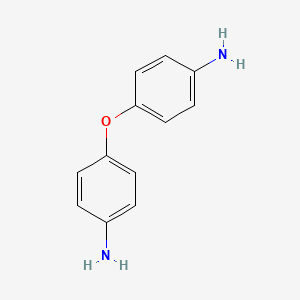
4,4'-Diaminodiphenyl Ether
4-Aminophenyl ether is an aromatic ether. — ChEBI
- IUPAC name
- 4-(4-aminophenoxy)aniline
- Molecular formula
- C12H12N2O
- Molecular weight
- 200.24 g/mol
- Exact mass
- 200.094963011 Da
- XLogP3
- 1.4
- Topological polar surface area
- 61.3 Ų
- Hydrogen-bond donors
- 2
- Hydrogen-bond acceptors
- 3
- Covalent units
- 1
- Defined stereocentres
- 0
Also known as
16 more reported names
External database identifiers
- ChEBI:CHEBI:34384
- ChEMBL:CHEMBL354663
- EPA DTXSID:DTXSID0021094
- PubMed:22751261
- PubMed:22435290
- PubMed:22233638
- PubMed:22160135
- PubMed:21860525
- PubMed:21754434
- PubMed:21754087
- PubMed:21752381
- PubMed:21730539
- PubMed:21582198
- PubMed:21577659
- PubMed:21202654
Evidence from additional scientific databases
EMBL-EBI ChEBI
4-Aminophenyl ether
- Formula
- C12H12N2O
- Average mass
- 200.241 g/mol
- Monoisotopic mass
- 200.09496 Da
- Formal charge
- 0
- aromatic ether — is a (CHEBI:35618)
- aromatic ether — is a (CHEBI:35618)
Additional curated names
Cross-references from this source
- CAS: 101-80-4 — KEGG COMPOUND
- MANUAL_X_REF: C14759 — KEGG COMPOUND
Mapped by: Exact CAS cross-reference in the ChEBI compound record. Source updated: 2015-01-19. Retrieved: 2026-08-31. Open source record
NIH PubChem PUG-View
Attributed physical-property, hazard, environmental and use annotations.
- Autoignition Temperature: 914 °F (NTP, 1992) Source: CAMEO Chemicals
- Autoignition Temperature: 490 °C Source: Hazardous Substances Data Bank (HSDB)
- Boiling Point: Sublimes (NTP, 1992) Source: CAMEO Chemicals
- Boiling Point: >300 °C Source: Hazardous Substances Data Bank (HSDB)
- Color/Form: Colorless crystals Source: Hazardous Substances Data Bank (HSDB)
- Flash Point: 426 °F (NTP, 1992) Source: CAMEO Chemicals
- Flash Point: 219 °C Source: Haz-Map, Information on Hazardous Chemicals and Occupational Diseases
- Flash Point: 219 °C (closed cup) Source: Hazardous Substances Data Bank (HSDB)
- LogP: log Kow = 1.36 Source: Hazardous Substances Data Bank (HSDB)
- Melting Point: 367 to 369 °F (NTP, 1992) Source: CAMEO Chemicals
- Melting Point: 189 °C (decomposes Source: Hazardous Substances Data Bank (HSDB)
- Melting Point: 187 °C Source: PAC Chemical Database, U.S. Department of Energy
- Physical Description: 4,4'-diaminodiphenyl ether appears as odorless colorless crystals or an odorless fine, beige powder. (NTP, 1992) Source: CAMEO Chemicals
- Physical Description: Dry Powder Source: EPA Chemical Data Reporting (CDR)
- Physical Description: Colorless solid; [HSDB] Colorless crystalline solid; [MSDSonline] Source: Haz-Map, Information on Hazardous Chemicals and Occupational Diseases
- Solubility: less than 0.1 mg/mL at 59 °F (NTP, 1992) Source: CAMEO Chemicals
- Solubility: Insoluble in water, benzene, carbon tetrachloride and ethanol; soluble in acetone Source: Hazardous Substances Data Bank (HSDB)
- Vapor Pressure: 10 mmHg at 464 °F ; 15 mmHg at 482 °F (NTP, 1992) Source: CAMEO Chemicals
- Vapor Pressure: 0.00000436 [mmHg] Source: Haz-Map, Information on Hazardous Chemicals and Occupational Diseases
- Vapor Pressure: 0.0000003 [mm Hg] @25 °C Source: PAC Chemical Database, U.S. Department of Energy
- IARC Carcinogenic Agent: 4,4'-Diaminodiphenyl ether Source: International Agency for Research on Cancer (IARC)
- IARC Carcinogenic Classes: Group 2B: Possibly carcinogenic to humans Source: International Agency for Research on Cancer (IARC)
- IARC Monographs: Volume 29: (1982) Some Industrial Chemicals and Dyestuffs; Volume Sup 7: Overall Evaluations of Carcinogenicity: An Updating of IARC Monographs Volumes 1 to 42, 1987; 440 pages; ISBN 92-832-1411-0 (out of print) Source: International Agency for Research on Cancer (IARC)
- Publication Year: 1987 Source: International Agency for Research on Cancer (IARC)
- Evaluation Year: 1987 Source: International Agency for Research on Cancer (IARC)
- Substance: 4,4'-Oxydianiline Source: NTP Technical Reports
- NTP Technical Report: TR-205: Bioassay of 4,4'-Oxydianiline for Possible Carcinogenicity (CASRN 101-80-4) (1980 ) Source: NTP Technical Reports
- Peer Review Date: 02/15/80 Source: NTP Technical Reports
- Conclusion for Male Rat: Clear Evidence Source: NTP Technical Reports
- Conclusion for Female Rat: Clear Evidence Source: NTP Technical Reports
- Conclusion for Male Mice: Clear Evidence Source: NTP Technical Reports
- Conclusion for Female Mice: Clear Evidence Source: NTP Technical Reports
- First Aid: EYES: First check the victim for contact lenses and remove if present. Flush victim's eyes with water or normal saline solution for 20 to 30 minutes while simultaneously calling a hospital or poison control center. Do not put any ointments, oils, or medication in the victim's eyes without specific instructions from a physician. IMMEDIATELY transport the victim after flushing eyes to a hospital even if no symptoms (such as redness or irritation) develop.; SKIN: IMMEDIATELY flood affected skin with water while removing and isolating all contaminated clothing. Gently wash all affected skin areas thoroughly with soap and water. If symptoms such as redness or irritation develop, IMMEDIATELY call a physician and be prepared to transport the victim to a hospital for treatment.; INHALATION: IMMEDIATELY leave the contaminated area; take deep breaths of fresh air. IMMEDIATELY call a physician and be prepared to transport the victim to a hospital even if no symptoms (such as wheezing, coughing, shortness of breath, or burning in the mouth, throat, or chest) develop. Provide proper respiratory protection to rescuers entering an unknown atmosphere. Whenever possible, Self-Contained Breathing Ap Source: CAMEO Chemicals
- Signal: Danger Source: Regulation (EC) No 1272/2008 of the European Parliament and of the Council
- GHS Hazard Statements: H301: Toxic if swallowed [Danger Acute toxicity, oral]; H311: Toxic in contact with skin [Danger Acute toxicity, dermal]; H331: Toxic if inhaled [Danger Acute toxicity, inhalation]; H340: May cause genetic defects [Danger Germ cell mutagenicity]; H350: May cause cancer [Danger Carcinogenicity]; H361f ***: Suspected of damaging fertility [Warning Reproductive toxicity]; H411: Toxic to aquatic life with long lasting effects [Hazardous to the aquatic environment, long-term hazard] Source: Regulation (EC) No 1272/2008 of the European Parliament and of the Council
- Precautionary Statement Codes: P203, P261, P262, P264, P270, P271, P273, P280, P301+P316, P302+P352, P304+P340, P316, P318, P321, P330, P361+P364, P391, P403+P233, P405, and P501 (click each P-code to see the statement) Source: Regulation (EC) No 1272/2008 of the European Parliament and of the Council
- Signal: Warning Source: NITE-CMC
- GHS Hazard Statements: H341: Suspected of causing genetic defects [Warning Germ cell mutagenicity]; H400: Very toxic to aquatic life [Warning Hazardous to the aquatic environment, acute hazard]; H410: Very toxic to aquatic life with long lasting effects [Warning Hazardous to the aquatic environment, long-term hazard] Source: NITE-CMC
- Precautionary Statement Codes: P203, P273, P280, P318, P391, P405, and P501 (click each P-code to see the statement) Source: NITE-CMC
- Signal: Danger Source: NITE-CMC
- GHS Hazard Statements: H302: Harmful if swallowed [Warning Acute toxicity, oral]; H317: May cause an allergic skin reaction [Warning Sensitization, Skin]; H341: Suspected of causing genetic defects [Warning Germ cell mutagenicity]; H350: May cause cancer [Danger Carcinogenicity]; H361: Suspected of damaging fertility or the unborn child [Warning Reproductive toxicity]; H372: Causes damage to organs through prolonged or repeated exposure [Danger Specific target organ toxicity, repeated exposure]; H373: May causes damage to organs through prolonged or repeated exposure [Warning Specific target organ toxicity, repeated exposure]; H400: Very toxic to aquatic life [Warning Hazardous to the aquatic environment, acute hazard]; H410: Very toxic to aquatic life with long lasting effects [Warning Hazardous to the aquatic environment, long-term hazard] Source: NITE-CMC
- Precautionary Statement Codes: P203, P260, P261, P264, P270, P272, P273, P280, P301+P317, P302+P352, P318, P319, P321, P330, P333+P317, P362+P364, P391, P405, and P501 (click each P-code to see the statement) Source: NITE-CMC
- GHS Hazard Statements: H302: Harmful if swallowed [Warning Acute toxicity, oral]; H317: May cause an allergic skin reaction [Warning Sensitization, Skin]; H351: Suspected of causing cancer [Warning Carcinogenicity]; H373: May causes damage to organs through prolonged or repeated exposure [Warning Specific target organ toxicity, repeated exposure] Source: NITE-CMC
- Precautionary Statement Codes: P203, P260, P261, P264, P270, P272, P280, P301+P317, P302+P352, P318, P319, P321, P330, P333+P317, P362+P364, P405, and P501 (click each P-code to see the statement) Source: NITE-CMC
- Signal: Danger Source: Hazardous Chemical Information System (HCIS), Safe Work Australia
- Environmental Bioconcentration: An estimated BCF of 4 was calculated in fish for bis(4-aminophenyl) ether(SRC), using a log Kow of 1.36(1) and a regression-derived equation(2). According to a classification scheme(3), this BCF suggests the potential for bioconcentration in aquatic organisms is low(SRC). Source: Hazardous Substances Data Bank (HSDB)
- Environmental Fate: TERRESTRIAL FATE: Based on a classification scheme(1), an estimated Koc value of 450(SRC), determined from a structure estimation method(2), indicates that bis(4-aminophenyl) ether is expected to have moderate mobility in soil(SRC). However, aromatic amines are expected to bind strongly to humus or organic matter in soils due to the high reactivity of the aromatic amino group(3,4), suggesting that mobility may be much lower in some soils(SRC). Volatilization of bis(4-aminophenyl) ether from moist soil surfaces is not expected to be an important fate process(SRC) given an estimated Henry's Law constant of 1.5X10⁻¹¹ atm-cu m/mole(SRC), using a fragment constant estimation method(5). bis(4-Aminophenyl) ether is not expected to volatilize from dry soil surfaces(SRC) based upon an estimated vapor pressure of 2.5X10⁻⁶ mm Hg(SRC), determined from a fragment constant method(6). Biodegradation data were not available(SRC, 2009). Source: Hazardous Substances Data Bank (HSDB)
- Environmental Fate: AQUATIC FATE: Based on a classification scheme(1), an estimated Koc value of 450(SRC), determined from a structure estimation method(2), indicates that bis(4-aminophenyl) ether is expected to adsorb to suspended solids and sediment(SRC). Volatilization from water surfaces is not expected(3) based upon an estimated Henry's Law constant of 1.5X10⁻¹¹ atm-cu m/mole(SRC), developed using a fragment constant estimation method(4). According to a classification scheme(5), an estimated BCF of 4(SRC), from its log Kow of 1.36(6) and a regression-derived equation(7), suggests the potential for bioconcentration in aquatic organisms is low(SRC). bis(4-Aminophenyl) ether is not expected to undergo hydrolysis in the environment due to the lack of functional groups that hydrolyze under environmental conditions(3). Biodegradation data were not available(SRC, 2009). Source: Hazardous Substances Data Bank (HSDB)
- Environmental Fate: ATMOSPHERIC FATE: According to a model of gas/particle partitioning of semivolatile organic compounds in the atmosphere(1), bis(4-aminophenyl) ether, which has an estimated vapor pressure of 2.5X10⁻⁶ mm Hg at 25 °C(SRC), determined from a fragment constant method(2), will exist in both the vapor and particulate phases in the ambient atmosphere. Vapor-phase bis(4-aminophenyl) ether is degraded in the atmosphere by reaction with photochemically-produced hydroxyl radicals(SRC); the half-life for this reaction in air is estimated to be 1.8 hours(SRC), calculated from its rate constant of 2.1X10⁻¹⁰ cu cm/molecule-sec at 25 °C(3). Particulate-phase bis(4-aminophenyl) ether may be removed from the air by wet or dry deposition(SRC). bis(4-Aminophenyl) ether does not contain chromophores that absorb at wavelengths >290 nm(4) and therefore is not expected to be susceptible to direct photolysis by sunlight(SRC). Source: Hazardous Substances Data Bank (HSDB)
- Industry Uses: Monomers Source: EPA Chemical Data Reporting (CDR)
- Sources/Uses: Used as a chemical intermediate for polyimide and poly(ester-imide) resins; [HSDB] Source: Haz-Map, Information on Hazardous Chemicals and Occupational Diseases
- Uses: Chem int for polyimide and poly(ester-imide) resins Source: Hazardous Substances Data Bank (HSDB)
- Uses: Substance listed with specific concentration in tattoo ink and/or permanent make up according to EU Commission Regulation 2020/2081. The concentration limit (by weight) is 0.0005%. Source: NORMAN Suspect List Exchange
Mapped by: Existing checksum-valid CAS to unique PubChem CID match. Retrieved: 2026-08-31. Open source record
Scientific classifications and hazard annotations provide context and do not replace the market-specific regulatory decision shown above.
Additional source coverage and match status
| Source | Result | Checked |
|---|---|---|
| EMBL-EBI ChEBI | Exact match | 2026-08-31 |
| NIH PubChem PUG-View | Exact match | 2026-08-31 |
A recorded no-match is useful evidence that the source was checked; it is not a claim that the substance does not exist elsewhere.
Retrieved from NIH PubChem on 2026-09-02 by checksum-valid CAS matching. Chemical properties do not replace the regulatory decision on this page.
Record details
Chemical name
4,4'-Oxydianiline (p-aminophenyl ether) and its salts
Regulatory information
SCCS opinions
- Opinion concerning Request for Confirmation of the SCCNFP Opinion 0474/01 on Chemical Ingredients in Cosmetic Products Classified as Carcinogenic, Mutagenic or Toxic to Reproduction according to Council Directive 67/548/EEC
- Opinion concerning Request for Confirmation of the SCCNFP Opinion 0474/01 on Chemical Ingredients in Cosmetic Products Classified as Carcinogenic, Mutagenic or Toxic to Reproduction according to Council Directive 67/548/EEC
CMR
| Category | Carcinogenic | Mutagenic | Reprotoxic |
|---|---|---|---|
| Cat. 1B | ✓ | ✓ | — |
| Cat. 2 | — | — | ✓ |
Key data
Related records for 4,4'-Oxydianiline (p-aminophenyl ether) and its salts
Direct matches are limited for this record, so nearby entries from Annex II are shown as well.
4,4'-Thiodianiline and its salts
N,N,N',N'-Tetramethyl-4,4'-methylenedianiline
2,4,5-Trimethylaniline [1]; 2,4,5-trimethylaniline hydrochloride [2]
6-Methoxy-m-toluidine (p-Cresidine)
3-Ethyl-2-methyl-2-(3-methylbutyl)-1,3-oxazolidine
2-[2-Hydroxy-3-(2-chlorophenyl)carbamoyl-1-naphthylazo]-7-[2-hydroxy-3-(3-methylphenyl)carbamoyl-1-…
A mixture of: 1,3,5-Tris(3-Aminomethylphenyl)-1,3,5-(1H,3H,5H)-triazine-2,4,6-trione, and a mixtur…
(Methylenebis(4,1-phenylenazo(1-(3-(dimethylamino)propyl)-1,2-dihydro-6-hydroxy-4-methyl-2-oxopyrid…
A mixture of: Disodium 4-(3-ethoxycarbonyl-4-(5-(3-ethoxycarbonyl-5-hydroxy-1-(4-sulfonatophenyl)p…
What Annex II means for 4,4'-Oxydianiline (p-aminophenyl ether) and its salts
4,4'-Oxydianiline (p-aminophenyl ether) and its salts is listed as a prohibited substance under Annex II of EU Cosmetics Regulation 1223/2009 and must not be intentionally added. Article 17 separately addresses unintended small quantities that are technically unavoidable under good manufacturing practice and compatible with the Article 3 safety requirement.
Formulators must screen their ingredients and raw materials to ensure none contain this substance. Suppliers should provide documentation confirming absence when requested.
The page also surfaces 12 related annex records with overlapping identifiers, annex logic or naming patterns.
Compliance checklist
- Verify this substance is absent from all raw materials and finished formulations.
- Request absence confirmation or CoA from raw material suppliers.
- Document the screening result in the Product Information File (PIF).
- This substance has CMR classification. Review the CMR table above and verify current Annex II/III status before use.
Frequently asked questions
Source note for Annex II record 4,4'-Oxydianiline (p-aminophenyl ether) and its salts
This page summarizes one Annex II record for 4,4'-Oxydianiline (p-aminophenyl ether) and its salts from public European Commission cosmetic materials and adds linked inventory or identifier matches when available.
Use this record page to review Annex II conditions for 4,4'-Oxydianiline (p-aminophenyl ether) and its salts, but confirm any final regulatory decision against the current official annex wording and source files.
Tools & next steps
Check your formula
Paste a full INCI list to detect 4,4'-Oxydianiline (p-aminophenyl ether) and its salts and other flagged EU annex records in one pass.
INCI CheckerCompare entries
Compare 4,4'-Oxydianiline (p-aminophenyl ether) and its salts side by side with another annex record to review differences in restrictions, concentrations and annex placement.
CompareBrowse the annex
See all records in Annex II and compare regulatory conditions across substances in this annex.
Open Annex II