
UNDECANOIC ACID
Undecanoic acid
UNDECANOIC ACID is listed in the EU CosIng inventory, but no direct annex records are linked on this page yet.
Regulatory evidence by market
No rule for this ingredient has been imported for any of the 13 markets tracked here.
That describes this inventory, not the law. No imported rule is not evidence that an ingredient is permitted: a rule may exist under another name or identifier, or in a dataset not yet imported here.
Chemical identity and properties
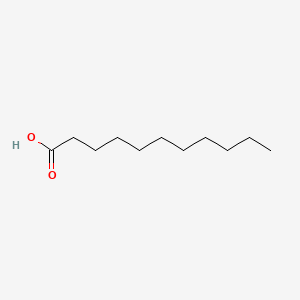
Undecanoic Acid
Undecanoic acid is a straight-chain, eleven-carbon saturated medium-chain fatty acid found in body fluids; the most fungitoxic of the C7:0 - C18:0 fatty acid series. It has a role as an antifungal agent and a human metabolite. It is a straight-chain saturated fatty acid and a medium-chain fatty acid. It is a conjugate acid of an undecanoate. It derives from a hydride of an undecane. — ChEBI
- IUPAC name
- undecanoic acid
- Molecular formula
- C11H22O2
- Molecular weight
- 186.29 g/mol
- Exact mass
- 186.161979940 Da
- XLogP3
- 3.7
- Topological polar surface area
- 37.3 Ų
- Hydrogen-bond donors
- 1
- Hydrogen-bond acceptors
- 2
- Covalent units
- 1
- Defined stereocentres
- 0
Also known as
16 more reported names
External database identifiers
- ChEBI:CHEBI:32368
- ChEMBL:CHEMBL108030
- EPA DTXSID:DTXSID8021690
- PubMed:29445768
- PubMed:22858839
- PubMed:22701831
- PubMed:22448484
- PubMed:22363891
- PubMed:22268394
- PubMed:22180816
- PubMed:22023735
- PubMed:21997768
- PubMed:21954937
- PubMed:21927705
- PubMed:21831316
Evidence from additional scientific databases
NIH PubChem PUG-View
Attributed physical-property, hazard, environmental and use annotations.
- Boiling Point: 442.2 °F at 160 mmHg (USCG, 1999) Source: CAMEO Chemicals
- Boiling Point: 284 °C Source: Joint FAO/WHO Expert Committee on Food Additives (JECFA)
- Density: 0.891 (USCG, 1999) - Less dense than water; will float Source: CAMEO Chemicals
- Density: 0.9948 (20 °C/20 °C) Source: Joint FAO/WHO Expert Committee on Food Additives (JECFA)
- Flash Point: greater than 230 °F (USCG, 1999) Source: CAMEO Chemicals
- LogP: 4.42 Source: Human Metabolome Database (HMDB)
- Melting Point: 83.3 °F (USCG, 1999) Source: CAMEO Chemicals
- Melting Point: 28.6 °C Source: Human Metabolome Database (HMDB)
- Physical Description: Undecanoic acid is a white crystalline solid. Insoluble in water. Specific gravity 0.85. Hence floats on water. Source: CAMEO Chemicals
- Physical Description: Other Solid Source: EPA Chemical Data Reporting (CDR)
- Physical Description: White solid; mp= 28.5 deg C; [CHRIS] Colorless solidified mass or fragments; mp = 28-31 deg C; [Sigma-Aldrich MSDS] Source: Haz-Map, Information on Hazardous Chemicals and Occupational Diseases
- Physical Description: Solid Source: Human Metabolome Database (HMDB)
- Physical Description: colourless crystals/ faint fatty, aldehydic odour Source: Joint FAO/WHO Expert Committee on Food Additives (JECFA)
- Refractive Index: 1.4355 (30 °C) Source: Joint FAO/WHO Expert Committee on Food Additives (JECFA)
- Solubility: 0.0522 mg/mL Source: Human Metabolome Database (HMDB)
- Solubility: Insoluble in water; very soluble in alcohol, chloroform, acetone Source: Joint FAO/WHO Expert Committee on Food Additives (JECFA)
- Solubility: (in ethanol) Source: Joint FAO/WHO Expert Committee on Food Additives (JECFA)
- First Aid: INHALATION: Call for medical aid. Remove the victim to fresh air. If not breathing give artificial respiration. If breathing is difficult give oxygen.; EYES OR SKIN: Flush with copious amounts of water for at least 15 minutes. Insure adequate flushing of the eyes by separating the eyelids with the fingers. (USCG, 1999) Source: CAMEO Chemicals
- Note: This chemical does not meet GHS hazard criteria for 1.2% (2 of 167) of reports. Source: European Chemicals Agency (ECHA)
- Signal: Warning Source: European Chemicals Agency (ECHA)
- GHS Hazard Statements: H315 (98.8%): Causes skin irritation [Warning Skin corrosion/irritation]; H319 (84.4%): Causes serious eye irritation [Warning Serious eye damage/eye irritation]; H335 (82.6%): May cause respiratory irritation [Warning Specific target organ toxicity, single exposure; Respiratory tract irritation] Source: European Chemicals Agency (ECHA)
- Precautionary Statement Codes: P261, P264, P264+P265, P271, P280, P302+P352, P304+P340, P305+P351+P338, P319, P321, P332+P317, P337+P317, P362+P364, P403+P233, P405, and P501 (click each P-code to see the statement) Source: European Chemicals Agency (ECHA)
- ECHA C&L Notifications Summary: Aggregated GHS information provided per 167 reports by companies from 11 notifications to the ECHA C&L Inventory. Each notification may be associated with multiple companies.; Reported as not meeting GHS hazard criteria per 2 of 167 reports by companies.; There are 10 notifications provided by 165 of 167 reports by companies with hazard statement code(s).; Information may vary between notifications depending on impurities, additives, and other factors. The percentage value in parenthesis indicates the notified classification ratio from companies that provide hazard codes. Only hazard codes with percentage values above 10% are shown. For more detailed information, please visit ECHA C&L website. Source: European Chemicals Agency (ECHA)
- Cosmetic Ingredient Review Conclusion: The CIR Expert Panel concluded that the following ingredients are safe in the present practices of use andconcentration described in the safety assessment when formulated to be non-irritating and non-sensitizing, which may be basedon a QRA...Undecanoic Acid... Source: Cosmetic Ingredient Review (CIR)
- Cosmetic Ingredient Review Finding(s): Safe for use in cosmetics, with qualifications Source: Cosmetic Ingredient Review (CIR)
- Consumer Uses: Soil amendments (fertilizers) Source: EPA Chemical Data Reporting (CDR)
- Industry Uses: Soil amendments (fertilizers); Lubricating agent Source: EPA Chemical Data Reporting (CDR)
- Cosmetic Ingredient Review Link: CIR ingredient: Undecanoic Acid Source: Cosmetic Ingredient Review (CIR)
- Sources/Uses: Used as flavoring agent or adjuvant; [FDA] Source: Haz-Map, Information on Hazardous Chemicals and Occupational Diseases
Mapped by: Existing checksum-valid CAS to unique PubChem CID match. Retrieved: 2026-08-31. Open source record
Scientific classifications and hazard annotations provide context and do not replace the market-specific regulatory decision shown above.
Additional source coverage and match status
| Source | Result | Checked |
|---|---|---|
| NIH PubChem PUG-View | Exact match | 2026-08-31 |
A recorded no-match is useful evidence that the source was checked; it is not a claim that the substance does not exist elsewhere.
Retrieved from NIH PubChem on 2026-08-31 by checksum-valid CAS matching. Chemical properties do not replace the regulatory decision on this page.
Inventory details for UNDECANOIC ACID
INCI name
UNDECANOIC ACID
Description
Undecanoic acid
Record provenance
- Inventory reference
- 80491
- Imported identity
- UNDECANOIC ACID
- Source update
- 15/10/2010
Annex records for UNDECANOIC ACID
Key data
- ANTI-SEBUM
- Helping control sebum production.
- CLEANSING
- Helping to keep the body surface clean.
- FRAGRANCE
- Imparting an odour or taste. Creating a perceivable pleasant smell and/or masking a bad smell.
- SURFACTANT - CLEANSING
- Wetting body surfaces, emulsifying or solubilizing oils, and suspending soil (generally, such ingredients contribute to the foaming and lathering properties of cleansing products).
- SURFACTANT - EMULSIFYING
- Helping suspensions or dispersions of liquids in a second liquid by reducing the surface tension of the substances to be emulsified.
Official EU ingredient-name evidence
The ingredient name exactly matches the official 2025 EU glossary of common ingredient names.
Related inventory evidence
Ingredients with overlapping formulation functions
Additional official and scientific sources
11 external databases to check this identity in
Each link searches that source for this identity. What each source is, and its legal weight
How UNDECANOIC ACID appears in the CosIng inventory
The CosIng inventory lists UNDECANOIC ACID as a cosmetic ingredient and this page links it to 0 annex records. The inventory entry captures names and identifiers, while the annex records show where the substance is prohibited, restricted or positively listed in EU cosmetics law.
UNDECANOIC ACID is also tagged with 5 cosmetic functions in the official data. Function labels describe intended use, but they do not replace regulatory review of linked annex records before formulation or labelling work.
Frequently asked questions
Source note for UNDECANOIC ACID
This page reproduces the CosIng inventory entry for UNDECANOIC ACID from public European Commission cosmetic ingredient materials and shows linked identifiers even when no direct annex match is currently attached.
Use this inventory page to research UNDECANOIC ACID and compare linked records, but verify restrictions and legal status against the current official source text and law before making regulatory decisions.
Tools & next steps
Check your formula
Scan a full INCI list to detect UNDECANOIC ACID and any linked EU annex restrictions or allergen flags.
INCI CheckerSearch similar ingredients
Find other inventory ingredients and annex entries related to UNDECANOIC ACID, its identifiers or nearby name variants.
Search