
METHYL MYRISTATE
Methyl myristate
METHYL MYRISTATE is listed in the EU CosIng inventory, but no direct annex records are linked on this page yet.
Regulatory evidence by market
No rule for this ingredient has been imported for any of the 13 markets tracked here.
That describes this inventory, not the law. No imported rule is not evidence that an ingredient is permitted: a rule may exist under another name or identifier, or in a dataset not yet imported here.
Chemical identity and properties
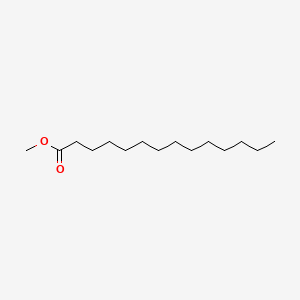
Methyl Myristate
Methyl tetradecanoate is a fatty acid methyl ester resulting from the formal condensation of the carboxy group of tetradecanoic acid (myristic acid) with methanol. It has a role as a flavouring agent, a fragrance and a plant metabolite. It is functionally related to a tetradecanoic acid. — ChEBI
- IUPAC name
- methyl tetradecanoate
- Molecular formula
- C15H30O2
- Molecular weight
- 242.40 g/mol
- Exact mass
- 242.224580195 Da
- XLogP3
- 6.8
- Topological polar surface area
- 26.3 Ų
- Hydrogen-bond donors
- 0
- Hydrogen-bond acceptors
- 2
- Covalent units
- 1
- Defined stereocentres
- 0
Also known as
16 more reported names
External database identifiers
- ChEBI:CHEBI:89199
- ChEMBL:CHEMBL207549
- EPA DTXSID:DTXSID5027019
- PubMed:22649385
- PubMed:21151471
- PubMed:21062023
- PubMed:20949032
- PubMed:20936848
- PubMed:20618668
- PubMed:20479979
- PubMed:20393784
- PubMed:20234969
- PubMed:20053122
- PubMed:19945866
- PubMed:18636987
Evidence from additional scientific databases
NIH PubChem PUG-View
Attributed physical-property, hazard, environmental and use annotations.
- Boiling Point: 295 °C Source: Hazardous Substances Data Bank (HSDB)
- Boiling Point: Boiling point: 155 °C @ 2 mm Hg Source: Hazardous Substances Data Bank (HSDB)
- Boiling Point: 323.00 °C. @ 760.00 mm Hg Source: Human Metabolome Database (HMDB)
- Boiling Point: 295-300 °C Source: Joint FAO/WHO Expert Committee on Food Additives (JECFA)
- Color/Form: COLORLESS, OILY LIQ OR WHITE, WAXY SOLID Source: Hazardous Substances Data Bank (HSDB)
- Density: 0.8671 @ 20 °C Source: Hazardous Substances Data Bank (HSDB)
- Density: 0.870(15.5 °C) Source: Joint FAO/WHO Expert Committee on Food Additives (JECFA)
- LogP: log Kow= 6.41 Source: Hazardous Substances Data Bank (HSDB)
- LogP: 6.41 Source: Human Metabolome Database (HMDB)
- Melting Point: 19 °C Source: Hazardous Substances Data Bank (HSDB)
- Melting Point: 18.5 °C Source: Human Metabolome Database (HMDB)
- Odor: Honey & orris-like (Iris florentina) odor Source: Hazardous Substances Data Bank (HSDB)
- Odor: FATTY COCONUT, COGNAC ODOR Source: Hazardous Substances Data Bank (HSDB)
- Physical Description: CBI; Liquid Source: EPA Chemical Data Reporting (CDR)
- Physical Description: Colorless liquid; mp = 17.8 deg C; [Hawley] Colorless liquid or white solid; mp = 19 deg C; [HSDB] Colorless liquid; mp = 18 deg C; [MSDSonline] Source: Haz-Map, Information on Hazardous Chemicals and Occupational Diseases
- Physical Description: Liquid Source: Human Metabolome Database (HMDB)
- Physical Description: colourless, oily liquid or white, waxy solid with a faint onion, honey, orris odour Source: Joint FAO/WHO Expert Committee on Food Additives (JECFA)
- Refractive Index: Index of refraction: 1.425 @ 45 °C Source: Hazardous Substances Data Bank (HSDB)
- Refractive Index: 1.435-1.4875 Source: Joint FAO/WHO Expert Committee on Food Additives (JECFA)
- Solubility: Insol in water; miscible in ethyl alcohol, ether, acetone Source: Hazardous Substances Data Bank (HSDB)
- Solubility: SOL IN OILS Source: Hazardous Substances Data Bank (HSDB)
- Solubility: Insoluble in water Source: Hazardous Substances Data Bank (HSDB)
- Solubility: soluble in alcohol, most fixed oils; insoluble in water Source: Joint FAO/WHO Expert Committee on Food Additives (JECFA)
- Solubility: (in ethanol) Source: Joint FAO/WHO Expert Committee on Food Additives (JECFA)
- Vapor Pressure: 0.00049 [mmHg] Source: Haz-Map, Information on Hazardous Chemicals and Occupational Diseases
- Vapor Pressure: 4.9X10⁻⁴ mm Hg @ 25 °C Source: Hazardous Substances Data Bank (HSDB)
- Note: This chemical does not meet GHS hazard criteria for 99.9% (1614 of 1616) of all reports. Source: European Chemicals Agency (ECHA)
- GHS Hazard Statements: Not Classified; Reported as not meeting GHS hazard criteria by 1614 of 1616 companies (only 0.1% companies provided GHS information). For more detailed information, please visit ECHA C&L website. Source: European Chemicals Agency (ECHA)
- ECHA C&L Notifications Summary: Aggregated GHS information provided per 1616 reports by companies from 3 notifications to the ECHA C&L Inventory.; Reported as not meeting GHS hazard criteria per 1614 of 1616 reports by companies.; There are 2 notifications provided by 2 of 1616 reports by companies with hazard statement code(s).; Information may vary between notifications depending on impurities, additives, and other factors. The percentage value in parenthesis indicates the notified classification ratio from companies that provide hazard codes. Only hazard codes with percentage values above 10% are shown. For more detailed information, please visit ECHA C&L website. Source: European Chemicals Agency (ECHA)
- Cosmetic Ingredient Review Finding(s): Safe in the present practices of use and concentration. Ingredient, concentration, and use information are available in documents discoverable at https://cir-reports.cir-safety.org Source: Cosmetic Ingredient Review (CIR)
- Environmental Bioconcentration: An estimated BCF of 1100 was calculated for methyl myristate(SRC) using a log Kow of 6.41(1) and a regression-derived equation(2). According to a classification scheme(3), the estimated BCF suggests the potential for bioconcentration in aquatic organisms is high. However, bioconcentration studies on compounds which are structurally similar(4,5) suggests that bioconcentration may be lower than that indicated by the regression-derived equation due to the ability of aquatic organisms to readily metabolize this class of compounds(SRC). Source: Hazardous Substances Data Bank (HSDB)
- Environmental Fate: TERRESTRIAL FATE: Based on a classification scheme(1), an estimated Koc value of 5,400(SRC), determined from a structure estimation method(2), indicates that methyl myristate is expected to be immobile in soil(SRC). Volatilization of methyl myristate from moist soil surfaces is expected to be an important fate process(SRC) given an estimated Henry's Law constant of 0.005 atm-cu m/mole(SRC), using a fragment constant estimation method(3). However, adsorption to soil is expected to attenuate volatilization(SRC). Methyl myristate is not expected to volatilize from dry soil surfaces(SRC) based upon a vapor pressure of 0.00049 mm Hg(4). Methyl myristate is expected to rapidly biodegrade in aerobic soils by analogy to structurally similar long-chain fatty acid esters(5-7). Source: Hazardous Substances Data Bank (HSDB)
- Environmental Fate: AQUATIC FATE: Based on a classification scheme(1), an estimated Koc value of 5400(SRC), determined from a structure estimation method(2), indicates that methyl myristate is expected to adsorb to suspended solids and sediment in water(SRC). Volatilization from water surfaces is expected(3) based upon an estimated Henry's Law constant of 0.005 atm-cu m/mole(SRC), developed using a fragment constant estimation method(4). Volatilization half-lives for a model river and model lake are 5 hours and 6.2 days, respectively(SRC), using an estimation method(3). However, volatilization from water surfaces is expected to be attenuated by adsorption to suspended solids and sediment in the water column(SRC). The volatilization half-life from a model pond is estimated to be about 57 hours ignoring adsorption; when considering maximum adsorption the volatilization half-life increases to 45 days(5). According to a classification scheme(6), an estimated BCF of 540(SRC) from its log Kow of 6.41(12) and a regression-derived equation(7), suggests the potential for bioconcentration in aquatic organisms is high although it may be lower than that indicated due to the expected rapid metabolism rate for long Source: Hazardous Substances Data Bank (HSDB)
- Environmental Fate: ATMOSPHERIC FATE: According to a model of gas/particle partitioning of semivolatile organic compounds in the atmosphere(1), methyl myristate, which has a vapor pressure of 0.00049 mm Hg at 25 °C(2), will exist solely in the vapor phase in the ambient atmosphere. Vapor-phase methyl myristate is degraded in the atmosphere by reaction with photochemically-produced hydroxyl radicals(SRC); the half-life for this reaction in air is estimated to be 24 hours(SRC) from its estimated rate constant of 1.6X10⁻¹¹ cu cm/molecule-sec at 25 °C(3). Source: Hazardous Substances Data Bank (HSDB)
- Consumer Uses: Softener and conditioner; Emulsifier Source: EPA Chemical Data Reporting (CDR)
- Industry Uses: Emulsifier; Softener and conditioner; Intermediate Source: EPA Chemical Data Reporting (CDR)
- Cosmetic Ingredient Review Link: CIR ingredient: Methyl Myristate Source: Cosmetic Ingredient Review (CIR)
- Sources/Uses: Used to make myristic acid detergents, emulsifiers, wetting agents, stabilizers, resins, lubricants, plasticizers, textiles, animal feeds, alkanolamides, and fatty alcohols and acids; Also used as standard for gas chromatography and for flavoring; [HSDB] Source: Haz-Map, Information on Hazardous Chemicals and Occupational Diseases
- Industrial Processes with risk of exposure: Textiles (Fiber & Fabric Manufacturing) [Category: Industry]; Farming (Feed Additives) [Category: Industry] Source: Haz-Map, Information on Hazardous Chemicals and Occupational Diseases
- Uses: Intermediate for myristic acid detergents, emulsifiers, wetting agents, stabilizers, resins, lubricants, plasticizers, textiles, animal feeds; std for gas chromatography, flavoring. Source: Hazardous Substances Data Bank (HSDB)
- Uses: CHEM INT-EG, FOR ALKANOLAMIDES, FATTY ALCOHOLS & ACIDS Source: Hazardous Substances Data Bank (HSDB)
- Uses: FLAVORING AGENT, EG, IN CANDY & ICE CREAM Source: Hazardous Substances Data Bank (HSDB)
Mapped by: Existing checksum-valid CAS to unique PubChem CID match. Retrieved: 2026-08-31. Open source record
Scientific classifications and hazard annotations provide context and do not replace the market-specific regulatory decision shown above.
Additional source coverage and match status
| Source | Result | Checked |
|---|---|---|
| NIH PubChem PUG-View | Exact match | 2026-08-31 |
A recorded no-match is useful evidence that the source was checked; it is not a claim that the substance does not exist elsewhere.
Retrieved from NIH PubChem on 2026-08-31 by checksum-valid CAS matching. Chemical properties do not replace the regulatory decision on this page.
Inventory details for METHYL MYRISTATE
INCI name
METHYL MYRISTATE
Description
Methyl myristate
Record provenance
- Inventory reference
- 78371
- Imported identity
- METHYL MYRISTATE
- Source update
- 15/10/2010
Annex records for METHYL MYRISTATE
Key data
- SKIN CONDITIONING
- Maintaining the skin in good condition.
- SKIN CONDITIONING - EMOLLIENT
- Acting as lubricants on the skin surface providing the skin with a soft and smooth appearance.
Official EU ingredient-name evidence
The ingredient name exactly matches the official 2025 EU glossary of common ingredient names.
Related inventory evidence
Ingredients with overlapping formulation functions
Additional official and scientific sources
11 external databases to check this identity in
Each link searches that source for this identity. What each source is, and its legal weight
How METHYL MYRISTATE appears in the CosIng inventory
The CosIng inventory lists METHYL MYRISTATE as a cosmetic ingredient and this page links it to 0 annex records. The inventory entry captures names and identifiers, while the annex records show where the substance is prohibited, restricted or positively listed in EU cosmetics law.
METHYL MYRISTATE is also tagged with 2 cosmetic functions in the official data. Function labels describe intended use, but they do not replace regulatory review of linked annex records before formulation or labelling work.
Frequently asked questions
Source note for METHYL MYRISTATE
This page reproduces the CosIng inventory entry for METHYL MYRISTATE from public European Commission cosmetic ingredient materials and shows linked identifiers even when no direct annex match is currently attached.
Use this inventory page to research METHYL MYRISTATE and compare linked records, but verify restrictions and legal status against the current official source text and law before making regulatory decisions.
Tools & next steps
Check your formula
Scan a full INCI list to detect METHYL MYRISTATE and any linked EU annex restrictions or allergen flags.
INCI CheckerSearch similar ingredients
Find other inventory ingredients and annex entries related to METHYL MYRISTATE, its identifiers or nearby name variants.
Search