
HYDROXYETHYL ISOBUTYL PIPERIDINE CARBOXYLATE
1-Piperidinecarboxylic acid, 2-(2-hydroxyethyl)-, 1-methylpropyl ester
HYDROXYETHYL ISOBUTYL PIPERIDINE CARBOXYLATE is listed in the EU CosIng inventory, but no direct annex records are linked on this page yet.
Regulatory evidence by market
No rule for this ingredient has been imported for any of the 13 markets tracked here.
That describes this inventory, not the law. No imported rule is not evidence that an ingredient is permitted: a rule may exist under another name or identifier, or in a dataset not yet imported here.
Chemical identity and properties
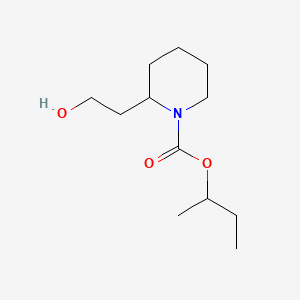
Icaridin
Butan-2-yl 2-(2-hydroxyethyl)piperidine-1-carboxylate is a member of piperidines and a carboxylic acid. — ChEBI
- IUPAC name
- butan-2-yl 2-(2-hydroxyethyl)piperidine-1-carboxylate
- Molecular formula
- C12H23NO3
- Molecular weight
- 229.32 g/mol
- Exact mass
- 229.16779360 Da
- XLogP3
- 2.0
- Topological polar surface area
- 49.8 Ų
- Hydrogen-bond donors
- 1
- Hydrogen-bond acceptors
- 3
- Covalent units
- 1
- Defined stereocentres
- 0
Also known as
16 more reported names
External database identifiers
- ChEBI:CHEBI:143733
- ChEMBL:CHEMBL2104314
- EPA DTXSID:DTXSID0034227
- PubMed:40403953
- PubMed:36077093
- PubMed:27535661
- PubMed:25522134
- PubMed:25349401
- PubMed:25332663
- PubMed:22216951
- PubMed:22030833
- PubMed:21436880
- PubMed:21301870
- PubMed:20695288
- PubMed:20128903
Evidence from additional scientific databases
NIH PubChem PUG-View
Attributed physical-property, hazard, environmental and use annotations.
- Boiling Point: 208 at 1013 hPa Source: DrugBank
- Boiling Point: 296 °C Source: Hazardous Substances Data Bank (HSDB)
- Boiling Point: BP: 208 °C at 1013 hPa Source: Hazardous Substances Data Bank (HSDB)
- Color/Form: Colorless liquid Source: Hazardous Substances Data Bank (HSDB)
- Density: 1.07 at 20 °C Source: Hazardous Substances Data Bank (HSDB)
- LogP: log Kow = 2.11 at 20 °C (unbuffered); 2.23 (pH 4-9) at 20 °C Source: Hazardous Substances Data Bank (HSDB)
- Melting Point: < -170 Source: DrugBank
- Melting Point: < -170 °C Source: Hazardous Substances Data Bank (HSDB)
- Odor: Nearly odorless Source: Hazardous Substances Data Bank (HSDB)
- Physical Description: Colorless liquid; [Merck Index] Source: Haz-Map, Information on Hazardous Chemicals and Occupational Diseases
- Refractive Index: Index of refraction = 1.4717 at 20 °C/D Source: Hazardous Substances Data Bank (HSDB)
- Solubility: Insoluble Source: DrugBank
- Solubility: In water, 8.2 g/L (pH 4-9); 8.6 g/L (unbuffered), at 20 °C Source: Hazardous Substances Data Bank (HSDB)
- Solubility: In water, 8.2X10+3 mg/L at 20 °C, pH 4-9 Source: Hazardous Substances Data Bank (HSDB)
- Solubility: In acetone, 7520 g/L at 20 °C Source: Hazardous Substances Data Bank (HSDB)
- Vapor Pressure: 0.00044 [mmHg] Source: Haz-Map, Information on Hazardous Chemicals and Occupational Diseases
- Vapor Pressure: VP: 3.4X10⁻⁴ hPa at 20 °C; 5.9X10⁻⁴ hPa at 25 °C; 7.1X10⁻³ hPa at 50 °C Source: Hazardous Substances Data Bank (HSDB)
- Vapor Pressure: 4.43X10⁻⁴ mm Hg at 25 °C Source: Hazardous Substances Data Bank (HSDB)
- Viscosity: 135.5 mPa.s at 20 °C Source: Hazardous Substances Data Bank (HSDB)
- Carcinogen Classification: No indication of carcinogenicity to humans (not listed by IARC). Source: Toxin and Toxin Target Database (T3DB)
- Signal: Warning Source: European Chemicals Agency (ECHA)
- GHS Hazard Statements: H319 (100%): Causes serious eye irritation [Warning Serious eye damage/eye irritation] Source: European Chemicals Agency (ECHA)
- Precautionary Statement Codes: P264+P265, P280, P305+P351+P338, and P337+P317 (click each P-code to see the statement) Source: European Chemicals Agency (ECHA)
- ECHA C&L Notifications Summary: Aggregated GHS information provided per 50 reports by companies from 1 notifications to the ECHA C&L Inventory.; Information may vary between notifications depending on impurities, additives, and other factors. The percentage value in parenthesis indicates the notified classification ratio from companies that provide hazard codes. Only hazard codes with percentage values above 10% are shown. For more detailed information, please visit ECHA C&L website. Source: European Chemicals Agency (ECHA)
- ECHA C&L Notifications Summary: Aggregated GHS information provided per 40 reports by companies from 2 notifications to the ECHA C&L Inventory.; Information may vary between notifications depending on impurities, additives, and other factors. The percentage value in parenthesis indicates the notified classification ratio from companies that provide hazard codes. Only hazard codes with percentage values above 10% are shown. For more detailed information, please visit ECHA C&L website. Source: European Chemicals Agency (ECHA)
- Toxicity Summary: IDENTIFICATION AND USE: Picaridin is a colorless liquid. Picaridin is an insect repellent, for application to human or animal skin. In particular, it is used as mosquito repellent. HUMAN EXPOSURE AND TOXICITY: Allergic contact dermatitis has been reported in a human following routine application of picaridin and produced erythema and pruritis. It is not clear whether the solvent methyl glucose-dioleate had a causative or additive effect. However, insect repellents containing picaridin may be acceptable alternatives in patients who demonstrate sensitivity to products containing DEET. Primary symptoms across all insect repellent exposures included ocular irritation/pain, vomiting, red eye/conjunctivitis, and oral irritation. Unintentional ingestion of picaridin-containing and other insect repellents was associated only with minor toxicity. ANIMAL STUDIES: The skin of 50 rats/sex/group was treated with 0, 50, 100 or 200 mg/kg/day 5 days per week for 2 years (the two year cohort). Additionally, 20 animals/sex/group were treated with 0 or 200 mg/kg/kg and 10 animals/sex/group were treated with 50 or 100 mg/kg/day of the test material. These animals received the treatment for one year (o Source: Hazardous Substances Data Bank (HSDB)
- Environmental Bioconcentration: An estimated BCF of 14 was calculated in fish for picaridin(SRC), using a log Kow of 2.23(1) and a regression-derived equation(2). According to a classification scheme(3), this BCF suggests the potential for bioconcentration in aquatic organisms is low(SRC). Source: Hazardous Substances Data Bank (HSDB)
- Environmental Fate: TERRESTRIAL FATE: Based on a classification scheme(1), an estimated Koc value of 80(SRC), determined from a structure estimation method(2), indicates that picaridin is expected to have high mobility in soil(SRC). Volatilization of picaridin from moist soil surfaces is not expected to be an important fate process(SRC) given an estimated Henry's Law constant of 1.6X10⁻⁸ atm-cu m/mole(SRC), based upon its vapor pressure, 4.43X10⁻⁴ mm Hg(3), and water solubility, 8200 mg/L(3). Picaridin is not expected to volatilize from dry soil surfaces(SRC) based upon its vapor pressure(3). Biodegradation data in soil were not available(SRC, 2016). Source: Hazardous Substances Data Bank (HSDB)
- Environmental Fate: AQUATIC FATE: Based on a classification scheme(1), an estimated Koc value of 80(SRC), determined from a structure estimation method(2), indicates that picaridin is not expected to adsorb to suspended solids and sediment(SRC). Volatilization from water surfaces is not expected(3) based upon an estimated Henry's Law constant of 1.6X10⁻⁸ atm-cu m/mole(SRC), derived from its vapor pressure, 4.43X10⁻⁴ mm Hg(4), and water solubility, 8200 mg/L(4). Picaridin did not undergo hydrolysis at pH 5, 7 and 9, 25 °C over 30 days(4). According to a classification scheme(5), an estimated BCF of 14(SRC), from its log Kow of 2.23(4) and a regression-derived equation(2), suggests the potential for bioconcentration in aquatic organisms is low(SRC). Biodegradation data in water were not available(SRC, 2016). Source: Hazardous Substances Data Bank (HSDB)
- Environmental Fate: ATMOSPHERIC FATE: According to a model of gas/particle partitioning of semivolatile organic compounds in the atmosphere(1), picaridin, which has a vapor pressure of 4.43X10⁻⁴ mm Hg at 25 °C(2), is expected to exist solely as a vapor in the ambient atmosphere. Vapor-phase picaridin is degraded in the atmosphere by reaction with photochemically-produced hydroxyl radicals(SRC); the half-life for this reaction in air is estimated to be 7 hours(SRC), calculated from its rate constant of 5.6X10⁻¹¹ cu cm/molecule-sec at 25 °C(SRC) that was derived using a structure estimation method(3). Picaridin does not contain chromophores that absorb at wavelengths >290 nm(2) and, therefore, is not expected to be susceptible to direct photolysis by sunlight(SRC). Source: Hazardous Substances Data Bank (HSDB)
- Sources/Uses: Used as insect repellent applied to skin against biting flies, mosquitoes, chiggers, ticks, and fleas; [Reference #1] Source: Haz-Map, Information on Hazardous Chemicals and Occupational Diseases
- Uses: For picaridin (USEPA/OPP Pesticide Code: 070705) ACTIVE products with label matches. /SRP: Registered for use in the U.S. but approved pesticide uses may change periodically and so federal, state and local authorities must be consulted for currently approved uses./ Source: Hazardous Substances Data Bank (HSDB)
- Uses: Mosquito repellent Source: Hazardous Substances Data Bank (HSDB)
- Uses: Icaridin is an insect repellent, for application to human or animal skin. Source: Hazardous Substances Data Bank (HSDB)
Mapped by: Existing checksum-valid CAS to unique PubChem CID match. Retrieved: 2026-08-31. Open source record
Scientific classifications and hazard annotations provide context and do not replace the market-specific regulatory decision shown above.
Additional source coverage and match status
| Source | Result | Checked |
|---|---|---|
| NIH PubChem PUG-View | Exact match | 2026-08-31 |
A recorded no-match is useful evidence that the source was checked; it is not a claim that the substance does not exist elsewhere.
Retrieved from NIH PubChem on 2026-08-31 by checksum-valid CAS matching. Chemical properties do not replace the regulatory decision on this page.
Inventory details for HYDROXYETHYL ISOBUTYL PIPERIDINE CARBOXYLATE
INCI name
HYDROXYETHYL ISOBUTYL PIPERIDINE CARBOXYLATE
Description
1-Piperidinecarboxylic acid, 2-(2-hydroxyethyl)-, 1-methylpropyl ester
Record provenance
- Inventory reference
- 56802
- Imported identity
- HYDROXYETHYL ISOBUTYL PIPERIDINE CARBOXYLATE
- Source update
- 15/10/2010
Annex records for HYDROXYETHYL ISOBUTYL PIPERIDINE CARBOXYLATE
Key data
Official EU ingredient-name evidence
The ingredient name exactly matches the official 2025 EU glossary of common ingredient names.
Related inventory evidence
Ingredients with overlapping formulation functions
Additional official and scientific sources
11 external databases to check this identity in
Each link searches that source for this identity. What each source is, and its legal weight
How HYDROXYETHYL ISOBUTYL PIPERIDINE CARBOXYLATE appears in the CosIng inventory
The CosIng inventory lists HYDROXYETHYL ISOBUTYL PIPERIDINE CARBOXYLATE as a cosmetic ingredient and this page links it to 0 annex records. The inventory entry captures names and identifiers, while the annex records show where the substance is prohibited, restricted or positively listed in EU cosmetics law.
HYDROXYETHYL ISOBUTYL PIPERIDINE CARBOXYLATE is also tagged with 1 cosmetic function in the official data. Function labels describe intended use, but they do not replace regulatory review of linked annex records before formulation or labelling work.
Frequently asked questions
Source note for HYDROXYETHYL ISOBUTYL PIPERIDINE CARBOXYLATE
This page reproduces the CosIng inventory entry for HYDROXYETHYL ISOBUTYL PIPERIDINE CARBOXYLATE from public European Commission cosmetic ingredient materials and shows linked identifiers even when no direct annex match is currently attached.
Use this inventory page to research HYDROXYETHYL ISOBUTYL PIPERIDINE CARBOXYLATE and compare linked records, but verify restrictions and legal status against the current official source text and law before making regulatory decisions.
Tools & next steps
Check your formula
Scan a full INCI list to detect HYDROXYETHYL ISOBUTYL PIPERIDINE CARBOXYLATE and any linked EU annex restrictions or allergen flags.
INCI CheckerSearch similar ingredients
Find other inventory ingredients and annex entries related to HYDROXYETHYL ISOBUTYL PIPERIDINE CARBOXYLATE, its identifiers or nearby name variants.
Search