
PHENYLACETIC ACID
Phenylacetic Acid
PHENYLACETIC ACID is listed in the EU CosIng inventory, but no direct annex records are linked on this page yet.
Regulatory evidence by market
No rule for this ingredient has been imported for any of the 13 markets tracked here.
That describes this inventory, not the law. No imported rule is not evidence that an ingredient is permitted: a rule may exist under another name or identifier, or in a dataset not yet imported here.
Chemical identity and properties
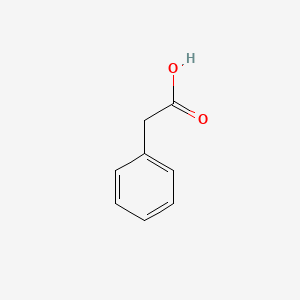
Phenylacetic Acid
Phenylacetic acid is a monocarboxylic acid that is toluene in which one of the hydrogens of the methyl group has been replaced by a carboxy group. It has a role as an auxin, a toxin, a plant growth retardant, an allergen, a Saccharomyces cerevisiae metabolite, a plant metabolite, an Aspergillus metabolite, an Escherichia coli metabolite, a human metabolite and an EC 6.4.1.1 (pyruvate carboxylase) inhibitor. It is a member of benzenes, a monocarboxylic acid and a member of phenylacetic acids. It is functionally related to an acetic acid. It is a conjugate acid of a phenylacetate. — ChEBI
- IUPAC name
- 2-phenylacetic acid
- Molecular formula
- C8H8O2
- Molecular weight
- 136.15 g/mol
- Exact mass
- 136.052429494 Da
- XLogP3
- 1.4
- Topological polar surface area
- 37.3 Ų
- Hydrogen-bond donors
- 1
- Hydrogen-bond acceptors
- 2
- Covalent units
- 1
- Defined stereocentres
- 0
Also known as
16 more reported names
External database identifiers
- ChEBI:CHEBI:30745
- ChEMBL:CHEMBL1044
- EPA DTXSID:DTXSID2021656
- PubMed:23113079
- PubMed:23099616
- PubMed:23054002
- PubMed:23010151
- PubMed:22961985
- PubMed:22958974
- PubMed:22936930
- PubMed:22919580
- PubMed:22841743
- PubMed:22811365
- PubMed:22782469
- PubMed:22743821
Evidence from additional scientific databases
EMBL-EBI ChEBI
phenylacetic acid
A monocarboxylic acid that is toluene in which one of the hydrogens of the methyl group has been replaced by a carboxy group.
- Formula
- C8H8O2
- Average mass
- 136.150 g/mol
- Monoisotopic mass
- 136.05243 Da
- Formal charge
- 0
- monocarboxylic acid — is a (CHEBI:25384)
- phenylacetic acids — is a (CHEBI:25978)
- benzenes — is a (CHEBI:22712)
- auxin — has role (CHEBI:22676)
- toxin — has role (CHEBI:27026)
- human metabolite — has role (CHEBI:77746)
- Aspergillus metabolite — has role (CHEBI:76956)
- plant growth retardant — has role (CHEBI:35219)
- Escherichia coli metabolite — has role (CHEBI:76971)
- plant metabolite — has role (CHEBI:76924)
- Saccharomyces cerevisiae metabolite — has role (CHEBI:75772)
- EC 6.4.1.1 (pyruvate carboxylase) inhibitor — has role (CHEBI:90318)
- allergen — has role (CHEBI:50904)
- acetic acid — has functional parent (CHEBI:15366)
- auxin — has role (CHEBI:22676)
- toxin — has role (CHEBI:27026)
- human metabolite — has role (CHEBI:77746)
- Aspergillus metabolite — has role (CHEBI:76956)
- plant growth retardant — has role (CHEBI:35219)
- Escherichia coli metabolite — has role (CHEBI:76971)
- plant metabolite — has role (CHEBI:76924)
- Saccharomyces cerevisiae metabolite — has role (CHEBI:75772)
- EC 6.4.1.1 (pyruvate carboxylase) inhibitor — has role (CHEBI:90318)
- allergen — has role (CHEBI:50904)
- monocarboxylic acid — is a (CHEBI:25384)
- phenylacetic acids — is a (CHEBI:25978)
- benzenes — is a (CHEBI:22712)
- phenylacetate — is conjugate acid of (CHEBI:18401)
- 10476877 Source: PubMed
- 12147706 Source: PubMed
- 12569987 Source: PubMed
- 15057459 Source: PubMed
- 15506622 Source: PubMed
- 15646820 Source: PubMed
- 15857133 Source: PubMed
- 17300161 Source: PubMed
- 17622769 Source: PubMed
- 17870536 Source: PubMed
- 18572410 Source: PubMed
- 19056282 Source: PubMed
- 19817384 Source: PubMed
- 20014752 Source: PubMed
- 20307077 Source: PubMed
- 2083978 Source: PubMed
- 22577085 Source: PubMed
- 24587751 Source: PubMed
- 24631718 Source: PubMed
- 25913862 Source: PubMed
- 31257875 Source: PubMed
- 33848153 Source: PubMed
- 35080396 Source: PubMed
- 36262388 Source: PubMed
Additional curated names
Cross-references from this source
- CAS: 103-82-2 — NIST Chemistry WebBook
- CAS: 103-82-2 — KEGG COMPOUND
- CAS: 103-82-2 — ChemIDplus
- REGISTRY_NUMBER: 1099647 — Reaxys
- REGISTRY_NUMBER: 68976 — Gmelin
- MANUAL_X_REF: 4624 — DrugCentral
- MANUAL_X_REF: C00000750 — KNApSAcK
- MANUAL_X_REF: C07086 — KEGG COMPOUND
- MANUAL_X_REF: C07086 — KEGG COMPOUND
- MANUAL_X_REF: ECMDB04128 — ECMDB
- MANUAL_X_REF: HMDB0000209 — HMDB
- MANUAL_X_REF: PAC — PDBeChem
- MANUAL_X_REF: PHENYLACETATE — MetaCyc
- MANUAL_X_REF: Phenylacetic_acid — Wikipedia
- MANUAL_X_REF: YMDB00891 — YMDB
Mapped by: Exact CAS cross-reference in the ChEBI compound record. Source updated: 2026-05-19. Retrieved: 2026-08-31. Open source record
NIH PubChem PUG-View
Attributed physical-property, hazard, environmental and use annotations.
- Autoignition Temperature: 543 °C Source: ILO-WHO International Chemical Safety Cards (ICSCs)
- Boiling Point: 265.5 deg at 760 mm Hg Source: Hazardous Substances Data Bank (HSDB)
- Boiling Point: Liquid, BP: 215 °C /Phenylacetic acid methyl ester/ Source: Hazardous Substances Data Bank (HSDB)
- Boiling Point: 265.5 °C Source: ILO-WHO International Chemical Safety Cards (ICSCs)
- Boiling Point: 265 °C Source: Joint FAO/WHO Expert Committee on Food Additives (JECFA)
- Color/Form: Leaflets on distillation in-vacuo; plates, tablets from petroleum ether Source: Hazardous Substances Data Bank (HSDB)
- Color/Form: Shiny, white plate crystals Source: Hazardous Substances Data Bank (HSDB)
- Color/Form: White to yellow crystals or flakes Source: Hazardous Substances Data Bank (HSDB)
- Density: 1.091 at 77 °C/4 °C Source: Hazardous Substances Data Bank (HSDB)
- Density: Density (at 77 °C): 1.09 g/cm³ Source: ILO-WHO International Chemical Safety Cards (ICSCs)
- Dissociation Constants: pKa = 4.31 Source: Hazardous Substances Data Bank (HSDB)
- Flash Point: 132 °C (270 °F) Source: Hazardous Substances Data Bank (HSDB)
- Flash Point: >212 °F (>100 °C) (closed cup) Source: Hazardous Substances Data Bank (HSDB)
- Flash Point: 132 °C c.c. Source: ILO-WHO International Chemical Safety Cards (ICSCs)
- LogP: log Kow = 1.41 Source: Hazardous Substances Data Bank (HSDB)
- LogP: 1.41 Source: Human Metabolome Database (HMDB)
- LogP: 1.41 Source: ILO-WHO International Chemical Safety Cards (ICSCs)
- Melting Point: 76.7 °C Source: Hazardous Substances Data Bank (HSDB)
- Melting Point: 76.7 °C Source: Human Metabolome Database (HMDB)
- Melting Point: 76.5 °C Source: ILO-WHO International Chemical Safety Cards (ICSCs)
- Odor: Floral odor Source: Hazardous Substances Data Bank (HSDB)
- Odor: Disagreeable odor of geranium Source: Hazardous Substances Data Bank (HSDB)
- Odor: Has a sweet honey-like odor when diluted; the odor of the concentrated solution is suffocating and unpleasant. Source: Hazardous Substances Data Bank (HSDB)
- Physical Description: Shiny white solid with a floral odor; [Hawley] White crystalline solid; [MSDSonline] Source: Haz-Map, Information on Hazardous Chemicals and Occupational Diseases
- Physical Description: Solid Source: Human Metabolome Database (HMDB)
- Physical Description: WHITE-TO-YELLOW CRYSTALS OR FLAKES WITH PUNGENT ODOUR. Source: ILO-WHO International Chemical Safety Cards (ICSCs)
- Physical Description: Glistening white crystalline solid with leafy crystals; sweet animal honey-like odour Source: Joint FAO/WHO Expert Committee on Food Additives (JECFA)
- Solubility: In water, 1.73X10+4 mg/L at 25 °C Source: Hazardous Substances Data Bank (HSDB)
- Solubility: In water, 1.66X10+4 mg/L at 20 °C Source: Hazardous Substances Data Bank (HSDB)
- Solubility: Soluble in alcohol and ether; Soluble 4.422 moles/L in chloroform at 25 °C; 1.842 moles/L in carbon tetrachloride at 25 °C; 4.513 moles/L in acetylene tetrachloride at 25 °C; 3.29 moles/L in trichlorethylene at 25 °C; 1.558 moles/L in tetrachlorethylene at 25 °C; 3.252 moles/L in pentachloroethane at 25 °C Source: Hazardous Substances Data Bank (HSDB)
- Solubility: Very soluble in ethanol, ethyl ether, carbon disulfide; soluble in acetone; slightly soluble in chloroform; insoluble in ligroin Source: Hazardous Substances Data Bank (HSDB)
- Solubility: 16.6 mg/mL Source: Human Metabolome Database (HMDB)
- Solubility: Solubility in water, g/100ml at 20 °C: 0.16 Source: ILO-WHO International Chemical Safety Cards (ICSCs)
- Solubility: Slightly soluble in water; soluble in oils Source: Joint FAO/WHO Expert Committee on Food Additives (JECFA)
- Solubility: Soluble at room temperature (in ethanol) Source: Joint FAO/WHO Expert Committee on Food Additives (JECFA)
- Vapor Pressure: 0.0038 [mmHg] Source: Haz-Map, Information on Hazardous Chemicals and Occupational Diseases
- Vapor Pressure: 3.8X10⁻³ mm Hg at 25 °C (extrapolated) Source: Hazardous Substances Data Bank (HSDB)
- Vapor Pressure: Vapor pressure at 20 °C: negligible Source: ILO-WHO International Chemical Safety Cards (ICSCs)
- pH: Aqueous solutions of phenyl acetic acid are weakly acidic. Source: Hazardous Substances Data Bank (HSDB)
- Carcinogen Classification: No indication of carcinogenicity to humans (not listed by IARC). Source: Toxin and Toxin Target Database (T3DB)
- Exposure Routes: Endogenous, Ingestion, Dermal (contact) Source: Toxin and Toxin Target Database (T3DB)
- Note: This chemical does not meet GHS hazard criteria for < 0.1% (1 of 1864) of reports. Source: European Chemicals Agency (ECHA)
- Signal: Danger Source: European Chemicals Agency (ECHA)
- GHS Hazard Statements: H318 (14.4%): Causes serious eye damage [Danger Serious eye damage/eye irritation]; H319 (85.5%): Causes serious eye irritation [Warning Serious eye damage/eye irritation] Source: European Chemicals Agency (ECHA)
- Precautionary Statement Codes: P264+P265, P280, P305+P351+P338, P305+P354+P338, P317, and P337+P317 (click each P-code to see the statement) Source: European Chemicals Agency (ECHA)
- ECHA C&L Notifications Summary: Aggregated GHS information provided per 1864 reports by companies from 16 notifications to the ECHA C&L Inventory. Each notification may be associated with multiple companies.; Reported as not meeting GHS hazard criteria per 1 of 1864 reports by companies.; There are 15 notifications provided by 1863 of 1864 reports by companies with hazard statement code(s).; Information may vary between notifications depending on impurities, additives, and other factors. The percentage value in parenthesis indicates the notified classification ratio from companies that provide hazard codes. Only hazard codes with percentage values above 10% are shown. For more detailed information, please visit ECHA C&L website. Source: European Chemicals Agency (ECHA)
- Signal: Warning Source: Hazardous Substances Data Bank (HSDB)
- GHS Hazard Statements: H319: Causes serious eye irritation [Warning Serious eye damage/eye irritation] Source: Hazardous Substances Data Bank (HSDB)
- Precautionary Statement Codes: P264+P265, P280, P305+P351+P338, and P337+P317 (click each P-code to see the statement) Source: Hazardous Substances Data Bank (HSDB)
- Health Effects: Chronic exposure to uremic toxins can lead to a number of conditions including renal damage, chronic kidney disease and cardiovascular disease. Source: Toxin and Toxin Target Database (T3DB)
- NFPA Health Rating: 2 - Materials that, under emergency conditions, can cause temporary incapacitation or residual injury. Source: Hazardous Substances Data Bank (HSDB)
- NFPA Fire Rating: 1 - Materials that must be preheated before ignition can occur. Materials require considerable preheating, under all ambient temperature conditions, before ignition and combustion can occur. Source: Hazardous Substances Data Bank (HSDB)
- NFPA Instability Rating: 0 - Materials that in themselves are normally stable, even under fire conditions. Source: Hazardous Substances Data Bank (HSDB)
- Toxicity Summary: IDENTIFICATION AND USE: Phenylacetic acid forms white to yellow crystals or flakes. It is used in perfume, as a precursor in manufacture of penicillin G, fungicide, flavoring, and laboratory reagent. It is also used in production of drugs of abuse. HUMAN STUDIES: Inhalation exposure leads to cough, sore throat. Skin exposure leads to redness. Eyes exposure leads to redness, pain. ANIMAL STUDIES: Acute oral toxicity in rats is low. In study of acute effects in mice, ip injection of 300 mg/kg was toxic. Phenylacetic acid did not promote tumor formation when given to rabbits iv and sc for 40 days. In vitro phenylacetic acid induced dose-related embryotoxicity above 0.3 mg/mL. In teratogenic study with rats, administration of 3.2 mg/kg phenylacetic acid on 12th day of embryogenesis affected body weight, retarded skeletal ossification, and caused embryos to be resorbed at twice rate of controls. Phenylacetic acid inhibits activity of coenzyme A. Source: Hazardous Substances Data Bank (HSDB)
- Toxicity Summary: Uremic toxins such as phenylacetic acid are actively transported into the kidneys via organic ion transporters (especially OAT3). Increased levels of uremic toxins can stimulate the production of reactive oxygen species. This seems to be mediated by the direct binding or inhibition by uremic toxins of the enzyme NADPH oxidase (especially NOX4 which is abundant in the kidneys and heart) (A7868). Reactive oxygen species can induce several different DNA methyltransferases (DNMTs) which are involved in the silencing of a protein known as KLOTHO. KLOTHO has been identified as having important roles in anti-aging, mineral metabolism, and vitamin D metabolism. A number of studies have indicated that KLOTHO mRNA and protein levels are reduced during acute or chronic kidney diseases in response to high local levels of reactive oxygen species (A7869) Source: Toxin and Toxin Target Database (T3DB)
- Environmental Bioconcentration: An estimated BCF of 3 was calculated in fish for phenylacetic acid(SRC), using a log Kow of 1.41(1) and a regression-derived equation(2). According to a classification scheme(3), this BCF suggests the potential for bioconcentration in aquatic organisms is low(SRC). Source: Hazardous Substances Data Bank (HSDB)
- Environmental Fate: TERRESTRIAL FATE: Based on a classification scheme(1), Koc values of 31, 26, and 28 from Podzol soil, Alfisol soil, and lake sediment, respectively(2) indicate that phenylacetic acid is expected to have very high mobility in soil(SRC). The pKa of phenylacetic acid is 4.31(3), indicating that this compound will exist almost entirely in the anion form in the environment and anions generally do not adsorb more strongly to soils containing organic carbon and clay than their neutral counterparts(4). Volatilization from moist soil is not expected because the compound exists as an anion and anions do not volatilize. Phenylacetic acid is not expected to volatilize from dry soil surfaces(SRC) based upon its vapor pressure of 0.0038 mm Hg at 25 °C(5). Utilizing an unadapted soil suspension, biodegradation of 90% in 3 days was reported(6), indicating that biodegradation may be an important environmental fate process in soil(SRC). Source: Hazardous Substances Data Bank (HSDB)
- Environmental Fate: AQUATIC FATE: Based on a classification scheme(1), Koc values of 31, 26 and 28, determined from Podzol soil, Alfisol soil, and lake sediment, respectively(2) indicate that phenylacetic acid is not expected to adsorb to suspended solids and sediment(SRC). A pKa of 4.31(3) indicates phenylacetic acid will exist almost entirely in the anion form at pH values of 5 to 9(4) and, therefore, volatilization from water surfaces is not expected to be an important fate process. According to a classification scheme(5), an estimated BCF of 3(SRC), from a log Kow of 1.41(6) and a regression-derived equation(7), suggests the potential for bioconcentration in aquatic organisms is low(SRC). Utilizing an unadapted soil suspension, biodegradation of 90% in 3 days was reported(8), suggesting that biodegradation may be an important environmental fate process in water(SRC). Under anaerobic conditions, phenylacetic acid biodegraded >90% in 60 days using municipal sewage waste water(9). Hydrolysis is not expected to be an important environmental fate process since this compound lacks functional groups that hydrolyze under environmental conditions(4). Source: Hazardous Substances Data Bank (HSDB)
- Environmental Fate: ATMOSPHERIC FATE: According to a model of gas/particle partitioning of semivolatile organic compounds in the atmosphere(1), phenylacetic acid, which has a vapor pressure of 3.8X10⁻³ mm Hg at 25 °C(2), is expected to exist solely as a vapor in the ambient atmosphere. Vapor-phase phenylacetic acid is degraded in the atmosphere by reaction with photochemically-produced hydroxyl radicals(SRC); the half-life for this reaction in air is estimated to be 3.6 days(SRC), calculated from its rate constant of 4.5X10⁻¹² cu cm/molecule-sec at 25 °C(SRC) that was derived using a structure estimation method(3). Phenylacetic acid does not absorb at wavelengths >290 nm(4) and, therefore, is not expected to be susceptible to direct photolysis by sunlight(SRC). Source: Hazardous Substances Data Bank (HSDB)
- Sources/Uses: Naturally occurs in some essential oils, honeys, and teas; Used to make penicillin G, penicillin derivatives, and its esters; Also used as a fungicide, flavoring agent, lab reagent, and starting material for synthetic perfumes; [HSDB] A metabolite of phenylalanine and may cause some of the neurotoxic effects of maternal phenylketonuria; [REPROTOX] Source: Haz-Map, Information on Hazardous Chemicals and Occupational Diseases
- Industrial Processes with risk of exposure: Farming (Pesticides) [Category: Industry] Source: Haz-Map, Information on Hazardous Chemicals and Occupational Diseases
- Uses: This is a DEA List 1 chemical substance. Source: Hazardous Substances Data Bank (HSDB)
- Uses: List I chemical means a chemical specifically designated by the Administrator in section 1310.02(a) of this chapter that, in addition to legitimate uses, is used in manufacturing a controlled substance in violation of the Act and is important to the manufacture of a controlled substance. Source: Hazardous Substances Data Bank (HSDB)
- Uses: Used in production of drugs of abuse. Source: Hazardous Substances Data Bank (HSDB)
- Uses: Used in perfume, precursor in manufacture of penicillin G, fungicide, flavoring, laboratory reagent. Source: Hazardous Substances Data Bank (HSDB)
- Uses: For more Uses (Complete) data for Phenylacetic acid (7 total), please visit the HSDB record page. Source: Hazardous Substances Data Bank (HSDB)
- Uses: Naturally produced by the body (endogenous). Source: Toxin and Toxin Target Database (T3DB)
Mapped by: Existing checksum-valid CAS to unique PubChem CID match. Retrieved: 2026-08-31. Open source record
Scientific classifications and hazard annotations provide context and do not replace the market-specific regulatory decision shown above.
Additional source coverage and match status
| Source | Result | Checked |
|---|---|---|
| EMBL-EBI ChEBI | Exact match | 2026-08-31 |
| NIH PubChem PUG-View | Exact match | 2026-08-31 |
A recorded no-match is useful evidence that the source was checked; it is not a claim that the substance does not exist elsewhere.
Retrieved from NIH PubChem on 2026-08-31 by checksum-valid CAS matching. Chemical properties do not replace the regulatory decision on this page.
Inventory details for PHENYLACETIC ACID
INCI name
PHENYLACETIC ACID
Description
Phenylacetic Acid
Record provenance
- Inventory reference
- 40630
- Imported identity
- PHENYLACETIC ACID
- Source update
- 02/03/2011
Annex records for PHENYLACETIC ACID
Key data
Related inventory evidence
Ingredients with overlapping formulation functions
Additional official and scientific sources
11 external databases to check this identity in
Each link searches that source for this identity. What each source is, and its legal weight
How PHENYLACETIC ACID appears in the CosIng inventory
The CosIng inventory lists PHENYLACETIC ACID as a cosmetic ingredient and this page links it to 0 annex records. The inventory entry captures names and identifiers, while the annex records show where the substance is prohibited, restricted or positively listed in EU cosmetics law.
PHENYLACETIC ACID is also tagged with 1 cosmetic function in the official data. Function labels describe intended use, but they do not replace regulatory review of linked annex records before formulation or labelling work.
Frequently asked questions
Source note for PHENYLACETIC ACID
This page reproduces the CosIng inventory entry for PHENYLACETIC ACID from public European Commission cosmetic ingredient materials and shows linked identifiers even when no direct annex match is currently attached.
Use this inventory page to research PHENYLACETIC ACID and compare linked records, but verify restrictions and legal status against the current official source text and law before making regulatory decisions.
Tools & next steps
Check your formula
Scan a full INCI list to detect PHENYLACETIC ACID and any linked EU annex restrictions or allergen flags.
INCI CheckerSearch similar ingredients
Find other inventory ingredients and annex entries related to PHENYLACETIC ACID, its identifiers or nearby name variants.
Search