
4-ETHYLPHENOL
4-Ethylphenol
4-ETHYLPHENOL is listed in the EU CosIng inventory, but no direct annex records are linked on this page yet.
Regulatory evidence by market
No rule for this ingredient has been imported for any of the 13 markets tracked here.
That describes this inventory, not the law. No imported rule is not evidence that an ingredient is permitted: a rule may exist under another name or identifier, or in a dataset not yet imported here.
Chemical identity and properties
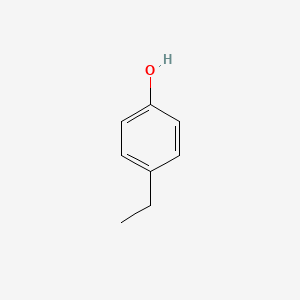
4-Ethylphenol
4-ethylphenol is a member of the class of phenols carrying an ethyl substituent at position 4. It has a role as a fungal xenobiotic metabolite. — ChEBI
- IUPAC name
- 4-ethylphenol
- Molecular formula
- C8H10O
- Molecular weight
- 122.16 g/mol
- Exact mass
- 122.073164938 Da
- XLogP3
- 2.6
- Topological polar surface area
- 20.2 Ų
- Hydrogen-bond donors
- 1
- Hydrogen-bond acceptors
- 1
- Covalent units
- 1
- Defined stereocentres
- 0
Also known as
16 more reported names
External database identifiers
- ChEBI:CHEBI:49584
- ChEMBL:CHEMBL108475
- EPA DTXSID:DTXSID4021977
- PubMed:31127318
- PubMed:29658714
- PubMed:23800587
- PubMed:22908955
- PubMed:22717604
- PubMed:22698780
- PubMed:22694318
- PubMed:22619602
- PubMed:22611432
- PubMed:22608775
- PubMed:22470482
- PubMed:22452960
Evidence from additional scientific databases
NIH PubChem PUG-View
Attributed physical-property, hazard, environmental and use annotations.
- Boiling Point: 217.9 °C Source: Hazardous Substances Data Bank (HSDB)
- Boiling Point: 218.00 to 219.00 °C. @ 760.00 mm Hg Source: Human Metabolome Database (HMDB)
- Boiling Point: 218-219 °C Source: Joint FAO/WHO Expert Committee on Food Additives (JECFA)
- Color/Form: COLORLESS OR WHITE NEEDLES; TEND TO YELLOW ON EXPOSURE TO LIGHT Source: Hazardous Substances Data Bank (HSDB)
- Density: 1.011 @ 20 °C Source: Hazardous Substances Data Bank (HSDB)
- Dissociation Constants: pK = 10.38 @ 20 °C Source: Hazardous Substances Data Bank (HSDB)
- Dissociation Constants: pK = 10.0 at 25 °C Source: Hazardous Substances Data Bank (HSDB)
- Flash Point: 104 °C Source: Haz-Map, Information on Hazardous Chemicals and Occupational Diseases
- Flash Point: 219 °F (104 °C) (Open Cup) Source: Hazardous Substances Data Bank (HSDB)
- LogP: Log Kow = 2.58 Source: Hazardous Substances Data Bank (HSDB)
- LogP: 2.580 Source: Human Metabolome Database (HMDB)
- Melting Point: 46 °C Source: Hazardous Substances Data Bank (HSDB)
- Melting Point: 44.00 to 46.00 °C. @ 760.00 mm Hg Source: Human Metabolome Database (HMDB)
- Odor: POWERFUL WOODY-PHENOLIC, YET SOMEWHAT SWEET Source: Hazardous Substances Data Bank (HSDB)
- Odor: MEDICINAL, PHENOLIC Source: Hazardous Substances Data Bank (HSDB)
- Physical Description: Liquid Source: EPA Chemical Data Reporting (CDR)
- Physical Description: Colorless or white solid; Yellows upon exposure to light; [HSDB] Source: Haz-Map, Information on Hazardous Chemicals and Occupational Diseases
- Physical Description: Solid Source: Human Metabolome Database (HMDB)
- Physical Description: Colourless needle like crystals, powerful, woody phenolic, medicinal, yet rather sweet odour Source: Joint FAO/WHO Expert Committee on Food Additives (JECFA)
- Refractive Index: INDEX OF REFRACTION: 1.5239 @ 25 °C Source: Hazardous Substances Data Bank (HSDB)
- Solubility: SLIGHTLY SOL IN WATER; SOL IN ALC, ETHER, & BENZENE; SOL IN CARBON DISULFIDE, & ACETONE Source: Hazardous Substances Data Bank (HSDB)
- Solubility: In water, 4.90X10+3 mg/l at 25 °C Source: Hazardous Substances Data Bank (HSDB)
- Solubility: slightly soluble in water; soluble in oils Source: Joint FAO/WHO Expert Committee on Food Additives (JECFA)
- Solubility: very soluble (in ethanol) Source: Joint FAO/WHO Expert Committee on Food Additives (JECFA)
- Vapor Pressure: 0.03 [mmHg] Source: Haz-Map, Information on Hazardous Chemicals and Occupational Diseases
- Vapor Pressure: 0.0372 mm Hg at 25 °C. Source: Hazardous Substances Data Bank (HSDB)
- Carcinogen Classification: No indication of carcinogenicity (not listed by IARC). (L135) Source: Toxin and Toxin Target Database (T3DB)
- Exposure Routes: Dermal (T36) ; inhalation (T36) ; oral (T36) Source: Toxin and Toxin Target Database (T3DB)
- Note: This chemical does not meet GHS hazard criteria for 0.4% (7 of 1875) of reports. Source: European Chemicals Agency (ECHA)
- Signal: Danger Source: European Chemicals Agency (ECHA)
- GHS Hazard Statements: H314 (86%): Causes severe skin burns and eye damage [Danger Skin corrosion/irritation]; H318 (81.3%): Causes serious eye damage [Danger Serious eye damage/eye irritation] Source: European Chemicals Agency (ECHA)
- Precautionary Statement Codes: P260, P264, P264+P265, P280, P301+P330+P331, P302+P361+P354, P304+P340, P305+P354+P338, P316, P317, P321, P363, P405, and P501 (click each P-code to see the statement) Source: European Chemicals Agency (ECHA)
- ECHA C&L Notifications Summary: Aggregated GHS information provided per 1875 reports by companies from 14 notifications to the ECHA C&L Inventory. Each notification may be associated with multiple companies.; Reported as not meeting GHS hazard criteria per 7 of 1875 reports by companies.; There are 13 notifications provided by 1868 of 1875 reports by companies with hazard statement code(s).; Information may vary between notifications depending on impurities, additives, and other factors. The percentage value in parenthesis indicates the notified classification ratio from companies that provide hazard codes. Only hazard codes with percentage values above 10% are shown. For more detailed information, please visit ECHA C&L website. Source: European Chemicals Agency (ECHA)
- Signal: Danger Source: NITE-CMC
- GHS Hazard Statements: H318: Causes serious eye damage [Danger Serious eye damage/eye irritation] Source: NITE-CMC
- Precautionary Statement Codes: P264+P265, P280, P305+P354+P338, and P317 (click each P-code to see the statement) Source: NITE-CMC
- Signal: Danger Source: Hazardous Chemical Information System (HCIS), Safe Work Australia
- GHS Hazard Statements: H302: Harmful if swallowed [Warning Acute toxicity, oral]; H318: Causes serious eye damage [Danger Serious eye damage/eye irritation] Source: Hazardous Chemical Information System (HCIS), Safe Work Australia
- Precautionary Statement Codes: P264, P264+P265, P270, P280, P301+P317, P305+P354+P338, P317, P330, and P501 (click each P-code to see the statement) Source: Hazardous Chemical Information System (HCIS), Safe Work Australia
- Health Effects: Respiratory distress, cardiovascular collapse, shock, ventricular tachycardia, and coma in an adult. Liver, lung, central nervous system and renal injury may also occur (T36). Source: Toxin and Toxin Target Database (T3DB)
- NFPA Health Rating: 2 - Materials that, under emergency conditions, can cause temporary incapacitation or residual injury. Source: Hazardous Substances Data Bank (HSDB)
- NFPA Fire Rating: 1 - Materials that must be preheated before ignition can occur. Materials require considerable preheating, under all ambient temperature conditions, before ignition and combustion can occur. Source: Hazardous Substances Data Bank (HSDB)
- NFPA Instability Rating: 0 - Materials that in themselves are normally stable, even under fire conditions. Source: Hazardous Substances Data Bank (HSDB)
- Toxicity Summary: Metabolized to 1- and 2- phenylethanol (A622). Source: Toxin and Toxin Target Database (T3DB)
- Environmental Bioconcentration: An estimated BCF value of 54 was calculated for p-ethylphenol(SRC), using a measured log Kow of 2.58(1) and a recommended regression-derived equation(2). According to a recommended classification scheme(3), this BCF value suggests that bioconcentration in aquatic organisms may be an important fate process(SRC). Source: Hazardous Substances Data Bank (HSDB)
- Environmental Fate: TERRESTRIAL FATE: Based on a recommended classification scheme(1), an estimated Koc value of 600(SRC), determined from a measured log Kow(2) and a recommended regression-derived equation(3), indicates that p-ethylphenol will have low mobility in soil(SRC). Based on limited data, biodegradation of this compound is likely. A system where water was passed through contaminated soil (initial p-ethylphenol concentration = 4000 ug/l) and then through an upflow aerated column was capable of 76% removal in 37 days(4). p-Ethylphenol's values for vapor pressure(5) and Henry's Law constant(5,6,SRC) indicate that volatilization from dry and moist soil surfaces is possible, but will not be a major fate process for this compound(SRC). Source: Hazardous Substances Data Bank (HSDB)
- Environmental Fate: AQUATIC FATE: Based on a recommended classification scheme(1), an estimated Koc value of 600(SRC), determined from a measured log Kow(2) and a recommended regression-derived equation(3), indicates that p-ethylphenol may adsorb to suspended solids and sediment(SRC) in water. Based on limited soil study data, biodegradation of this compound is likely. 76% removal of p-ethylphenol in 37 days was seen in a soil column study(4). p-Ethylphenol should volatilize from water surfaces based on an estimated Henry's Law constant of 1.2X10⁻⁶ atm-cu m/mole(SRC), calculated from experimental values for vapor pressure(5) and water solubility(6). Estimated half-lives for a model river and model lake are 33 and 245 days, respectively(3,SRC). An estimated BCF value of 54(3,SRC), from an experimental log Kow(2), suggests that p-ethylphenol may bioconcentrate in aquatic organisms(SRC) according to a recommended classification scheme(7). Source: Hazardous Substances Data Bank (HSDB)
- Environmental Fate: ATMOSPHERIC FATE: According to a suggested classification scheme(1), a measured vapor pressure of 0.0372 mm Hg at 25 °C(2) indicates that p-ethylphenol will mainly exist in the vapor phase in the ambient atmosphere(SRC). Vapor-phase p-ethylphenol is degraded in the atmosphere by reaction with photochemically produced hydroxyl radicals(SRC); the half-life for this reaction in air is estimated to be about 9 hours(3,SRC). Source: Hazardous Substances Data Bank (HSDB)
- Consumer Uses: Solvent; Cleaning agent Source: EPA Chemical Data Reporting (CDR)
- Industry Uses: Corrosion inhibitor; Cleaning agent; Solvent Source: EPA Chemical Data Reporting (CDR)
- Sources/Uses: Used as a flavor and to make pharmaceuticals, dyes, and antioxidants (used in rubber and polymers); [HSDB] Source: Haz-Map, Information on Hazardous Chemicals and Occupational Diseases
- Uses: SYNTHETIC FLAVOR Source: Hazardous Substances Data Bank (HSDB)
- Uses: 4-Ethylphenol is contained in the xylenol fraction boiling between ca. 205 and 225 °C obtained from tar phenols, which is used, for example, for the production of phenolic resins. A xylenol fraction boiling between 216 and 218 °C containing predominantly 3- and 4-ethylphenol is obtained from brown coal low-temperature tar and used in the varnish industry. Source: Hazardous Substances Data Bank (HSDB)
- Uses: Pure 4-ethylphenol is the starting material for the production of 4-vinylphenol and of various antioxidants (eg, 2,6-di-t-butyl-4-ethylphenol and 2,2'-methylenebis(6-t-butyl-4-ethylphenol)), which are used in rubber and polymers. 4-Ethylphenol is an intermediate for pharmaceuticals and dyes. Source: Hazardous Substances Data Bank (HSDB)
Mapped by: Existing checksum-valid CAS to unique PubChem CID match. Retrieved: 2026-08-31. Open source record
Scientific classifications and hazard annotations provide context and do not replace the market-specific regulatory decision shown above.
Additional source coverage and match status
| Source | Result | Checked |
|---|---|---|
| NIH PubChem PUG-View | Exact match | 2026-08-31 |
A recorded no-match is useful evidence that the source was checked; it is not a claim that the substance does not exist elsewhere.
Retrieved from NIH PubChem on 2026-08-31 by checksum-valid CAS matching. Chemical properties do not replace the regulatory decision on this page.
Inventory details for 4-ETHYLPHENOL
INCI name
4-ETHYLPHENOL
Description
4-Ethylphenol
Record provenance
- Inventory reference
- 39919
- Imported identity
- 4-ETHYLPHENOL
- Source update
- 02/03/2011
Annex records for 4-ETHYLPHENOL
Key data
Related inventory evidence
Ingredients with overlapping formulation functions
Additional official and scientific sources
11 external databases to check this identity in
Each link searches that source for this identity. What each source is, and its legal weight
How 4-ETHYLPHENOL appears in the CosIng inventory
The CosIng inventory lists 4-ETHYLPHENOL as a cosmetic ingredient and this page links it to 0 annex records. The inventory entry captures names and identifiers, while the annex records show where the substance is prohibited, restricted or positively listed in EU cosmetics law.
4-ETHYLPHENOL is also tagged with 1 cosmetic function in the official data. Function labels describe intended use, but they do not replace regulatory review of linked annex records before formulation or labelling work.
Frequently asked questions
Source note for 4-ETHYLPHENOL
This page reproduces the CosIng inventory entry for 4-ETHYLPHENOL from public European Commission cosmetic ingredient materials and shows linked identifiers even when no direct annex match is currently attached.
Use this inventory page to research 4-ETHYLPHENOL and compare linked records, but verify restrictions and legal status against the current official source text and law before making regulatory decisions.
Tools & next steps
Check your formula
Scan a full INCI list to detect 4-ETHYLPHENOL and any linked EU annex restrictions or allergen flags.
INCI CheckerSearch similar ingredients
Find other inventory ingredients and annex entries related to 4-ETHYLPHENOL, its identifiers or nearby name variants.
Search