
EICOSAPENTAENOIC ACID
5,8,11,14,17-Eicosapentaenoic acid
EICOSAPENTAENOIC ACID is listed in the EU CosIng inventory, but no direct annex records are linked on this page yet.
Regulatory evidence by market
No rule for this ingredient has been imported for any of the 13 markets tracked here.
That describes this inventory, not the law. No imported rule is not evidence that an ingredient is permitted: a rule may exist under another name or identifier, or in a dataset not yet imported here.
Chemical identity and properties
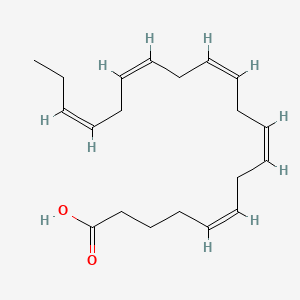
Icosapent
All-cis-5,8,11,14,17-icosapentaenoic acid is an icosapentaenoic acid having five cis-double bonds at positions 5, 8, 11, 14 and 17. It has a role as a micronutrient, an antidepressant, an antineoplastic agent, an anticholesteremic drug, a nutraceutical, a mouse metabolite, a fungal metabolite and a Daphnia galeata metabolite. It is an omega-3 fatty acid and an icosapentaenoic acid. It is a conjugate acid of an all-cis-5,8,11,14,17-icosapentaenoate. — ChEBI
- IUPAC name
- (5Z,8Z,11Z,14Z,17Z)-icosa-5,8,11,14,17-pentaenoic acid
- Molecular formula
- C20H30O2
- Molecular weight
- 302.5 g/mol
- Exact mass
- 302.224580195 Da
- XLogP3
- 5.6
- Topological polar surface area
- 37.3 Ų
- Hydrogen-bond donors
- 1
- Hydrogen-bond acceptors
- 2
- Covalent units
- 1
- Defined stereocentres
- 0
Also known as
16 more reported names
External database identifiers
- ChEBI:CHEBI:28364
- ChEMBL:CHEMBL460026
- EPA DTXSID:DTXSID9041023
- PubMed:29968805
- PubMed:21683321
- PubMed:20671299
- PubMed:15753205
- PubMed:15619630
- PubMed:15519495
- PubMed:11347965
Evidence from additional scientific databases
EMBL-EBI ChEBI
all-cis-5,8,11,14,17-icosapentaenoic acid
An icosapentaenoic acid having five cis-double bonds at positions 5, 8, 11, 14 and 17.
- Formula
- C20H30O2
- Average mass
- 302.458 g/mol
- Monoisotopic mass
- 302.22458 Da
- Formal charge
- 0
- icosapentaenoic acid — is a (CHEBI:36006)
- ω−3 fatty acid — is a (CHEBI:25681)
- antiviral agent — has role (CHEBI:22587)
- renoprotective agent — has role (CHEBI:231911)
- immunosuppressive agent — has role (CHEBI:35705)
- anti-obesity agent — has role (CHEBI:74518)
- micronutrient — has role (CHEBI:27027)
- nutraceutical — has role (CHEBI:50733)
- Daphnia galeata metabolite — has role (CHEBI:83038)
- anticholesteremic drug — has role (CHEBI:35821)
- mouse metabolite — has role (CHEBI:75771)
- antineoplastic agent — has role (CHEBI:35610)
- antidepressant — has role (CHEBI:35469)
- fungal metabolite — has role (CHEBI:76946)
- geroprotector — has role (CHEBI:176497)
- antirheumatic drug — has role (CHEBI:35842)
- anti-asthmatic agent — has role (CHEBI:65023)
- antipsychotic agent — has role (CHEBI:35476)
- antiviral agent — has role (CHEBI:22587)
- renoprotective agent — has role (CHEBI:231911)
- immunosuppressive agent — has role (CHEBI:35705)
- anti-obesity agent — has role (CHEBI:74518)
- micronutrient — has role (CHEBI:27027)
- nutraceutical — has role (CHEBI:50733)
- Daphnia galeata metabolite — has role (CHEBI:83038)
- anticholesteremic drug — has role (CHEBI:35821)
- mouse metabolite — has role (CHEBI:75771)
- antineoplastic agent — has role (CHEBI:35610)
- antidepressant — has role (CHEBI:35469)
- fungal metabolite — has role (CHEBI:76946)
- geroprotector — has role (CHEBI:176497)
- antirheumatic drug — has role (CHEBI:35842)
- anti-asthmatic agent — has role (CHEBI:65023)
- antipsychotic agent — has role (CHEBI:35476)
- cardiovascular drug — has role (CHEBI:35554)
- anticonvulsant — has role (CHEBI:35623)
- anti-inflammatory agent — has role (CHEBI:67079)
- gastrointestinal drug — has role (CHEBI:55324)
- icosapentaenoic acid — is a (CHEBI:36006)
- ω−3 fatty acid — is a (CHEBI:25681)
- all-cis-5,8,11,14,17-icosapentaenoate — is conjugate acid of (CHEBI:58562)
- 11421736 Source: PubMed
- 12549599 Source: PubMed
- 16643058 Source: PubMed
- 17420205 Source: PubMed
- 18459759 Source: PubMed
- 18638380 Source: PubMed
- 19036594 Source: PubMed
- 19054597 Source: PubMed
- 20014752 Source: PubMed
- 21118482 Source: PubMed
- 21274596 Source: PubMed
- 21903399 Source: PubMed
- 22260081 Source: PubMed
- 22822908 Source: PubMed
- 23920312 Source: PubMed
- 24108131 Source: PubMed
- 24238887 Source: PubMed
- 24351031 Source: PubMed
- 24387137 Source: PubMed
- 24389665 Source: PubMed
- 26784936 Source: PubMed
- 31483660 Source: PubMed
- 31618024 Source: PubMed
- 33378197 Source: PubMed
Additional curated names
Cross-references from this source
- CAS: 10417-94-4 — KEGG COMPOUND
- CAS: 10417-94-4 — ChemIDplus
- REGISTRY_NUMBER: 1714433 — Reaxys
- MANUAL_X_REF: 3174 — DrugCentral
- MANUAL_X_REF: C00000408 — KNApSAcK
- MANUAL_X_REF: C00001215 — KNApSAcK
- MANUAL_X_REF: C06428 — KEGG COMPOUND
- MANUAL_X_REF: D08061 — KEGG DRUG
- MANUAL_X_REF: DB00159 — DrugBank
- MANUAL_X_REF: EICOSAPENTAENOATE — MetaCyc
- MANUAL_X_REF: EPA — PDBeChem
- MANUAL_X_REF: HMDB0001999 — HMDB
- MANUAL_X_REF: LMFA01030759 — LIPID MAPS
Mapped by: Exact CAS cross-reference in the ChEBI compound record. Source updated: 2018-03-05. Retrieved: 2026-08-31. Open source record
NIH PubChem PUG-View
Attributed physical-property, hazard, environmental and use annotations.
- LogP: 6.1 Source: DrugBank
- Physical Description: Liquid Source: Human Metabolome Database (HMDB)
- Signal: Danger Source: European Chemicals Agency (ECHA)
- GHS Hazard Statements: H314 (100%): Causes severe skin burns and eye damage [Danger Skin corrosion/irritation] Source: European Chemicals Agency (ECHA)
- Precautionary Statement Codes: P260, P264, P280, P301+P330+P331, P302+P361+P354, P304+P340, P305+P354+P338, P316, P321, P363, P405, and P501 (click each P-code to see the statement) Source: European Chemicals Agency (ECHA)
- ECHA C&L Notifications Summary: Aggregated GHS information provided per 92 reports by companies from 1 notifications to the ECHA C&L Inventory.; Information may vary between notifications depending on impurities, additives, and other factors. The percentage value in parenthesis indicates the notified classification ratio from companies that provide hazard codes. Only hazard codes with percentage values above 10% are shown. For more detailed information, please visit ECHA C&L website. Source: European Chemicals Agency (ECHA)
Mapped by: Existing checksum-valid CAS to unique PubChem CID match. Retrieved: 2026-08-31. Open source record
Scientific classifications and hazard annotations provide context and do not replace the market-specific regulatory decision shown above.
Additional source coverage and match status
| Source | Result | Checked |
|---|---|---|
| EMBL-EBI ChEBI | Exact match | 2026-08-31 |
| NIH PubChem PUG-View | Exact match | 2026-08-31 |
A recorded no-match is useful evidence that the source was checked; it is not a claim that the substance does not exist elsewhere.
Retrieved from NIH PubChem on 2026-08-31 by checksum-valid CAS matching. Chemical properties do not replace the regulatory decision on this page.
What the official INCI name states
The official label identifies a biological source material and its stated preparation or plant part.
- Identity type from wording
- biological_material
This structure is derived only from the official label wording. It does not establish composition, concentration, chemical equivalence, safety or regulatory permission.
Inventory details for EICOSAPENTAENOIC ACID
INCI name
EICOSAPENTAENOIC ACID
INN name
icosapent
Description
5,8,11,14,17-Eicosapentaenoic acid
Record provenance
- Inventory reference
- 33757
- Imported identity
- EICOSAPENTAENOIC ACID
- Source update
- 15/10/2010
Annex records for EICOSAPENTAENOIC ACID
Key data
- SKIN CONDITIONING
- Maintaining the skin in good condition.
- SKIN CONDITIONING - EMOLLIENT
- Acting as lubricants on the skin surface providing the skin with a soft and smooth appearance.
Official EU ingredient-name evidence
The ingredient name exactly matches the official 2025 EU glossary of common ingredient names.
Related inventory evidence
Ingredients with overlapping formulation functions
Additional official and scientific sources
11 external databases to check this identity in
Each link searches that source for this identity. What each source is, and its legal weight
How EICOSAPENTAENOIC ACID appears in the CosIng inventory
The CosIng inventory lists EICOSAPENTAENOIC ACID as a cosmetic ingredient and this page links it to 0 annex records. The inventory entry captures names and identifiers, while the annex records show where the substance is prohibited, restricted or positively listed in EU cosmetics law.
EICOSAPENTAENOIC ACID is also tagged with 2 cosmetic functions in the official data. Function labels describe intended use, but they do not replace regulatory review of linked annex records before formulation or labelling work.
Frequently asked questions
Source note for EICOSAPENTAENOIC ACID
This page reproduces the CosIng inventory entry for EICOSAPENTAENOIC ACID from public European Commission cosmetic ingredient materials and shows linked identifiers even when no direct annex match is currently attached.
Use this inventory page to research EICOSAPENTAENOIC ACID and compare linked records, but verify restrictions and legal status against the current official source text and law before making regulatory decisions.
Tools & next steps
Check your formula
Scan a full INCI list to detect EICOSAPENTAENOIC ACID and any linked EU annex restrictions or allergen flags.
INCI CheckerSearch similar ingredients
Find other inventory ingredients and annex entries related to EICOSAPENTAENOIC ACID, its identifiers or nearby name variants.
Search