
BHT
2,6-Di-tert-butyl-p-cresol
BHT is linked to 1 EU annex record on this page.
Regulatory evidence by market
This matrix separates verified ingredient rules from sources that are mapped but not yet imported. No imported rule does not mean the ingredient is permitted.
Swipe or scroll horizontally to see every column.
| Market | Evidence status | Records | Source language |
|---|---|---|---|
| European Union | Evidence linked Restricted entry found Open this evidence | 1 | English and EU languages |
| Great Britain | Evidence linked Restricted Open this evidence | 1 | English |
| Canada | Source mapped Official source mapped; ingredient rule not imported | 0 | English and French |
| New Zealand | Source mapped Official source mapped; ingredient rule not imported | 0 | English |
| ASEAN | Evidence linked Restricted Open this evidence | 1 | English and national languages |
| China | Source mapped Official source mapped; ingredient rule not imported | 0 | Chinese with selected English material |
| Japan | Source mapped Official source mapped; ingredient rule not imported | 0 | Japanese; official English translation available |
| South Korea | Source mapped Official source mapped; ingredient rule not imported | 0 | Korean with some English names |
| United States | Source mapped Official source mapped; ingredient rule not imported | 0 | English |
| Australia | Source mapped Official source mapped; ingredient rule not imported | 0 | English |
| Brazil | Source mapped Official source mapped; ingredient rule not imported | 0 | Portuguese with INCI crosswalks |
| India | Source mapped Official source mapped; ingredient rule not imported | 0 | English and Hindi |
| Saudi Arabia | Evidence linked Restricted Open this evidence | 1 | Arabic and English |
Chemical identity and properties
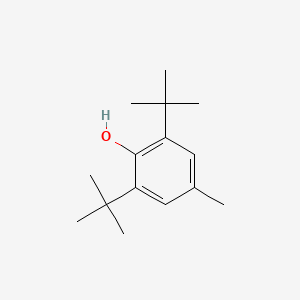
2,6-Di-tert-butyl-4-methylphenol
2,6-di-tert-butyl-4-methylphenol is a member of the class of phenols that is 4-methylphenol substituted by tert-butyl groups at positions 2 and 6. It has a role as a ferroptosis inhibitor, a geroprotector, an antioxidant and a food additive. It is functionally related to a phenol. — ChEBI
- IUPAC name
- 2,6-ditert-butyl-4-methylphenol
- Molecular formula
- C15H24O
- Molecular weight
- 220.35 g/mol
- Exact mass
- 220.182715385 Da
- XLogP3
- 5.3
- Topological polar surface area
- 20.2 Ų
- Hydrogen-bond donors
- 1
- Hydrogen-bond acceptors
- 1
- Covalent units
- 1
- Defined stereocentres
- 0
Also known as
16 more reported names
External database identifiers
Evidence from additional scientific databases
NIH PubChem PUG-View
Attributed physical-property, hazard, environmental and use annotations.
- Boiling Point: 509 °F at 760 mmHg (NTP, 1992) Source: CAMEO Chemicals
- Boiling Point: 265 °C Source: Hazardous Substances Data Bank (HSDB)
- Boiling Point: 265.00 °C. @ 760.00 mm Hg Source: Human Metabolome Database (HMDB)
- Boiling Point: 265 °C Source: ILO-WHO International Chemical Safety Cards (ICSCs)
- Boiling Point: 509 °F Source: Occupational Safety and Health Administration (OSHA)
- Boiling Point: 509 °F Source: The National Institute for Occupational Safety and Health (NIOSH)
- Color/Form: White, crystalline solid Source: Hazardous Substances Data Bank (HSDB)
- Color/Form: Crystals Source: Hazardous Substances Data Bank (HSDB)
- Color/Form: Pale yellowish crystalline powder Source: Hazardous Substances Data Bank (HSDB)
- Color/Form: White to pale-yellow, crystalline solid. Source: Hazardous Substances Data Bank (HSDB)
- Density: 1.048 at 68 °F (NTP, 1992) - Denser than water; will sink Source: CAMEO Chemicals
- Density: 1.048 at 20 °C/4 °C Source: Hazardous Substances Data Bank (HSDB)
- Density: Density: 0.8937 g/cu cm at 75 °C Source: Hazardous Substances Data Bank (HSDB)
- Density: 1.03-1.05 g/cm³ Source: ILO-WHO International Chemical Safety Cards (ICSCs)
- Density: 1.05 Source: Occupational Safety and Health Administration (OSHA)
- Density: 1.05 Source: The National Institute for Occupational Safety and Health (NIOSH)
- Flash Point: 260 °F (NTP, 1992) Source: CAMEO Chemicals
- Flash Point: 260 °F Source: Haz-Map, Information on Hazardous Chemicals and Occupational Diseases
- Flash Point: 127.0 °C (260.6 °F) - closed cup Source: Hazardous Substances Data Bank (HSDB)
- Flash Point: 260 °F (127 °C) open cup Source: Hazardous Substances Data Bank (HSDB)
- Flash Point: 261 °F (127 °C) closed cup Source: Hazardous Substances Data Bank (HSDB)
- Flash Point: 127 °C c.c. Source: ILO-WHO International Chemical Safety Cards (ICSCs)
- Flash Point: 261 °F Source: Occupational Safety and Health Administration (OSHA)
- Flash Point: 261 °F Source: The National Institute for Occupational Safety and Health (NIOSH)
- LogP: log Kow = 5.10 Source: Hazardous Substances Data Bank (HSDB)
- LogP: 5.10 Source: Human Metabolome Database (HMDB)
- LogP: 5.1 Source: ILO-WHO International Chemical Safety Cards (ICSCs)
- Melting Point: 156 to 160 °F (NTP, 1992) Source: CAMEO Chemicals
- Melting Point: 70 °C Source: Hazardous Substances Data Bank (HSDB)
- Melting Point: 71 °C Source: Human Metabolome Database (HMDB)
- Melting Point: 70 °C Source: ILO-WHO International Chemical Safety Cards (ICSCs)
- Melting Point: 158 °F Source: Occupational Safety and Health Administration (OSHA)
- Melting Point: 158 °F Source: The National Institute for Occupational Safety and Health (NIOSH)
- Odor: Very faint, musty, occasional cresylic-type odor Source: Hazardous Substances Data Bank (HSDB)
- Physical Description: Butylated hydroxytoluene is a white crystalline solid. (NTP, 1992) Source: CAMEO Chemicals
- Physical Description: Other Solid; Dry Powder; CBI; Large Crystals; Liquid; Large Crystals; Liquid; Other Solid Source: EPA Chemical Data Reporting (CDR)
- Physical Description: White, crystalline or flaked solid, odourless or having a characteristic faint aromatic odour Source: EU Food Improvement Agents
- Physical Description: White to pale-yellow, crystalline solid with a slight, phenolic odor; (food preservative); [NIOSH] Source: Haz-Map, Information on Hazardous Chemicals and Occupational Diseases
- Physical Description: Solid Source: Human Metabolome Database (HMDB)
- Physical Description: COLOURLESS-TO-PALE-YELLOW CRYSTALS OR POWDER. Source: ILO-WHO International Chemical Safety Cards (ICSCs)
- Physical Description: White to pale-yellow, crystalline solid with a slight, phenolic odor. Source: Occupational Safety and Health Administration (OSHA)
- Physical Description: White to pale-yellow, crystalline solid with a slight, phenolic odor. [food preservative] Source: The National Institute for Occupational Safety and Health (NIOSH)
- Refractive Index: Index of refraction: 1.4859 at 75 °C/D Source: Hazardous Substances Data Bank (HSDB)
- Solubility: less than 1 mg/mL at 68 °F (NTP, 1992) Source: CAMEO Chemicals
- Solubility: Insoluble in water and propane- 1,2-diol; Freely soluble in ethanol Source: EU Food Improvement Agents
- Solubility: In water, 0.6 mg/L at 25 °C Source: Hazardous Substances Data Bank (HSDB)
- Solubility: In water, 0.4 mg/L at 20 °C Source: Hazardous Substances Data Bank (HSDB)
- Solubility: Insoluble in water Source: Hazardous Substances Data Bank (HSDB)
- Solubility: Freely soluble in toluene; soluble in methanol, isopropanol, methyl ethyl ketone, acetone, cellosolve, benzene, most hydrocarbon solvents, ethanol, petroleum ether, liquid petrolatum (white oil): 0.5% wt/wt; more sol in food oils and fats than butylated hydroxyanisol; good solubility in linseed oil. Insoluble in propylene glycol Source: Hazardous Substances Data Bank (HSDB)
- Solubility: For more Solubility (Complete) data for 2,6-DI-T-BUTYL-P-CRESOL (6 total), please visit the HSDB record page. Source: Hazardous Substances Data Bank (HSDB)
- Solubility: 0.0006 mg/mL at 25 °C Source: Human Metabolome Database (HMDB)
- Solubility: Solubility in water, g/100ml at 25 °C: 0.00006 Source: ILO-WHO International Chemical Safety Cards (ICSCs)
- Solubility: 0.00004% Source: The National Institute for Occupational Safety and Health (NIOSH)
- Vapor Pressure: 0.01 mmHg (NIOSH, 2024) Source: CAMEO Chemicals
- Vapor Pressure: 0.01 [mmHg] Source: Haz-Map, Information on Hazardous Chemicals and Occupational Diseases
- Vapor Pressure: 5.16X10⁻³ mm Hg at 25 °C Source: Hazardous Substances Data Bank (HSDB)
- Vapor Pressure: Vapor pressure, Pa at 20 °C: 1.3 Source: ILO-WHO International Chemical Safety Cards (ICSCs)
- Vapor Pressure: 0.01 mmHg Source: Occupational Safety and Health Administration (OSHA)
- Vapor Pressure: 0.01 mmHg Source: The National Institute for Occupational Safety and Health (NIOSH)
- Viscosity: 3.47 centistokes at 0 °C; 1.54 centistokes at 120 °C Source: Hazardous Substances Data Bank (HSDB)
- IARC Carcinogenic Agent: Butylated hydroxytoluene (BHT) Source: International Agency for Research on Cancer (IARC)
- IARC Carcinogenic Classes: Group 3: Not classifiable as to its carcinogenicity to humans Source: International Agency for Research on Cancer (IARC)
- IARC Monographs: Volume 40: (1986) Some Naturally Occurring and Synthetic Food Components, Furocoumarins and Ultraviolet Radiation; Volume Sup 7: Overall Evaluations of Carcinogenicity: An Updating of IARC Monographs Volumes 1 to 42, 1987; 440 pages; ISBN 92-832-1411-0 (out of print) Source: International Agency for Research on Cancer (IARC)
- Publication Year: 1987 Source: International Agency for Research on Cancer (IARC)
- Evaluation Year: 1987 Source: International Agency for Research on Cancer (IARC)
- Substance: Butylated hydroxytoluene Source: NTP Technical Reports
- NTP Technical Report: TR-150: Bioassay of Butylated Hydroxytoluene (BHT) for Possible Carcinogenicity (CASRN 128-37-0) (1979 ) Source: NTP Technical Reports
- Peer Review Date: 12/13/78 Source: NTP Technical Reports
- Conclusion for Male Rat: No Evidence Source: NTP Technical Reports
- Conclusion for Female Rat: No Evidence Source: NTP Technical Reports
- Conclusion for Male Mice: No Evidence Source: NTP Technical Reports
- Conclusion for Female Mice: No Evidence Source: NTP Technical Reports
- Exposure Routes: The substance can be absorbed into the body by inhalation of its aerosol and by ingestion. Source: ILO-WHO International Chemical Safety Cards (ICSCs)
- Exposure Routes: inhalation, ingestion, skin and/or eye contact Source: The National Institute for Occupational Safety and Health (NIOSH)
- Exposure Routes: Ingestion; Inhalation Source: Toxin and Toxin Target Database (T3DB)
- First Aid: EYES: First check the victim for contact lenses and remove if present. Flush victim's eyes with water or normal saline solution for 20 to 30 minutes while simultaneously calling a hospital or poison control center. Do not put any ointments, oils, or medication in the victim's eyes without specific instructions from a physician. IMMEDIATELY transport the victim after flushing eyes to a hospital even if no symptoms (such as redness or irritation) develop.; SKIN: IMMEDIATELY flood affected skin with water while removing and isolating all contaminated clothing. Gently wash all affected skin areas thoroughly with soap and water. If symptoms such as redness or irritation develop, IMMEDIATELY call a physician and be prepared to transport the victim to a hospital for treatment.; INHALATION: IMMEDIATELY leave the contaminated area; take deep breaths of fresh air. If symptoms (such as wheezing, coughing, shortness of breath, or burning in the mouth, throat, or chest) develop, call a physician and be prepared to transport the victim to a hospital. Provide proper respiratory protection to rescuers entering an unknown atmosphere. Whenever possible, Self-Contained Breathing Apparatus (SCBA) shou Source: CAMEO Chemicals
- First Aid: (General first aid procedures); Eye: Irrigate immediately - If this chemical contacts the eyes, immediately wash (irrigate) the eyes with large amounts of water, occasionally lifting the lower and upper lids. Get medical attention immediately.; Skin: Soap wash - If this chemical contacts the skin, wash the contaminated skin with soap and water.; Breathing: Fresh air; Swallow: Medical attention immediately - If this chemical has been swallowed, get medical attention immediately. Source: The National Institute for Occupational Safety and Health (NIOSH)
- Note: This chemical does not meet GHS hazard criteria for 4.6% (306 of 6619) of reports. Source: European Chemicals Agency (ECHA)
- Signal: Warning Source: European Chemicals Agency (ECHA)
- GHS Hazard Statements: H400 (42.6%): Very toxic to aquatic life [Warning Hazardous to the aquatic environment, acute hazard]; H410 (84.3%): Very toxic to aquatic life with long lasting effects [Warning Hazardous to the aquatic environment, long-term hazard] Source: European Chemicals Agency (ECHA)
- Precautionary Statement Codes: P273, P391, and P501 (click each P-code to see the statement) Source: European Chemicals Agency (ECHA)
- ECHA C&L Notifications Summary: Aggregated GHS information provided per 6619 reports by companies from 92 notifications to the ECHA C&L Inventory. Each notification may be associated with multiple companies.; Reported as not meeting GHS hazard criteria per 306 of 6619 reports by companies.; There are 91 notifications provided by 6313 of 6619 reports by companies with hazard statement code(s).; Information may vary between notifications depending on impurities, additives, and other factors. The percentage value in parenthesis indicates the notified classification ratio from companies that provide hazard codes. Only hazard codes with percentage values above 10% are shown. For more detailed information, please visit ECHA C&L website. Source: European Chemicals Agency (ECHA)
- Signal: Danger Source: NITE-CMC
- GHS Hazard Statements: H320: Causes eye irritation [Warning Serious eye damage/eye irritation]; H361: Suspected of damaging fertility or the unborn child [Warning Reproductive toxicity]; H370: Causes damage to organs [Danger Specific target organ toxicity, single exposure]; H373: May causes damage to organs through prolonged or repeated exposure [Warning Specific target organ toxicity, repeated exposure]; H400: Very toxic to aquatic life [Warning Hazardous to the aquatic environment, acute hazard]; H410: Very toxic to aquatic life with long lasting effects [Warning Hazardous to the aquatic environment, long-term hazard] Source: NITE-CMC
- Precautionary Statement Codes: P203, P260, P264, P264+P265, P270, P273, P280, P305+P351+P338, P308+P316, P318, P319, P321, P337+P317, P391, P405, and P501 (click each P-code to see the statement) Source: NITE-CMC
- GHS Hazard Statements: H302: Harmful if swallowed [Warning Acute toxicity, oral]; H313: May be harmful in contact with skin [Warning Acute toxicity, dermal]; H316: Causes mild skin irritation [Warning Skin corrosion/irritation]; H317: May cause an allergic skin reaction [Warning Sensitization, Skin]; H320: Causes eye irritation [Warning Serious eye damage/eye irritation]; H370: Causes damage to organs [Danger Specific target organ toxicity, single exposure]; H373: May causes damage to organs through prolonged or repeated exposure [Warning Specific target organ toxicity, repeated exposure] Source: NITE-CMC
- Precautionary Statement Codes: P260, P261, P264, P264+P265, P270, P272, P280, P301+P317, P302+P317, P302+P352, P305+P351+P338, P308+P316, P319, P321, P330, P332+P317, P333+P317, P337+P317, P362+P364, P405, and P501 (click each P-code to see the statement) Source: NITE-CMC
- Signal: Warning Source: Hazardous Substances Data Bank (HSDB)
- GHS Hazard Statements: H400: Very toxic to aquatic life [Warning Hazardous to the aquatic environment, acute hazard]; H410: Very toxic to aquatic life with long lasting effects [Warning Hazardous to the aquatic environment, long-term hazard] Source: Hazardous Substances Data Bank (HSDB)
- Health Effects: BHT is of low acute toxicity. Acute exposure to BHT can cause coughs and sore throat (inhalation), redness on the skin (via contact) and abdominal pain, confusion, dizziness and nausea (via ingestion). Long-term exposure to high doses of BHT is toxic in mice and rats, causing liver, thyroid and kidney problems and affecting lung function and blood coagulation. BHT can act as a tumour promoter in certain situations (A15353) although it is not a genotoxic carcinogen. Limited evidence suggests that high doses of BHT may mimic estrogen (A15354), the primary female sex hormone, and prevent expression of male sex hormones, resulting in adverse reproductive affects. On chronic oral exposure of rats, liver and thyroid are the main targets. Doses above 25 mg/kg bw/day BHT resulted in thyroid hyperactivity and enlargement of the liver. Source: Toxin and Toxin Target Database (T3DB)
- NFPA Health Rating: 2 - Materials that, under emergency conditions, can cause temporary incapacitation or residual injury. Source: Hazardous Substances Data Bank (HSDB)
- NFPA Fire Rating: 1 - Materials that must be preheated before ignition can occur. Materials require considerable preheating, under all ambient temperature conditions, before ignition and combustion can occur. Source: Hazardous Substances Data Bank (HSDB)
- NFPA Instability Rating: 0 - Materials that in themselves are normally stable, even under fire conditions. Source: Hazardous Substances Data Bank (HSDB)
- Target Organs: Eyes, skin Source: The National Institute for Occupational Safety and Health (NIOSH)
- Toxicity Summary: IDENTIFICATION AND USE: Butylated hydroxytoluene( BHT) is a white, crystalline, odorless solid. It is used as an antioxidant for fats and oils or in packaging material for fat containing foods. HUMAN EXPOSURE AND TOXICITY: Potential symptoms of overexposure are irritation of eyes and skin. ANIMAL STUDIES: Rats fed high doses of BHT, showed increases in serum cholesterol in both sexes. Groups of weanling rats fed BHT in conjunction with lard supplementation had a reduction in growth rate, especially in males. BHT also increased absolute liver weight and the ratio of liver weight to body weight in both sexes. BHT increased the ratio of left adrenal weight to body weight in male rats but had no consistent effect in female rats. BHT administered to rats for 68-82 days caused reduction in rate of increase in weight and fatty infiltration of the liver. BHT was given in feed of rats and mice of both sex at 3000 or 6000 ppm; in rats 105 wk and 107 or 108 wk in mice. No tumors occurred in either sex of rats and mice. When tested for teratogenic properties BHT produced anophthalmia in offspring in rats, but not in mice. BHT administered to pregnant mice for 18 days along with another group f Source: Hazardous Substances Data Bank (HSDB)
- Toxicity Summary: BHT is metabolized to quinone methides (QMs) which are responsible for promoting tumor formation in many animal models. One example of a QM is 2,6-di-tert-butyl-4-methylenecyclohexa-2,5-dienone (BHT-QM). QMs are strongly electrophilic and readily form adducts with proteins. Some of the QM targets include redox proteins such as glutathione S-transferase P1 (GST-P1), peroxiredoxin 6 (Prx6), Cu,Zn-superoxide dismutase (SOD1), carbonyl reductase, and selenium-binding protein 1, which have direct or indirect antioxidant functions. (A15087, A15355). The modification of these proteins leads to decreased cellular protection from electrophiles and oxidants. Alkylation also may interfere with GSTP1 regulation of stress kinases, thereby influencing phosphorylation and cell growth. BHT also binds to the retinoic acid receptor which can lead to changes in cell development. Source: Toxin and Toxin Target Database (T3DB)
- Environmental Bioconcentration: BCF values 330-1800, 230-2500 and 220-2800 were measured for 2,6-di-t-butyl-p-cresol present at 5, 50 and 500 ppb, respectively, using rice fish (Cyprinus carpio) which were exposed over a 6 to 8-week period(1). According to a classification scheme(2), these BCF values suggest that bioconcentration in aquatic organisms is high to very high(SRC), provided the compound is not metabolized by the organism(SRC). Source: Hazardous Substances Data Bank (HSDB)
- Environmental Fate: TERRESTRIAL FATE: Based on a classification scheme(1), an estimated Koc value of 1.5X10+4(SRC), determined from a structure estimation method(2), indicates that 2,6-di-t-butyl-p-cresol is expected to be immobile in soil(SRC). Volatilization of 2,6-di-t-butyl-p-cresol from moist soil surfaces is expected to be an important fate process(SRC) given an estimated Henry's Law constant of 2.5X10⁻³ atm-cu m/mole(SRC), using a fragment constant estimation method(3). However, adsorption to soil is expected to attenuate volatilization(SRC). 2,6-Di-t-butyl-p-cresol is not expected to volatilize from dry soil surfaces(SRC) based upon a vapor pressure of 5.16X10⁻³ mm Hg at 25 °C(4). Utilizing three soil innocula, 48.4-57.3% biodegradation was reached in 24 days(5) indicating that biodegradation is not an important environmental fate process in soil(SRC). Source: Hazardous Substances Data Bank (HSDB)
- Environmental Fate: AQUATIC FATE: Based on a classification scheme(1), an estimated Koc value of 1.5X10+4(SRC), determined from a structure estimation method(2), indicates that 2,6-di-t-butyl-p-cresol is expected to adsorb to suspended solids and sediment(SRC). Volatilization from water surfaces is expected(3) based upon an estimated Henry's Law constant of 2.5X10⁻³ atm-cu m/mole(SRC), developed using a fragment constant estimation method(4). Using this Henry's Law constant and an estimation method(3), volatilization half-lives for a model river and model lake are 5 hrs and 6 days, respectively(SRC). According to a classification scheme(5), BCF values of 330-1800, 230-2500 and 220-2800(6) suggest that bioconcentration in aquatic organisms is high to very high, provided the compound is not metabolized by the organism(SRC). Utilizing a sludge innocula, 4.5% of the Theoretical BOD was reached in four weeks(6) indicating that biodegradation is not an important environmental fate process in water(SRC). Source: Hazardous Substances Data Bank (HSDB)
- Environmental Fate: ATMOSPHERIC FATE: According to a model of gas/particle partitioning of semivolatile organic compounds in the atmosphere(1), 2,6-di-t-butyl-p-cresol, which has a vapor pressure of 5.16X10⁻³ mm Hg at 25 °C(2), is expected to exist solely as a vapor in the ambient atmosphere. Vapor-phase 2,6-di-t-butyl-p-cresol is degraded in the atmosphere by reaction with photochemically-produced hydroxyl radicals(SRC); the half-life for this reaction in air is estimated to be 0.6 days(SRC), calculated from its rate constant of 1.8X10⁻¹¹ cu cm/molecule-sec at 25 °C(SRC) that was derived using a structure estimation method(3). 2,6-Di-t-butyl-p-cresol absorbs at wavelengths >290 nm(4) and, therefore, may be susceptible to direct photolysis by sunlight(SRC). Source: Hazardous Substances Data Bank (HSDB)
- Consumer Uses: Heat transferring agent; Antioxidant; Plating agent; UV stabilizer; Lubricating agent; Polymerization promoter; Dispersing agent; Soil amendments (fertilizers); Not Known or Reasonably Ascertainable; Stabilizing agent; Preservative; Fragrance Source: EPA Chemical Data Reporting (CDR)
- Industry Uses: Plating agent; Heat transferring agent; Antioxidant; Processing aids not otherwise specified; UV stabilizer; Surfactant (surface active agent); Lubricating agent; Polymerization promoter; Dispersing agent; Defoamer; Heat stabilizer; Stabilizing agent; Preservative; Soil amendments (fertilizers); Not Known or Reasonably Ascertainable; Fragrance Source: EPA Chemical Data Reporting (CDR)
- Sources/Uses: Used as an anti-oxidant in gasoline, oils, waxes, rubbers, paints, and plastics; purified forms are used as anti-oxidants in foods; [ACGIH] Used as an anti-skinning agent in paints and inks; [Merck Index] BHT is a preservative and anti-oxidant used in food, cosmetics, and medications. Industrial applications include: animal feeds, jet fuels, rubber, plastics, paints, and glues. [Marks, p. 138-9] Source: Haz-Map, Information on Hazardous Chemicals and Occupational Diseases
- Industrial Processes with risk of exposure: Painting (Pigments, Binders, and Biocides) [Category: Paint]; Working with Glues and Adhesives [Category: Other]; Farming (Feed Additives) [Category: Industry] Source: Haz-Map, Information on Hazardous Chemicals and Occupational Diseases
- Uses: For 2,6-Di-tert-butyl-p-cresol (USEPA/OPP Pesticide Code: 022105) there are 0 labels match. /SRP: Not registered for current use in the U.S., but approved pesticide uses may change periodically and so federal, state and local authorities must be consulted for currently approved uses./ Source: Hazardous Substances Data Bank (HSDB)
- Uses: Reported uses (ppm):; Table: Reported uses (ppm): (Flavor and Extract Manufacturers' Association, 1994) [Table#2880] Source: Hazardous Substances Data Bank (HSDB)
- Uses: Antioxidant for food, animal feed, petroleum products, synthetic rubbers, plastics, animal and vegetable oils, soaps. Antiiskinning agent in paints and inks Source: Hazardous Substances Data Bank (HSDB)
- Uses: BHT is used as an antioxidant which finds many applications in a wide variety of industries. It is used in ground vehicle and aviation gasolines; lubricating, turbine, and insulation oils; waxes, synthetic and natural rubbers, paints, plastics, and elastomers. It protects these materials from oxidation during prolonged storage. Highly purified grades are suitable for use in foods to retard oxidation of animal fats, vegetable oils, and oil-soluble vitamins. It is also used in cosmetics and food packaging materials such as waxed paper, paper board, and polyethylene. It is important in delaying the onset of rancidity of oils and fats in animal feeds, and in preserving the essential nutrients and pigment-forming compounds of these foods. Source: Hazardous Substances Data Bank (HSDB)
- Uses: For more Uses (Complete) data for 2,6-DI-T-BUTYL-P-CRESOL (8 total), please visit the HSDB record page. Source: Hazardous Substances Data Bank (HSDB)
- Uses: BHT is primarily used as an antioxidant food additive (E number E321) as well as an antioxidant additive in cosmetics, pharmaceuticals, jet fuels, rubber, petroleum products, electrical transformer oil, and embalming fluid. Source: Toxin and Toxin Target Database (T3DB)
Mapped by: Existing checksum-valid CAS to unique PubChem CID match. Retrieved: 2026-08-31. Open source record
Scientific classifications and hazard annotations provide context and do not replace the market-specific regulatory decision shown above.
Additional source coverage and match status
| Source | Result | Checked |
|---|---|---|
| NIH PubChem PUG-View | Exact match | 2026-08-31 |
A recorded no-match is useful evidence that the source was checked; it is not a claim that the substance does not exist elsewhere.
Retrieved from NIH PubChem on 2026-08-31 by checksum-valid CAS matching. Chemical properties do not replace the regulatory decision on this page.
Inventory details for BHT
INCI name
BHT
INN name
butylated hydroxytoluene
Ph. Eur. name
butylhydroxytoluenum
Description
2,6-Di-tert-butyl-p-cresol
Record provenance
- Inventory reference
- 32185
- Imported identity
- BHT
- Source update
- 15/10/2010
Annex records for BHT
Key data
- ANTIOXIDANT
- Inhibiting reactions promoted by oxygen, thus avoiding oxidation and rancidity.
- FRAGRANCE
- Imparting an odour or taste. Creating a perceivable pleasant smell and/or masking a bad smell.
Official EU ingredient-name evidence
The ingredient name exactly matches the official 2025 EU glossary of common ingredient names.
Related inventory evidence
Ingredients with overlapping formulation functions
Additional official and scientific sources
11 external databases to check this identity in
Each link searches that source for this identity. What each source is, and its legal weight
How BHT appears in the CosIng inventory
The CosIng inventory lists BHT as a cosmetic ingredient and this page links it to 1 annex record. The inventory entry captures names and identifiers, while the annex record shows where the substance is prohibited, restricted or positively listed in EU cosmetics law.
BHT is also tagged with 2 cosmetic functions in the official data. Function labels describe intended use, but they do not replace regulatory review of linked annex records before formulation or labelling work.
Frequently asked questions
Source note for BHT
This page combines the CosIng inventory entry for BHT with 1 linked Annex II–VI record from the local dataset built from public European Commission cosmetic ingredient materials.
Use this inventory page to research BHT and compare linked records, but verify restrictions and legal status against the current official source text and law before making regulatory decisions.
Tools & next steps
Check your formula
Scan a full INCI list to detect BHT and any linked EU annex restrictions or allergen flags.
INCI CheckerSearch similar ingredients
Find other inventory ingredients and annex entries related to BHT, its identifiers or nearby name variants.
Search