
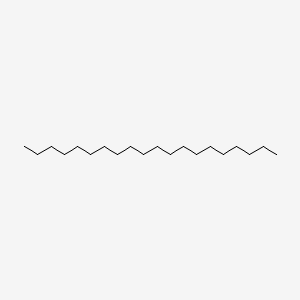
Eicosane
Icosane is a straight chain alkane composed of 20 carbon atoms. It has been isolated from the leaves of Agave attenuata. It has a role as a plant metabolite. — ChEBI
- IUPAC name
- icosane
- Molecular formula
- C20H42
- Molecular weight
- 282.5 g/mol
- Exact mass
- 282.328651340 Da
- XLogP3
- 10.4
- Topological polar surface area
- 0.0 Ų
- Hydrogen-bond donors
- 0
- Hydrogen-bond acceptors
- 0
- Covalent units
- 1
- Defined stereocentres
- 0
Also known as
16 more reported names
External database identifiers
Evidence from additional scientific databases
NIH PubChem PUG-View
Attributed physical-property, hazard, environmental and use annotations.
- Boiling Point: 648.9 °F at 760 mmHg (NTP, 1992) Source: CAMEO Chemicals
- Boiling Point: 344.1 °C Source: Hazardous Substances Data Bank (HSDB)
- Boiling Point: BP: 220 °C at 30 mm Hg Source: Hazardous Substances Data Bank (HSDB)
- Color/Form: Leaflets from alcohol Source: Hazardous Substances Data Bank (HSDB)
- Color/Form: White crystalline solid Source: Hazardous Substances Data Bank (HSDB)
- Density: 0.7886 at 68 °F (NTP, 1992) - Less dense than water; will float Source: CAMEO Chemicals
- Density: 0.7886 g/cu cm at 20 °C Source: Hazardous Substances Data Bank (HSDB)
- Flash Point: 212 °F (NTP, 1992) Source: CAMEO Chemicals
- Flash Point: > 113.00 °C (> 235.40 °F) - closed cup Source: Hazardous Substances Data Bank (HSDB)
- Melting Point: 98.1 °F (NTP, 1992) Source: CAMEO Chemicals
- Melting Point: 36.48 °C Source: Hazardous Substances Data Bank (HSDB)
- Odor: Odorless Source: Hazardous Substances Data Bank (HSDB)
- Physical Description: N-eicosane appears as colorless crystals or white crystalline solid. (NTP, 1992) Source: CAMEO Chemicals
- Physical Description: Other Solid Source: EPA Chemical Data Reporting (CDR)
- Physical Description: Colorless or white solid; mp = 36.7 deg C; [CAMEO] White solid; [Acros Organics MSDS] Source: Haz-Map, Information on Hazardous Chemicals and Occupational Diseases
- Refractive Index: Index of refraction = 1.4425 at 20 °C/D Source: Hazardous Substances Data Bank (HSDB)
- Solubility: less than 1 mg/mL at 77 °F (NTP, 1992) Source: CAMEO Chemicals
- Solubility: In water, 1.9X10⁻³ mg/L at 25 °C Source: Hazardous Substances Data Bank (HSDB)
- Solubility: Insoluble in water Source: Hazardous Substances Data Bank (HSDB)
- Solubility: Soluble in ether, petroleum ether, benzene; slightly soluble in chloroform; very soluble acetone Source: Hazardous Substances Data Bank (HSDB)
- Vapor Pressure: 4.62X10⁻⁶ mm Hg at 25 °C Source: Hazardous Substances Data Bank (HSDB)
- First Aid: EYES: First check the victim for contact lenses and remove if present. Flush victim's eyes with water or normal saline solution for 20 to 30 minutes while simultaneously calling a hospital or poison control center. Do not put any ointments, oils, or medication in the victim's eyes without specific instructions from a physician. IMMEDIATELY transport the victim after flushing eyes to a hospital even if no symptoms (such as redness or irritation) develop.; SKIN: IMMEDIATELY flood affected skin with water while removing and isolating all contaminated clothing. Gently wash all affected skin areas thoroughly with soap and water. If symptoms such as redness or irritation develop, IMMEDIATELY call a physician and be prepared to transport the victim to a hospital for treatment.; INHALATION: IMMEDIATELY leave the contaminated area; take deep breaths of fresh air. If symptoms (such as wheezing, coughing, shortness of breath, or burning in the mouth, throat, or chest) develop, call a physician and be prepared to transport the victim to a hospital. Provide proper respiratory protection to rescuers entering an unknown atmosphere. Whenever possible, Self-Contained Breathing Apparatus (SCBA) shou Source: CAMEO Chemicals
- Note: This chemical does not meet GHS hazard criteria for 40.4% (116 of 287) of reports. Source: European Chemicals Agency (ECHA)
- Signal: Danger Source: European Chemicals Agency (ECHA)
- GHS Hazard Statements: H304 (59.6%): May be fatal if swallowed and enters airways [Danger Aspiration hazard] Source: European Chemicals Agency (ECHA)
- Precautionary Statement Codes: P301+P316, P331, P405, and P501 (click each P-code to see the statement) Source: European Chemicals Agency (ECHA)
- ECHA C&L Notifications Summary: Aggregated GHS information provided per 287 reports by companies from 3 notifications to the ECHA C&L Inventory.; Reported as not meeting GHS hazard criteria per 116 of 287 reports by companies.; There are 2 notifications provided by 171 of 287 reports by companies with hazard statement code(s).; Information may vary between notifications depending on impurities, additives, and other factors. The percentage value in parenthesis indicates the notified classification ratio from companies that provide hazard codes. Only hazard codes with percentage values above 10% are shown. For more detailed information, please visit ECHA C&L website. Source: European Chemicals Agency (ECHA)
- Toxicity Summary: IDENTIFICATION AND USE: Eicosane is a solid n-alkane containing 20 carbon atoms (C20). It is used in cosmetic, lubricants, plasticizers. Solid n-alkanes (paraffin waxes) are also used as feeds for cracking them to gasoline blendstock materials, oxidation, and chlorination reactions. Recently, it has been reported that n-alkanes are principal components of diesel exhaust nanoparticles. HUMAN EXPOSURE AND TOXICITY: There are no data available. ANIMAL STUDIES: The addition of increasing amounts of eicosane to mouse surfactant increases surface compressibility at 30 mN/m during the second compression, suggesting that the deposition of alkane-rich nanoparticles onto pulmonary surfactants may be related to dysfunction of surfactant activity during breathing. A structure activity relationship of pure n-alkanes was undertaken in a mouse ear edema model to investigate the mechanism of cumulative irritancy. Alkanes were applied twice daily over a 4-day period. Hexadecane, octadecane, and eicosane exhibited progressively decreasing activity. Source: Hazardous Substances Data Bank (HSDB)
- Environmental Bioconcentration: An estimated BCF of 94 was calculated in fish for eicosane(SRC), using an estimated log Kow of 10.16(1). According to a classification scheme(2), this BCF suggests the potential for bioconcentration in aquatic organisms is moderate(SRC). Source: Hazardous Substances Data Bank (HSDB)
- Environmental Fate: TERRESTRIAL FATE: Based on a classification scheme(1), an estimated Koc value of 5.9X10+5(SRC), determined from a structure estimation method(2), indicates that eicosane is expected to be immobile in soil(SRC). Volatilization of eicosane from moist soil surfaces is expected to be an important fate process(SRC) given an estimated Henry's Law constant of 90 atm-cu m/mole(SRC), using a fragment constant estimation method(3). However, adsorption to soil is expected to attenuate volatilization(SRC). Eicosane is not expected to volatilize from dry soil surfaces(SRC) based upon a vapor pressure of 4.62X10⁻⁶ mm Hg at 25 °C(4). Utilizing the Japanese MITI test, eicosane reached 89% of its Theoretical BOD in 4 weeks(5). Eicosane achieved 6 to 27% biodegradation after 28 days in sediment and marine-water inoculums(6), indicating that biodegradation is an important environmental fate process in soil. Source: Hazardous Substances Data Bank (HSDB)
- Environmental Fate: AQUATIC FATE: Based on a classification scheme(1), an estimated Koc value of 5.9X10+5(SRC), determined from a structure estimation method(2), indicates that eicosane is expected to adsorb to suspended solids and sediment(SRC). Volatilization from water surfaces may occur(3) based upon an estimated Henry's Law constant of 90 atm-cu m/mole(SRC), using a fragment constant estimation method(4). Using this Henry's Law constant and an estimation method(3), volatilization half-lives for a model river and model lake are 1.7 hours and 6.7 days, respectively(SRC). However, adsorption to soil is expected to attenuate volatilization(SRC). The estimated volatilization half-life from a model pond is greater than 2 years if adsorption is considered(5). According to a classification scheme(6), an estimated BCF of 94(SRC), from an estimated log Kow of 10.16(2) and a regression-derived equation(2), suggests the potential for bioconcentration in aquatic organisms is moderate(SRC). Eicosane has a calculated half-life of 2.8 days(7) in unacclimated pond-water, indicating that biodegradation is an important environmental fate process under certain conditions in water. Source: Hazardous Substances Data Bank (HSDB)
- Environmental Fate: ATMOSPHERIC FATE: According to a model of gas/particle partitioning of semivolatile organic compounds in the atmosphere(1), eicosane, which has a vapor pressure of 4.62X10⁻⁶ mm Hg at 25 °C(2), will exist in both the vapor and particulate phases in the ambient atmosphere. Vapor-phase eicosane is degraded in the atmosphere by reaction with photochemically-produced hydroxyl radicals(SRC); the half-life for this reaction in air is estimated to be 15 hours(SRC), calculated from its rate constant of 2.52X10⁻¹¹ cu cm/molecule-sec at 25 °C(SRC) that was derived using a structure estimation method(3). Particulate-phase eicosane may be removed from the air by wet and dry deposition(SRC). Eicosane does not contain chromophores that absorb at wavelengths >290 nm(4) and, therefore, is not expected to be susceptible to direct photolysis by sunlight(SRC). Source: Hazardous Substances Data Bank (HSDB)
- Consumer Uses: Not Known or Reasonably Ascertainable Source: EPA Chemical Data Reporting (CDR)
- Industry Uses: Not Known or Reasonably Ascertainable Source: EPA Chemical Data Reporting (CDR)
- Sources/Uses: Used in cosmetics, lubricants, and plasticizers; [NTP] Source: Haz-Map, Information on Hazardous Chemicals and Occupational Diseases
- Uses: Cosmetic, lubricants, plasticizers. Source: Hazardous Substances Data Bank (HSDB)
- Uses: They are used mainly in applications for which isoalkanes are not acceptable for biological reasons, e.g., the production of detergents or proteins. /Higher n-Alkanes/ Source: Hazardous Substances Data Bank (HSDB)
- Uses: Solid n-alkanes (paraffin waxes) are used in a variety of applications, e.g., ... oxidation, and chlorination reactions. /Higher n-Alkanes/ Source: Hazardous Substances Data Bank (HSDB)
Mapped by: Existing checksum-valid CAS to unique PubChem CID match. Retrieved: 2026-08-31. Open source record
Scientific classifications and hazard annotations provide context and do not replace the market-specific regulatory decision shown above.
Additional source coverage and match status
| Source | Result | Checked |
|---|---|---|
| NIH PubChem PUG-View | Exact match | 2026-08-31 |
A recorded no-match is useful evidence that the source was checked; it is not a claim that the substance does not exist elsewhere.
Retrieved from NIH PubChem on 2026-08-31 by checksum-valid CAS matching. Chemical properties do not replace the regulatory decision on this page.