
Sodium Selenite
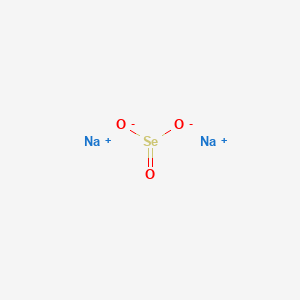
Disodium selenite is an inorganic sodium salt composed of sodium and selenite ions in a 2:1 ratio. It has a role as a nutraceutical. It is an inorganic sodium salt and a selenite salt. — ChEBI
- IUPAC name
- disodium;selenite
- Molecular formula
- Na2O3Se
- Molecular weight
- 172.95 g/mol
- Exact mass
- 173.88080 Da
- Topological polar surface area
- 63.2 Ų
- Hydrogen-bond donors
- 0
- Hydrogen-bond acceptors
- 3
- Covalent units
- 3
- Defined stereocentres
- 0
Also known as
16 more reported names
External database identifiers
- ChEBI:CHEBI:48843
- ChEMBL:CHEMBL112302
- EPA DTXSID:DTXSID0032077
Evidence from additional scientific databases
EMBL-EBI ChEBI
disodium selenite
An inorganic sodium salt composed of sodium and selenite ions in a 2:1 ratio.
- Formula
- 2Na.O3Se
- Average mass
- 172.937 g/mol
- Monoisotopic mass
- 173.88080 Da
- Formal charge
- 0
- selenite salt — is a (CHEBI:48840)
- inorganic sodium salt — is a (CHEBI:38702)
- nutraceutical — has role (CHEBI:50733)
- antineoplastic agent — has role (CHEBI:35610)
- cardiovascular drug — has role (CHEBI:35554)
- nutraceutical — has role (CHEBI:50733)
- antineoplastic agent — has role (CHEBI:35610)
- cardiovascular drug — has role (CHEBI:35554)
- selenite salt — is a (CHEBI:48840)
- inorganic sodium salt — is a (CHEBI:38702)
- 12798669 Source: PubMed
- 12852761 Source: PubMed
- 16889072 Source: PubMed
- 18044833 Source: PubMed
- 20971640 Source: PubMed
- 25282270 Source: PubMed
- 33276991 Source: PubMed
- 35486317 Source: PubMed
- 35662217 Source: PubMed
- 36397962 Source: PubMed
- 36567968 Source: PubMed
- 36600950 Source: PubMed
- 36798481 Source: PubMed
- 37006874 Source: PubMed
- 37020163 Source: PubMed
- 37048216 Source: PubMed
- 37302765 Source: PubMed
- 37362095 Source: PubMed
- 37967787 Source: PubMed
- 38008716 Source: PubMed
- 38023380 Source: PubMed
- 38070396 Source: PubMed
- 38150116 Source: PubMed
- 38177716 Source: PubMed
Additional curated names
Cross-references from this source
- CAS: 10102-18-8 — ChemIDplus
- CAS: 10102-18-8 — KEGG COMPOUND
- REGISTRY_NUMBER: 30272 — Gmelin
- MANUAL_X_REF: DBSALT001761 — DrugBank
- MANUAL_X_REF: Sodium_selenite — Wikipedia
Mapped by: Exact CAS cross-reference in the ChEBI compound record. Source updated: 2024-05-17. Retrieved: 2026-08-31. Open source record
NIH PubChem PUG-View
Attributed physical-property, hazard, environmental and use annotations.
- Boiling Point: Decomposes (NTP, 1992) Source: CAMEO Chemicals
- Color/Form: Tetragonal prisms Source: Hazardous Substances Data Bank (HSDB)
- Color/Form: White tetragonal crystals Source: Hazardous Substances Data Bank (HSDB)
- Color/Form: White powder Source: Hazardous Substances Data Bank (HSDB)
- Density: 3.1 (NTP, 1992) - Denser than water; will sink Source: CAMEO Chemicals
- Density: Specific gravity: 3.1 (Water = 1) Source: Hazardous Substances Data Bank (HSDB)
- Melting Point: 1310 °F (decomposes) (NTP, 1992) Source: CAMEO Chemicals
- Melting Point: 710 °C (decomposes) Source: Hazardous Substances Data Bank (HSDB)
- Melting Point: 710 °C Source: PAC Chemical Database, U.S. Department of Energy
- Physical Description: Sodium selenite appears as a white colored crystalline solid. Soluble in water and more dense than water. Contact may irritate skin, eyes and mucous membranes. Toxic by ingestion, inhalation and skin absorption. Source: CAMEO Chemicals
- Physical Description: Hygroscopic solid; [ICSC] White solid; [HSDB] Beige odorless crystalline powder; [MSDSonline] Source: Haz-Map, Information on Hazardous Chemicals and Occupational Diseases
- Physical Description: HYGROSCOPIC SOLID IN VARIOUS FORMS. Source: ILO-WHO International Chemical Safety Cards (ICSCs)
- Solubility: greater than or equal to 100 mg/mL at 70.7 °F (NTP, 1992) Source: CAMEO Chemicals
- Solubility: Insoluble in alcohol Source: Hazardous Substances Data Bank (HSDB)
- Solubility: 89.8 g/100 g water Source: Hazardous Substances Data Bank (HSDB)
- Solubility: Solubility in water, g/100ml at 20 °C: 85 Source: ILO-WHO International Chemical Safety Cards (ICSCs)
- Vapor Pressure: less than 0.001 mmHg at 68 °F (NTP, 1992) Source: CAMEO Chemicals
- Carcinogen Classification: 3, not classifiable as to its carcinogenicity to humans. (L135) Source: Toxin and Toxin Target Database (T3DB)
- Exposure Routes: The substance can be absorbed into the body by inhalation of its aerosol and by ingestion. Source: ILO-WHO International Chemical Safety Cards (ICSCs)
- Exposure Routes: Oral (L619) ; inhalation (L619) ; dermal (L619) Source: Toxin and Toxin Target Database (T3DB)
- First Aid: Signs and Symptoms of Sodium Selenite Exposure: Signs and symptoms of acute sodium selenite exposure include the following: garlic odor on breath, drooling, nasal irritation and burning sensation in nostrils, vomiting, hypotension, dizziness, and poor reflexes. Pulmonary edema, cardiopulmonary arrest, and coma are possible complications. Contact with sodium selenite often results in skin irritation and burns.; Emergency Life-Support Procedures: Acute exposure to sodium selenite may require decontamination and life support for the victims. Emergency personnel should wear protective clothing appropriate to the type and degree of contamination. Air-purifying or supplied-air respiratory equipment should also be worn, as necessary. Rescue vehicles should carry supplies such as plastic sheeting and disposable plastic bags to assist in preventing spread of contamination.; Inhalation Exposure:; 1. Move victims to fresh air. Emergency personnel should avoid self-exposure to sodium selenite.; 2. Evaluate vital signs including pulse and respiratory rate, and note any trauma. If no pulse is detected, provide CPR. If not breathing, provide artificial respiration. If breathing is labored, admini Source: CAMEO Chemicals
- Signal: Danger Source: Regulation (EC) No 1272/2008 of the European Parliament and of the Council
- GHS Hazard Statements: H300: Fatal if swallowed [Danger Acute toxicity, oral]; H317: May cause an allergic skin reaction [Warning Sensitization, Skin]; H331: Toxic if inhaled [Danger Acute toxicity, inhalation]; H411: Toxic to aquatic life with long lasting effects [Hazardous to the aquatic environment, long-term hazard] Source: Regulation (EC) No 1272/2008 of the European Parliament and of the Council
- Precautionary Statement Codes: P261, P264, P270, P271, P272, P273, P280, P301+P316, P302+P352, P304+P340, P316, P321, P330, P333+P317, P362+P364, P391, P403+P233, P405, and P501 (click each P-code to see the statement) Source: Regulation (EC) No 1272/2008 of the European Parliament and of the Council
- Signal: Danger Source: European Chemicals Agency (ECHA)
- GHS Hazard Statements: H300+H330 (11%): Fatal if swallowed or if inhaled [Danger Acute toxicity, oral; acute toxicity, inhalation]; H300 (100%): Fatal if swallowed [Danger Acute toxicity, oral]; H315 (28.4%): Causes skin irritation [Warning Skin corrosion/irritation]; H317 (92.9%): May cause an allergic skin reaction [Warning Sensitization, Skin]; H319 (28%): Causes serious eye irritation [Warning Serious eye damage/eye irritation]; H330 (28%): Fatal if inhaled [Danger Acute toxicity, inhalation]; H331 (71.6%): Toxic if inhaled [Danger Acute toxicity, inhalation]; H400 (29.7%): Very toxic to aquatic life [Warning Hazardous to the aquatic environment, acute hazard]; H410 (28.6%): Very toxic to aquatic life with long lasting effects [Warning Hazardous to the aquatic environment, long-term hazard]; H411 (75.5%): Toxic to aquatic life with long lasting effects [Hazardous to the aquatic environment, long-term hazard] Source: European Chemicals Agency (ECHA)
- Precautionary Statement Codes: P260, P261, P264, P264+P265, P270, P271, P272, P273, P280, P284, P301+P316, P302+P352, P304+P340, P305+P351+P338, P316, P320, P321, P330, P332+P317, P333+P317, P337+P317, P362+P364, P391, P403+P233, P405, and P501 (click each P-code to see the statement) Source: European Chemicals Agency (ECHA)
- ECHA C&L Notifications Summary: Aggregated GHS information provided per 518 reports by companies from 13 notifications to the ECHA C&L Inventory. Each notification may be associated with multiple companies.; Information may vary between notifications depending on impurities, additives, and other factors. The percentage value in parenthesis indicates the notified classification ratio from companies that provide hazard codes. Only hazard codes with percentage values above 10% are shown. For more detailed information, please visit ECHA C&L website. Source: European Chemicals Agency (ECHA)
- Signal: Danger Source: NITE-CMC
- GHS Hazard Statements: H300: Fatal if swallowed [Danger Acute toxicity, oral]; H315: Causes skin irritation [Warning Skin corrosion/irritation]; H319: Causes serious eye irritation [Warning Serious eye damage/eye irritation]; H341: Suspected of causing genetic defects [Warning Germ cell mutagenicity]; H361: Suspected of damaging fertility or the unborn child [Warning Reproductive toxicity]; H370: Causes damage to organs [Danger Specific target organ toxicity, single exposure]; H372: Causes damage to organs through prolonged or repeated exposure [Danger Specific target organ toxicity, repeated exposure]; H401: Toxic to aquatic life [Hazardous to the aquatic environment, acute hazard]; H410: Very toxic to aquatic life with long lasting effects [Warning Hazardous to the aquatic environment, long-term hazard] Source: NITE-CMC
- Precautionary Statement Codes: P203, P260, P264, P264+P265, P270, P273, P280, P301+P316, P302+P352, P305+P351+P338, P308+P316, P318, P319, P321, P330, P332+P317, P337+P317, P362+P364, P391, P405, and P501 (click each P-code to see the statement) Source: NITE-CMC
- Signal: Warning Source: NITE-CMC
- GHS Hazard Statements: H400: Very toxic to aquatic life [Warning Hazardous to the aquatic environment, acute hazard]; H410: Very toxic to aquatic life with long lasting effects [Warning Hazardous to the aquatic environment, long-term hazard] Source: NITE-CMC
- Health Effects: Chronic oral exposure to high concentrations of selenium compounds can produce a disease called selenosis. The major signs of selenosis are hair loss, nail brittleness, and neurological abnormalities (such as numbness and other odd sensations in the extremities). Animal studies have shown that selenium may also affect sperm production and the female reproductive cycle. (L619) Source: Toxin and Toxin Target Database (T3DB)
- Toxicity Summary: Selenium readily substitutes for sulfur in biomolecules and in many biochemical reactions, especially when the concentration of selenium is high and the concentration of sulfur is low. Inactivation of the sulfhydryl enzymes necessary for oxidative reactions in cellular respiration, through effects on mitochondrial and microsomal electron transport, might contribute to acute selenium toxicity. Selenomethionine (a common organic selenium compound) also appears to randomly substitute for methionine in protein synthesis. This substitution may affect the structure and functionability of the protein, for example, by altering disulfide bridges. Inorganic forms of selenium appear to react with tissue thiols by redox catalysis, resulting in formation of reactive oxygen species and causing damage by oxidative stress. (L619) Source: Toxin and Toxin Target Database (T3DB)
- Environmental Bioconcentration: The BCF values observed for selenium selenite in carp (Cyprinus carpio) after 28 days exposure at 10 and 1 ug/L concentrations were <8.1-10 and <85, respectively(1). Source: Hazardous Substances Data Bank (HSDB)
- Environmental Fate: TERRESTRIAL FATE: Selenite (Se(IV)) is soluble, but can strongly adsorb to soil minerals and organic material(1). In soils, inorganic selenium compounds can be methylated by microorganisms and subsequently volatilize to the atmosphere(2,3); dimethylselenide and dimethyl diselenide are the principal products(3). Source: Hazardous Substances Data Bank (HSDB)
- Environmental Fate: AQUATIC FATE: In aqueous solution, over the pH range of 3 to 9, the biselenite species predominates; at pHs >9, selenite is the major species(1). Source: Hazardous Substances Data Bank (HSDB)
- Sources/Uses: Used as a colorant in glass production; [Kanerva, p. 1501] Used in glass manufacturing to remove green color, as an alkaloidal reagent, to test seed germination, as a reagent in bacteriology, for decorating porcelain, and as a dietary supplement; [HSDB] Source: Haz-Map, Information on Hazardous Chemicals and Occupational Diseases
- Industrial Processes with risk of exposure: Glass Manufacturing [Category: Industry] Source: Haz-Map, Information on Hazardous Chemicals and Occupational Diseases
- Activities with risk of exposure: Ceramics making [Category: Hobbies]; Enameling [Category: Hobbies] Source: Haz-Map, Information on Hazardous Chemicals and Occupational Diseases
- Uses: Removing green color from glass during its mfr; alkaloidal reagent Source: Hazardous Substances Data Bank (HSDB)
- Uses: Reagent in bacteriology, testing germination of seeds, decorating porcelain Source: Hazardous Substances Data Bank (HSDB)
- Uses: As a soil additive for selenium-deficient areas. Source: Hazardous Substances Data Bank (HSDB)
- Uses: MEDICATION Source: Hazardous Substances Data Bank (HSDB)
- Uses: MEDICATION (VET) Source: Hazardous Substances Data Bank (HSDB)
- Uses: Sodium selenite is mainly used in the manufacture of colorless glass. Its pink coloration cancels out the green color imparted by iron impurities. (L737) Source: Toxin and Toxin Target Database (T3DB)
Mapped by: Existing checksum-valid CAS to unique PubChem CID match. Retrieved: 2026-08-31. Open source record
Scientific classifications and hazard annotations provide context and do not replace the market-specific regulatory decision shown above.
Additional source coverage and match status
| Source | Result | Checked |
|---|---|---|
| EMBL-EBI ChEBI | Exact match | 2026-08-31 |
| NIH PubChem PUG-View | Exact match | 2026-08-31 |
A recorded no-match is useful evidence that the source was checked; it is not a claim that the substance does not exist elsewhere.
Retrieved from NIH PubChem on 2026-08-31 by checksum-valid CAS matching. Chemical properties do not replace the regulatory decision on this page.