
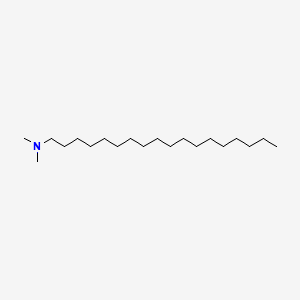
- IUPAC name
- N,N-dimethyloctadecan-1-amine
- Molecular formula
- C20H43N
- Molecular weight
- 297.6 g/mol
- Exact mass
- 297.339550376 Da
- XLogP3
- 9.1
- Topological polar surface area
- 3.2 Ų
- Hydrogen-bond donors
- 0
- Hydrogen-bond acceptors
- 1
- Covalent units
- 1
- Defined stereocentres
- 0
Also known as
DymanthineN,N-DimethyloctadecylamineN,N-Dimethyl-n-octadecylamineN,N-Dimethyl-1-octadecanamine1-Octadecanamine, N,N-dimethyl-OctadecyldimethylamineStearyldimethylamineOctadecylamine, N,N-dimethyl-
16 more reported names
N,N-DimethylstearylamineDimantinaN,N-DimethyloctadecanamineKemamine 9902DArmeen DM 18DFarmin DM 80Adogen 342DDimethylstearamineDimethyl-N-octadecylamineDimantinumADMA 18DM 18DN,N-Dimethyloktadecylamin1-octadecanamine, n,n-dimethyldimantinRefChem:136034
External database identifiers
- ChEBI:CHEBI:135258
- ChEMBL:CHEMBL2110847
- EPA DTXSID:DTXSID4027026
- PubMed:21845225
- PubMed:21616563
Evidence from additional scientific databases
NIH PubChem PUG-View
Exact identifier match15365
Attributed physical-property, hazard, environmental and use annotations.
- Melting Point: FREEZING POINT: 22.89 °C Source: Hazardous Substances Data Bank (HSDB)
- Physical Description: N,n-dimethyl-1-octadecanamine appears as a clear yellow liquid with a fishlike odor. Insoluble in water and less dense than water. Hence floats on water. Contact may irritate skin, eyes and mucous membranes. May be toxic by ingestion, inhalation or skin absorption. Used to make other chemicals. Source: CAMEO Chemicals
- Physical Description: CBI; Liquid; Liquid; Other Solid Source: EPA Chemical Data Reporting (CDR)
- Physical Description: mp = 22.89 deg C; [ChemIDplus] Clear yellow liquid with a fishy odor; [CAMEO] Colorless to yellow liquid; Clear or slightly cloudy with a fishy odor; [MSDSonline] Source: Haz-Map, Information on Hazardous Chemicals and Occupational Diseases
- First Aid: Excerpt from ERG Guide 153 [Substances - Toxic and/or Corrosive (Combustible)]:; Refer to the "General First Aid" section. Specific First Aid: For corrosives, in case of contact, immediately flush skin or eyes with running water for at least 30 minutes. Additional flushing may be required. Removal of solidified molten material from skin requires medical assistance. (ERG, 2024) Source: CAMEO Chemicals
- Signal: Danger Source: European Chemicals Agency (ECHA)
- GHS Hazard Statements: H226 (53.9%): Flammable liquid and vapor [Warning Flammable liquids]; H302 (96.9%): Harmful if swallowed [Warning Acute toxicity, oral]; H314 (100%): Causes severe skin burns and eye damage [Danger Skin corrosion/irritation]; H318 (85%): Causes serious eye damage [Danger Serious eye damage/eye irritation]; H400 (95%): Very toxic to aquatic life [Warning Hazardous to the aquatic environment, acute hazard]; H410 (28.6%): Very toxic to aquatic life with long lasting effects [Warning Hazardous to the aquatic environment, long-term hazard] Source: European Chemicals Agency (ECHA)
- Precautionary Statement Codes: P210, P233, P240, P241, P242, P243, P260, P264, P264+P265, P270, P273, P280, P301+P317, P301+P330+P331, P302+P361+P354, P303+P361+P353, P304+P340, P305+P354+P338, P316, P317, P321, P330, P363, P370+P378, P391, P403+P235, P405, and P501 (click each P-code to see the statement) Source: European Chemicals Agency (ECHA)
- ECHA C&L Notifications Summary: Aggregated GHS information provided per 833 reports by companies from 19 notifications to the ECHA C&L Inventory. Each notification may be associated with multiple companies.; Information may vary between notifications depending on impurities, additives, and other factors. The percentage value in parenthesis indicates the notified classification ratio from companies that provide hazard codes. Only hazard codes with percentage values above 10% are shown. For more detailed information, please visit ECHA C&L website. Source: European Chemicals Agency (ECHA)
- Signal: Danger Source: NITE-CMC
- GHS Hazard Statements: H314: Causes severe skin burns and eye damage [Danger Skin corrosion/irritation]; H319: Causes serious eye irritation [Warning Serious eye damage/eye irritation]; H336: May cause drowsiness or dizziness [Warning Specific target organ toxicity, single exposure; Narcotic effects]; H400: Very toxic to aquatic life [Warning Hazardous to the aquatic environment, acute hazard]; H410: Very toxic to aquatic life with long lasting effects [Warning Hazardous to the aquatic environment, long-term hazard] Source: NITE-CMC
- Precautionary Statement Codes: P260, P261, P264, P264+P265, P271, P273, P280, P301+P330+P331, P302+P361+P354, P304+P340, P305+P351+P338, P305+P354+P338, P316, P319, P321, P337+P317, P363, P391, P403+P233, P405, and P501 (click each P-code to see the statement) Source: NITE-CMC
- Signal: Danger Source: Hazardous Chemical Information System (HCIS), Safe Work Australia
- GHS Hazard Statements: H302: Harmful if swallowed [Warning Acute toxicity, oral]; H314: Causes severe skin burns and eye damage [Danger Skin corrosion/irritation]; H335: May cause respiratory irritation [Warning Specific target organ toxicity, single exposure; Respiratory tract irritation] Source: Hazardous Chemical Information System (HCIS), Safe Work Australia
- Precautionary Statement Codes: P260, P261, P264, P270, P271, P280, P301+P317, P301+P330+P331, P302+P361+P354, P304+P340, P305+P354+P338, P316, P319, P321, P330, P363, P403+P233, P405, and P501 (click each P-code to see the statement) Source: Hazardous Chemical Information System (HCIS), Safe Work Australia
- Cosmetic Ingredient Review Finding(s): Safe in the present practices of use and concentration. Ingredient, concentration, and use information are available in documents discoverable at https://cir-reports.cir-safety.org Source: Cosmetic Ingredient Review (CIR)
- Consumer Uses: Intermediate Source: EPA Chemical Data Reporting (CDR)
- Industry Uses: Intermediate; CBI; Surfactant (surface active agent) Source: EPA Chemical Data Reporting (CDR)
- Cosmetic Ingredient Review Link: CIR ingredient: Dimethyl Stearamine Source: Cosmetic Ingredient Review (CIR)
- Sources/Uses: Used as chemical intermediate and corrosion inhibitor for condensing systems; [HSDB] Source: Haz-Map, Information on Hazardous Chemicals and Occupational Diseases
- Uses: CHEM INT FOR N,N-DIMETHYL-N-OCTADECYLAMINE OXIDE-AS MIXT Source: Hazardous Substances Data Bank (HSDB)
- Uses: CHEM INT FOR BENZYL DIMETHYL OCTADECYL AMMONIUM CHLORIDE Source: Hazardous Substances Data Bank (HSDB)
- Uses: FILMING AMINE CORROSION INHIBITOR FOR CONDENSING SYSTEMS Source: Hazardous Substances Data Bank (HSDB)
- Uses: ANTHELMINTIC AGENT (HYDROCHLORIDE SALT) Source: Hazardous Substances Data Bank (HSDB)
Mapped by: Existing checksum-valid CAS to unique PubChem CID match. Retrieved: 2026-08-31. Open source record
Scientific classifications and hazard annotations provide context and do not replace the market-specific regulatory decision shown above.
Additional source coverage and match status
| Source | Result | Checked |
|---|---|---|
| NIH PubChem PUG-View | Exact match | 2026-08-31 |
A recorded no-match is useful evidence that the source was checked; it is not a claim that the substance does not exist elsewhere.
Retrieved from NIH PubChem on 2026-08-31 by checksum-valid CAS matching. Chemical properties do not replace the regulatory decision on this page.