
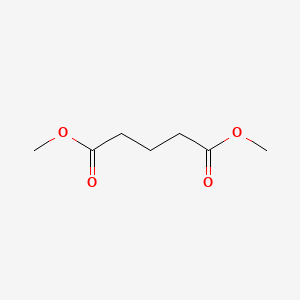
CAS 1119-40-0PubChem CID 14242
Dimethyl Glutarate
Dimethyl glutarate is a colorless liquid. (USCG, 1999) — CAMEO Chemicals
- IUPAC name
- dimethyl pentanedioate
- Molecular formula
- C7H12O4
- Molecular weight
- 160.17 g/mol
- Exact mass
- 160.07355886 Da
- XLogP3
- 0.6
- Topological polar surface area
- 52.6 Ų
- Hydrogen-bond donors
- 0
- Hydrogen-bond acceptors
- 4
- Covalent units
- 1
- Defined stereocentres
- 0
Also known as
Glutaric acid dimethyl esterPentanedioic acid, dimethyl esterGlutaric acid, dimethyl esterDBE 5Pentanedioic acid, 1,5-dimethyl ester1I9VFA346PNSC-58578FEMA NO. 4604
16 more reported names
RefChem:134243214-277-21,5-dimethyl pentanedioateDBE-5 dibasic esterHSDB 5789pentanedioic acid dimethyl esterGlutaric acid-dimethyl esterNSC 58578AI3-06026G0185dimethyl pentane-1,5-dioateCAS-1119-40-0EINECS 214-277-2UNII-1I9VFA346PEC 214-277-2DBE-5 dibasic ester, 99%
External database identifiers
- ChEMBL:CHEMBL1609626
- EPA DTXSID:DTXSID3025122
- PubMed:21092124
- PubMed:19350935
Evidence from additional scientific databases
NIH PubChem PUG-View
Exact identifier match14242
Attributed physical-property, hazard, environmental and use annotations.
- Boiling Point: 199.4 to 203 °F at 13 mmHg (USCG, 1999) Source: CAMEO Chemicals
- Boiling Point: 213.5-214 °C @ 752 MM HG; 93.5-94.5 °C @ 13 MM HG Source: Hazardous Substances Data Bank (HSDB)
- Boiling Point: 199.4-203 °F Source: Occupational Safety and Health Administration (OSHA)
- Color/Form: LIQUID Source: Hazardous Substances Data Bank (HSDB)
- Density: 1.087 (USCG, 1999) - Denser than water; will sink Source: CAMEO Chemicals
- Density: 1.0876 @ 20 °C/4 °C Source: Hazardous Substances Data Bank (HSDB)
- Density: 1.087 Source: Occupational Safety and Health Administration (OSHA)
- Flash Point: 218 °F (USCG, 1999) Source: CAMEO Chemicals
- Flash Point: 103 °C Source: Haz-Map, Information on Hazardous Chemicals and Occupational Diseases
- Flash Point: 218 °F Source: Occupational Safety and Health Administration (OSHA)
- Melting Point: -42.5 °C Source: Hazardous Substances Data Bank (HSDB)
- Odor: FAINT AGREEABLE ODOR Source: Hazardous Substances Data Bank (HSDB)
- Physical Description: Dimethyl glutarate is a colorless liquid. (USCG, 1999) Source: CAMEO Chemicals
- Physical Description: Liquid; CBI Source: EPA Chemical Data Reporting (CDR)
- Physical Description: Liquid with an agreeable odor; [HSDB] Source: Haz-Map, Information on Hazardous Chemicals and Occupational Diseases
- Physical Description: Colorless liquid Source: Occupational Safety and Health Administration (OSHA)
- Refractive Index: INDEX OF REFRACTION: 1.4242 @ 20 °C/D; SADTLER REFERENCE NUMBER: 692 (IR, PRISM) Source: Hazardous Substances Data Bank (HSDB)
- Solubility: VERY SOL IN ALC, ETHER Source: Hazardous Substances Data Bank (HSDB)
- First Aid: INHALATION: Call for medical aid. Remove the victim to fresh air. If not breathing give artificial respiration. If breathing is difficult give oxygen.; EYES: Flush immediately with copious amounts of water for at least 15 minutes.; SKIN: Wash immediately with soap and copious amounts of water for at least 15 minutes. (USCG, 1999) Source: CAMEO Chemicals
- Note: This chemical does not meet GHS hazard criteria for 95.5% (998 of 1045) of all reports. Source: European Chemicals Agency (ECHA)
- GHS Hazard Statements: Not Classified; Reported as not meeting GHS hazard criteria by 998 of 1045 companies (only 4.5% companies provided GHS information). For more detailed information, please visit ECHA C&L website. Source: European Chemicals Agency (ECHA)
- ECHA C&L Notifications Summary: Aggregated GHS information provided per 1045 reports by companies from 11 notifications to the ECHA C&L Inventory.; Reported as not meeting GHS hazard criteria per 998 of 1045 reports by companies.; There are 8 notifications provided by 47 of 1045 reports by companies with hazard statement code(s).; Information may vary between notifications depending on impurities, additives, and other factors. The percentage value in parenthesis indicates the notified classification ratio from companies that provide hazard codes. Only hazard codes with percentage values above 10% are shown. For more detailed information, please visit ECHA C&L website. Source: European Chemicals Agency (ECHA)
- Signal: Warning Source: NITE-CMC
- GHS Hazard Statements: H336: May cause drowsiness or dizziness [Warning Specific target organ toxicity, single exposure; Narcotic effects]; H373: May causes damage to organs through prolonged or repeated exposure [Warning Specific target organ toxicity, repeated exposure]; H402: Harmful to aquatic life [Hazardous to the aquatic environment, acute hazard] Source: NITE-CMC
- Precautionary Statement Codes: P260, P261, P271, P273, P304+P340, P319, P403+P233, P405, and P501 (click each P-code to see the statement) Source: NITE-CMC
- Cosmetic Ingredient Review Finding(s): Safe in the present practices of use and concentration. Ingredient, concentration, and use information are available in documents discoverable at https://cir-reports.cir-safety.org Source: Cosmetic Ingredient Review (CIR)
- Consumer Uses: Dispersing agent; Solvent; Fragrance; Cleaning agent; Not Known or Reasonably Ascertainable; Processing aids not otherwise specified; Adhesion/cohesion promoter Source: EPA Chemical Data Reporting (CDR)
- Industry Uses: Lubricating agent; Viscosity modifiers; Thickening agent; Not Known or Reasonably Ascertainable; Other; Preservative; Fragrance; Dispersing agent; Solvent; Adsorbent; Pigment; Adhesion/cohesion promoter; Processing aids not otherwise specified Source: EPA Chemical Data Reporting (CDR)
- Cosmetic Ingredient Review Link: CIR ingredient: Dimethyl Glutarate Source: Cosmetic Ingredient Review (CIR)
- Sources/Uses: Used to make polyester and polyamide resins; [HSDB] Source: Haz-Map, Information on Hazardous Chemicals and Occupational Diseases
- Uses: CHEM INT FOR EPICHLOROHYDRIN-POLYAMIDE RESINS FOR PAPER Source: Hazardous Substances Data Bank (HSDB)
- Uses: CHEM INT FOR POLYESTER RESINS (COATINGS, PLASTICIZERS) Source: Hazardous Substances Data Bank (HSDB)
- Uses: CHEM INT FOR POLYAMIDE RESINS Source: Hazardous Substances Data Bank (HSDB)
Mapped by: Existing checksum-valid CAS to unique PubChem CID match. Retrieved: 2026-08-31. Open source record
Scientific classifications and hazard annotations provide context and do not replace the market-specific regulatory decision shown above.
Additional source coverage and match status
| Source | Result | Checked |
|---|---|---|
| NIH PubChem PUG-View | Exact match | 2026-08-31 |
A recorded no-match is useful evidence that the source was checked; it is not a claim that the substance does not exist elsewhere.
Retrieved from NIH PubChem on 2026-08-31 by checksum-valid CAS matching. Chemical properties do not replace the regulatory decision on this page.