
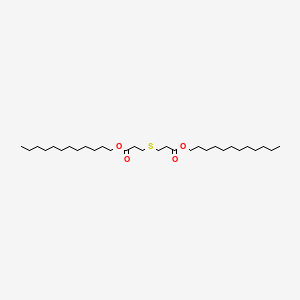
CAS 123-28-4PubChem CID 31250
Propanoic acid, 3,3'-thiobis-, didodecyl ester
Didodecyl thiobispropanoate is a dicarboxylic acid. — ChEBI
- IUPAC name
- dodecyl 3-(3-dodecoxy-3-oxopropyl)sulfanylpropanoate
- Molecular formula
- C30H58O4S
- Molecular weight
- 514.8 g/mol
- Exact mass
- 514.40558150 Da
- XLogP3
- 11.7
- Topological polar surface area
- 77.9 Ų
- Hydrogen-bond donors
- 0
- Hydrogen-bond acceptors
- 5
- Covalent units
- 1
- Defined stereocentres
- 0
Also known as
Propanoic acid 3,3'-thiobis(didodecyl) esterPTDERefChem:587954DILAURYL THIODIPROPIONATEDidodecyl 3,3'-thiodipropionateLusmitDltdpTyox B
16 more reported names
Carstab dltdpAntioxidant ASStabilizer DLTPlastanox LTDPNeganox DLTPDmptpDLTPMilban FAntioxidant LTDPIrganox PS 800DilaurylthiodipropionateDilauryl 3,3'-thiodipropionateIpognox 89Advastab 800D 1 (antioxidant)Plastanox LTDP Antioxidant
External database identifiers
- ChEBI:CHEBI:165384
- EPA DTXSID:DTXSID2026999
- PubMed:21535512
Evidence from additional scientific databases
NIH PubChem PUG-View
Exact identifier match31250
Attributed physical-property, hazard, environmental and use annotations.
- Color/Form: White flakes Source: Hazardous Substances Data Bank (HSDB)
- Density: 0.975 at 25 °C (solid 25 °C) Source: Hazardous Substances Data Bank (HSDB)
- Melting Point: 40 °C Source: Hazardous Substances Data Bank (HSDB)
- Melting Point: 43 - 44 °C Source: Human Metabolome Database (HMDB)
- Odor: Sweetish odor Source: Hazardous Substances Data Bank (HSDB)
- Physical Description: CBI; Large Crystals; Dry Powder; Liquid; Other Solid; Dry Powder; Large Crystals; Liquid; Dry Powder; Large Crystals Source: EPA Chemical Data Reporting (CDR)
- Physical Description: White solid with a sweet odor; [Hawley] White crystalline powder; [MSDSonline] Source: Haz-Map, Information on Hazardous Chemicals and Occupational Diseases
- Physical Description: Solid Source: Human Metabolome Database (HMDB)
- Solubility: Soluble in most organic solvents Source: Hazardous Substances Data Bank (HSDB)
- Vapor Pressure: 0.00000001 [mmHg] Source: Haz-Map, Information on Hazardous Chemicals and Occupational Diseases
- Vapor Pressure: Vapor pressure = 0.2 mm Hg at 163 deg Source: Hazardous Substances Data Bank (HSDB)
- Note: This chemical does not meet GHS hazard criteria for 65.8% (340 of 517) of all reports. Source: European Chemicals Agency (ECHA)
- GHS Hazard Statements: H412 (30.8%): Harmful to aquatic life with long lasting effects [Hazardous to the aquatic environment, long-term hazard] Source: European Chemicals Agency (ECHA)
- Precautionary Statement Codes: P273, and P501 (click each P-code to see the statement) Source: European Chemicals Agency (ECHA)
- ECHA C&L Notifications Summary: Aggregated GHS information provided per 517 reports by companies from 8 notifications to the ECHA C&L Inventory.; Reported as not meeting GHS hazard criteria per 340 of 517 reports by companies.; There are 6 notifications provided by 177 of 517 reports by companies with hazard statement code(s).; Information may vary between notifications depending on impurities, additives, and other factors. The percentage value in parenthesis indicates the notified classification ratio from companies that provide hazard codes. Only hazard codes with percentage values above 10% are shown. For more detailed information, please visit ECHA C&L website. Source: European Chemicals Agency (ECHA)
- Cosmetic Ingredient Review Conclusion: The CIR Expert Panel concludes that Dilauryl Thiodipropionate, Thiodipropionic Acid, Dicetyl Thiodipropionate, Dimyristyl Thiodipropionate, Distearyl Thiodipropionate, and Ditridecyl Thiodipropionate are safe as cosmetic ingredients in the practices of use and concentration given in this safety assessment when formulated to be non-irritating. Source: Cosmetic Ingredient Review (CIR)
- Cosmetic Ingredient Review Finding(s): Safe for use in cosmetics, with qualifications Source: Cosmetic Ingredient Review (CIR)
- Environmental Bioconcentration: An estimated BCF of 15 was calculated in fish for dilauryl thiodipropionate(SRC), using an estimated log Kow of 11.8(1) and a regression-derived equation(1). According to a classification scheme(2), this BCF suggests the potential for bioconcentration in aquatic organisms is low(SRC). Source: Hazardous Substances Data Bank (HSDB)
- Environmental Fate: TERRESTRIAL FATE: Based on a classification scheme(1), an estimated Koc value of 9X10+6(SRC), determined from a structure estimation method(2), indicates that dilauryl thiodipropionate is expected to be immobile in soil(SRC). Volatilization of dilauryl thiodipropionate from moist soil surfaces is not expected to be an important fate process(SRC) given an estimated Henry's Law constant of 4X10⁻⁶ atm-cu m/mole(SRC), using a fragment constant estimation method(2), and dilauryl thiopropionate's strong adsorption to soil that will attenuate volatilization(SRC). Dilauryl thiodipropionate is not expected to volatilize from dry soil surfaces(SRC) based upon an estimated vapor pressure of 3X10⁻⁸ mm Hg at 25 °C(SRC), determined from a fragment constant method(2). A 57% of theoretical BOD using activated sludge in the Japanese MITI test(3) suggests that biodegradation may be an important environmental fate process(SRC); although not classified as readily biodegradable (which requires a theoretical BOD of 60% or higher), dilauryl thiodipropionate is estimated to be inherently biodegradable(4). Source: Hazardous Substances Data Bank (HSDB)
- Environmental Fate: AQUATIC FATE: Based on a classification scheme(1), an estimated Koc value of 9X10+6(SRC), determined from a structure estimation method(2), indicates that dilauryl thiodipropionate is expected to adsorb to suspended solids and sediment(SRC). Volatilization from water surfaces is expected(3) based upon an estimated Henry's Law constant of 4X10⁻⁶ atm-cu m/mole(SRC), developed using a fragment constant estimation method(2). Using this Henry's Law constant and an estimation method(3), volatilization half-lives for a model river and model lake are 21 and 160 days, respectively(SRC). However, volatilization from water surfaces is expected to be attenuated by adsorption to suspended solids and sediment in the water column. The estimated volatilization half-life from a model pond is 60 years if adsorption is considered(4). According to a classification scheme(5), an estimated BCF of 15(SRC), from an estimated log Kow of 11.8(2) and a regression-derived equation(2), suggests the potential for bioconcentration in aquatic organisms is low(SRC). A base-catalyzed second-order hydrolysis rate constant of 0.077 L/mole-sec(SRC) was estimated using a structure estimation method(6); this corresponds Source: Hazardous Substances Data Bank (HSDB)
- Environmental Fate: ATMOSPHERIC FATE: According to a model of gas/particle partitioning of semivolatile organic compounds in the atmosphere(1), dilauryl thiodipropionate, which has an estimated vapor pressure of 3X10⁻⁸ mm Hg at 25 °C(SRC), determined from a fragment constant method(2), will exist in both the vapor and particulate phases in the ambient atmosphere. Vapor-phase dilauryl thiodipropionate is degraded in the atmosphere by reaction with photochemically-produced hydroxyl radicals(SRC); the half-life for this reaction in air is estimated to be 7.4 hours(SRC), calculated from its rate constant of 5.2X10⁻¹¹ cu cm/molecule-sec at 25 °C(SRC) that was derived using a structure estimation method(2). Particulate-phase dilauryl thiodipropionate may be removed from the air by wet or dry deposition(SRC). Source: Hazardous Substances Data Bank (HSDB)
- Consumer Uses: Heat stabilizer; UV stabilizer; Antioxidant; Other Source: EPA Chemical Data Reporting (CDR)
- Industry Uses: Other; Antioxidant; Chemical reaction regulator; Heat stabilizer; Intermediate Source: EPA Chemical Data Reporting (CDR)
- Cosmetic Ingredient Review Link: CIR ingredient: Dilauryl Thiodipropionate Source: Cosmetic Ingredient Review (CIR)
- Sources/Uses: Used as a stabilizer of food packaging films, an additive for high-pressure lubricants and greases, a plasticizer and softening agent, and an antioxidant for edible fats and oils (up to 0.02% oil content); [HSDB] Source: Haz-Map, Information on Hazardous Chemicals and Occupational Diseases
- Uses: Thiosynergist for polyolefin stabilization. Source: Hazardous Substances Data Bank (HSDB)
- Uses: Used as a secondary antioxidant in a variety of polymer systems including polyolefins, ABS, styrene-butadiene emulsions and certain adhesives. These antioxidants are added to help preserve the integrity of the plastics to which they are added. Common commercial products that may contain low levels of these antioxidants include household appliances such as coffee makers, food packaging trays like those found at the grocers, plastic patio furniture, and plastic covering for wire. In addition to these uses, dilauryl thiodipropionate is FDA approved for use in food-packaging under specific listings in the Code of Federal Regulations (CFR) Title 21-Food and Drugs Chapter I-Food and Drug Administration, Department of Health and Human Services, and DLTDP has both human and animal GRAS applications. Source: Hazardous Substances Data Bank (HSDB)
- Uses: Antioxidant, additive for high-pressure lubricants and greases, plasticizer and softening agent, antioxidant for edible fats and oils (up to 0.02% oil content). Source: Hazardous Substances Data Bank (HSDB)
- Uses: Antioxidant in cosmetics (use levels are normally about 0.1% and rarely exceed 0.2%) Source: Hazardous Substances Data Bank (HSDB)
Mapped by: Existing checksum-valid CAS to unique PubChem CID match. Retrieved: 2026-08-31. Open source record
Scientific classifications and hazard annotations provide context and do not replace the market-specific regulatory decision shown above.
Additional source coverage and match status
| Source | Result | Checked |
|---|---|---|
| NIH PubChem PUG-View | Exact match | 2026-08-31 |
A recorded no-match is useful evidence that the source was checked; it is not a claim that the substance does not exist elsewhere.
Retrieved from NIH PubChem on 2026-08-31 by checksum-valid CAS matching. Chemical properties do not replace the regulatory decision on this page.