
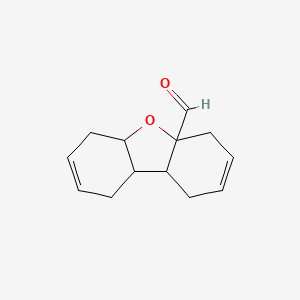
CAS 126-15-8PubChem CID 31341
2,3:4,5-Di(2-butenyl)tetrahydrofurfural
- IUPAC name
- 4,5a,6,9,9a,9b-hexahydro-1H-dibenzofuran-4a-carbaldehyde
- Molecular formula
- C13H16O2
- Molecular weight
- 204.26 g/mol
- Exact mass
- 204.115029749 Da
- XLogP3
- 2.1
- Topological polar surface area
- 26.3 Ų
- Hydrogen-bond donors
- 0
- Hydrogen-bond acceptors
- 2
- Covalent units
- 1
- Defined stereocentres
- 0
Also known as
Mgk repellent 11Dibutylene tetrafurfural1,5a,6,9,9a,9b-Hexahydro-4a(4H)-dibenzofurancarboxaldehydeCaswell No. 0894a(4H)-Dibenzofurancarboxaldehyde, 1,5a,6,9,9a,9b-hexahydro-2,3,4,5-Bis(2-butylene)tetrahydro-2-furaldehydeMGK R-11HSDB 5609
16 more reported names
UNII-C62PHK07EV2,3,4,5-Bisbutylene tetrafurfuralEINECS 204-773-7BRN 0011685AI3-17596Bis-delta(sup 2)-butylenetetrahydrofurfuralNSC-529652,3,4,5-Bis(delta-2-butylene)tetrahydrofurfural2,3,4,5-Bis(delta(sup 2)-butylene)tetrahydrofurfural2,3,4,5-Bis(delta(sup 2)-butenylene)tetrahydrofurfural4-17-00-05023 (Beilstein Handbook Reference)Bis(.DELTA.2-butylene)tetrahydrofurfural2,3:4,5-Bis(2-butenylene)tetrahydrofurfural2,3,4,5-Bis(.DELTA.2)butylene)tetrahydrofurfural2,3,4,5-Bis(.DELTA.2-butylene)tetrahydrofurfural2,3,4,5-Bis(.DELTA.2)butenylene)tetrahydrofurfural
External database identifiers
- EPA DTXSID:DTXSID3041320
Evidence from additional scientific databases
NIH PubChem PUG-View
Exact identifier match31341
Attributed physical-property, hazard, environmental and use annotations.
- Boiling Point: 307 °C Source: Hazardous Substances Data Bank (HSDB)
- Boiling Point: 307 °C @760 [mm Hg] Source: PAC Chemical Database, U.S. Department of Energy
- Color/Form: PALE YELLOW LIQUID Source: Hazardous Substances Data Bank (HSDB)
- Density: 1.10 @ 20 °C/4 °C Source: Hazardous Substances Data Bank (HSDB)
- Density: DENSITY: 1.120 @ 20 °C/20 °C /TECHNICAL GRADE/ Source: Hazardous Substances Data Bank (HSDB)
- Density: 1.10 @ 20°C Source: PAC Chemical Database, U.S. Department of Energy
- Melting Point: -80 °C Source: Hazardous Substances Data Bank (HSDB)
- Melting Point: -80 °C Source: PAC Chemical Database, U.S. Department of Energy
- Odor: FRUITY ODOR Source: Hazardous Substances Data Bank (HSDB)
- Physical Description: Pale yellow liquid with a fruity odor; [HSDB] Source: Haz-Map, Information on Hazardous Chemicals and Occupational Diseases
- Solubility: PRACTICALLY INSOL IN WATER & IN DILUTE ALKALI; MISCIBLE WITH PETROLEUM OILS, TOLUENE, XYLENE, ETHANOL Source: Hazardous Substances Data Bank (HSDB)
- GHS Hazard Statements: H411 (100%): Toxic to aquatic life with long lasting effects [Hazardous to the aquatic environment, long-term hazard] Source: European Chemicals Agency (ECHA)
- Precautionary Statement Codes: P273, P391, and P501 (click each P-code to see the statement) Source: European Chemicals Agency (ECHA)
- ECHA C&L Notifications Summary: The GHS information provided by 1 company from 1 notification to the ECHA C&L Inventory. Source: European Chemicals Agency (ECHA)
- Sources/Uses: Used as insect repellent; No longer registered with the EPA for use in the US, cancelled; [HSDB] Source: Haz-Map, Information on Hazardous Chemicals and Occupational Diseases
- Uses: The active ingredient is no longer contained in any registered pesticide products ... "cancelled." Source: Hazardous Substances Data Bank (HSDB)
- Uses: INSECT REPELLENT Source: Hazardous Substances Data Bank (HSDB)
Mapped by: Existing checksum-valid CAS to unique PubChem CID match. Retrieved: 2026-08-31. Open source record
Scientific classifications and hazard annotations provide context and do not replace the market-specific regulatory decision shown above.
Additional source coverage and match status
| Source | Result | Checked |
|---|---|---|
| NIH PubChem PUG-View | Exact match | 2026-08-31 |
A recorded no-match is useful evidence that the source was checked; it is not a claim that the substance does not exist elsewhere.
Retrieved from NIH PubChem on 2026-08-31 by checksum-valid CAS matching. Chemical properties do not replace the regulatory decision on this page.