
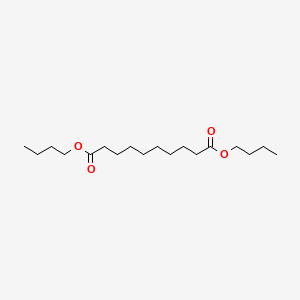
- IUPAC name
- dibutyl decanedioate
- Molecular formula
- C18H34O4
- Molecular weight
- 314.5 g/mol
- Exact mass
- 314.24570956 Da
- XLogP3
- 5.3
- Topological polar surface area
- 52.6 Ų
- Hydrogen-bond donors
- 0
- Hydrogen-bond acceptors
- 4
- Covalent units
- 1
- Defined stereocentres
- 0
Also known as
Butyl sebacateDecanedioic acid, dibutyl esterDi-n-butyl sebacateKodaflex DBSDibutyl sebacinateStaflex DBSMonoplex DBSBis(n-butyl) sebacate
16 more reported names
Sebacic acid, dibutyl ester1,10-dibutyl decanedioateDi-n-butylsebacateBis(n-butyl)sebacaten-Butyl sebacateFEMA No. 2373Dibutyl 1,8-octanedicarboxylateDibutylester kyseliny sebakovePX 4044W5IH7FLNYNSC-3893PX-404203-672-5DIBUTYLSEBACATERefChem:132946Sebacic acid dibutyl ester
External database identifiers
- ChEBI:CHEBI:165632
- ChEMBL:CHEMBL2106225
- EPA DTXSID:DTXSID1041847
- PubMed:22224401
- PubMed:22171316
- PubMed:22163795
- PubMed:22139757
- PubMed:22125769
- PubMed:21946490
- PubMed:21753876
- PubMed:21698780
- PubMed:21254067
- PubMed:21181509
- PubMed:21095223
- PubMed:20800682
Evidence from additional scientific databases
NIH PubChem PUG-View
Exact identifier match7986
Attributed physical-property, hazard, environmental and use annotations.
- Autoignition Temperature: 690 °F (365 °C) Source: Hazardous Substances Data Bank (HSDB)
- Boiling Point: 344.5 °C Source: Hazardous Substances Data Bank (HSDB)
- Boiling Point: 211.00 to 212.00 °C. @ 11.00 mm Hg Source: Human Metabolome Database (HMDB)
- Boiling Point: 344-345 °C Source: ILO-WHO International Chemical Safety Cards (ICSCs)
- Boiling Point: 345-349 °C; 211-212 °C (11 mm Hg) Source: Joint FAO/WHO Expert Committee on Food Additives (JECFA)
- Color/Form: Colorless liquid Source: Hazardous Substances Data Bank (HSDB)
- Density: 0.9405 @ 15 °C Source: Hazardous Substances Data Bank (HSDB)
- Density: Relative density (water = 1): 0.9 Source: ILO-WHO International Chemical Safety Cards (ICSCs)
- Density: 0.936-0.940 (20 °C) Source: Joint FAO/WHO Expert Committee on Food Additives (JECFA)
- Flash Point: 353 °F (178 °C) (OPEN CUP) Source: Hazardous Substances Data Bank (HSDB)
- Flash Point: 167 °C Source: ILO-WHO International Chemical Safety Cards (ICSCs)
- Melting Point: -10 °C Source: Hazardous Substances Data Bank (HSDB)
- Melting Point: 12 °C Source: Human Metabolome Database (HMDB)
- Melting Point: -10 °C Source: ILO-WHO International Chemical Safety Cards (ICSCs)
- Odor: Odorless Source: Hazardous Substances Data Bank (HSDB)
- Physical Description: CBI; Liquid Source: EPA Chemical Data Reporting (CDR)
- Physical Description: Colorless oily liquid; [ICSC] Odorless; [HSDB] Source: Haz-Map, Information on Hazardous Chemicals and Occupational Diseases
- Physical Description: Liquid Source: Human Metabolome Database (HMDB)
- Physical Description: COLOURLESS OILY LIQUID. Source: ILO-WHO International Chemical Safety Cards (ICSCs)
- Physical Description: colourless to oily liquid; fruity but very mild odour with a very faint fruity oily taste Source: Joint FAO/WHO Expert Committee on Food Additives (JECFA)
- Refractive Index: Index of refraction: 1.4433 @ 15 °C/D Source: Hazardous Substances Data Bank (HSDB)
- Refractive Index: 1.439-1.444 Source: Joint FAO/WHO Expert Committee on Food Additives (JECFA)
- Solubility: Soluble in ethyl ether Source: Hazardous Substances Data Bank (HSDB)
- Solubility: water solubility = 40 mg/l @ 20 °C Source: Hazardous Substances Data Bank (HSDB)
- Solubility: 0.04 mg/mL at 20 °C Source: Human Metabolome Database (HMDB)
- Solubility: Solubility in water: none Source: ILO-WHO International Chemical Safety Cards (ICSCs)
- Solubility: insoluble in water; soluble in alcohol; miscible in oil Source: Joint FAO/WHO Expert Committee on Food Additives (JECFA)
- Solubility: (in ethanol) Source: Joint FAO/WHO Expert Committee on Food Additives (JECFA)
- Vapor Pressure: 0.00000469 [mmHg] Source: Haz-Map, Information on Hazardous Chemicals and Occupational Diseases
- Vapor Pressure: 4.69X10⁻⁶ mm Hg @ 25 °C Source: Hazardous Substances Data Bank (HSDB)
- Carcinogen Classification: No indication of carcinogenicity to humans (not listed by IARC). Source: Toxin and Toxin Target Database (T3DB)
- Note: This chemical does not meet GHS hazard criteria for 82.8% (410 of 495) of all reports. Source: European Chemicals Agency (ECHA)
- Signal: Warning Source: European Chemicals Agency (ECHA)
- GHS Hazard Statements: H315 (16.8%): Causes skin irritation [Warning Skin corrosion/irritation]; H319 (16.8%): Causes serious eye irritation [Warning Serious eye damage/eye irritation]; H335 (16.6%): May cause respiratory irritation [Warning Specific target organ toxicity, single exposure; Respiratory tract irritation] Source: European Chemicals Agency (ECHA)
- Precautionary Statement Codes: P261, P264, P264+P265, P271, P280, P302+P352, P304+P340, P305+P351+P338, P319, P321, P332+P317, P337+P317, P362+P364, P403+P233, P405, and P501 (click each P-code to see the statement) Source: European Chemicals Agency (ECHA)
- ECHA C&L Notifications Summary: Aggregated GHS information provided per 495 reports by companies from 14 notifications to the ECHA C&L Inventory. Each notification may be associated with multiple companies.; Reported as not meeting GHS hazard criteria per 410 of 495 reports by companies.; There are 12 notifications provided by 85 of 495 reports by companies with hazard statement code(s).; Information may vary between notifications depending on impurities, additives, and other factors. The percentage value in parenthesis indicates the notified classification ratio from companies that provide hazard codes. Only hazard codes with percentage values above 10% are shown. For more detailed information, please visit ECHA C&L website. Source: European Chemicals Agency (ECHA)
- NFPA Health Rating: 0 - Materials that, under emergency conditions, would offer no hazard beyond that of ordinary combustible materials. Source: Hazardous Substances Data Bank (HSDB)
- NFPA Fire Rating: 1 - Materials that must be preheated before ignition can occur. Materials require considerable preheating, under all ambient temperature conditions, before ignition and combustion can occur. Source: Hazardous Substances Data Bank (HSDB)
- NFPA Instability Rating: 0 - Materials that in themselves are normally stable, even under fire conditions. Source: Hazardous Substances Data Bank (HSDB)
- Cosmetic Ingredient Review Finding(s): Safe in the present practices of use and concentration. Ingredient, concentration, and use information are available in documents discoverable at https://cir-reports.cir-safety.org Source: Cosmetic Ingredient Review (CIR)
- Environmental Bioconcentration: An estimated BCF of 77 was calculated for dibutyl sebacate(SRC), using a water solubility of 40 mg/l(1) and a regression-derived equation(2). According to a classification scheme(3), this BCF suggests the potential for bioconcentration in aquatic organisms is low(SRC). Source: Hazardous Substances Data Bank (HSDB)
- Environmental Fate: TERRESTRIAL FATE: Based on a classification scheme(1), an estimated Koc value of 575(SRC), determined from a water solubility of 40 mg/l(2) and a regression-derived equation(3), indicates that dibutyl sebacate is expected to have low mobility in soil(SRC). Volatilization of dibutyl sebacate from moist soil surfaces is not expected to be an important fate process(SRC) given an estimated Henry's Law constant of 4.8X10⁻⁸ atm-cu m/mole(SRC), calculated from a vapor pressure of 4.7X10⁻⁶ mm Hg(4) and water solubility of 40 mg/l(2). Dibutyl sebacate is not expected to volatilize from dry soil surfaces(SRC) based upon its vapor pressure(4). Dibutyl sebacate and other plasticizers were readily biodegraded by pure bacterial and fungal cultures(5,6). Source: Hazardous Substances Data Bank (HSDB)
- Environmental Fate: AQUATIC FATE: Based on a classification scheme(1), an estimated Koc value of 575(SRC), determined from a water solubility of 40 mg/l(2) and a regression-derived equation(3), indicates that dibutyl sebacate is expected to adsorb to suspended solids and sediment in water(SRC). Volatilization from water surfaces is not expected to be an important fate process(3) based upon an estimated Henry's Law constant of 4.8X10⁻⁸ atm-cu m/mole(SRC), calculated from a vapor pressure of 4.7X10⁻⁶ mm Hg(4) and water solubility of 40 mg/l(2). A base-catalyzed second-order hydrolysis rate constant of 0.05 L/mole-sec(SRC) was estimated using a structure estimation method(5); this corresponds to half-lives of 4.5 years and 166 days at pH values of 7 and 8, respectively(5). Dibutyl sebacate and other plasticizers were readily biodegraded by pure bacterial and fungal cultures(6,7). According to a classification scheme(8),an estimated BCF of 77(SRC), from its water solubility(2) and a regression-derived equation(3), suggests the potential for bioconcentration in aquatic organisms is moderate(SRC). Source: Hazardous Substances Data Bank (HSDB)
- Environmental Fate: ATMOSPHERIC FATE: According to a model of gas/particle partitioning of semivolatile organic compounds in the atmosphere(1), dibutyl sebacate, which has a vapor pressure of 4.7X10⁻⁶ mm Hg at 25 °C(2), is expected to exist in both the vapor and particulate phases in the ambient atmosphere. Vapor-phase dibutyl sebacate is degraded in the atmosphere by reaction with photochemically-produced hydroxyl radicals(SRC); the half-life for this reaction in air is estimated to be 21 hours(SRC), calculated from its estimated rate constant of 1.8X10⁻¹¹ cu cm/molecule-sec at 25 °C(SRC) determined using a structure estimation method(3). Particulate-phase dibutyl sebacate may be removed from the air by wet and dry deposition(SRC). Dibutyl sebacate may also undergo direct photolysis in the environment since this compound contains functional groups that can absorb light greater than 290 nm(4). Source: Hazardous Substances Data Bank (HSDB)
- Consumer Uses: Pigment; Not Known or Reasonably Ascertainable; Plasticizer Source: EPA Chemical Data Reporting (CDR)
- Industry Uses: Pigment; Not Known or Reasonably Ascertainable; Plasticizer Source: EPA Chemical Data Reporting (CDR)
- Cosmetic Ingredient Review Link: CIR ingredient: Dibutyl Sebacate Source: Cosmetic Ingredient Review (CIR)
- Sources/Uses: Used as plasticizer, rubber softener, dielectric liquid, flavoring ingredient, and additive to cosmetics and perfumes; [HSDB] Source: Haz-Map, Information on Hazardous Chemicals and Occupational Diseases
- Uses: SYNTHETIC FLAVORING ADJUVANT Source: Hazardous Substances Data Bank (HSDB)
- Uses: Plasticizer, rubber softener, dielectric liquid, cosmetic and perfumes, flavoring ingredient Source: Hazardous Substances Data Bank (HSDB)
- Uses: Plastics -> Typical concentration range in plastic materials -> 10.0 - 35.0% Source: NORMAN Suspect List Exchange
Mapped by: Existing checksum-valid CAS to unique PubChem CID match. Retrieved: 2026-08-31. Open source record
Scientific classifications and hazard annotations provide context and do not replace the market-specific regulatory decision shown above.
Additional source coverage and match status
| Source | Result | Checked |
|---|---|---|
| NIH PubChem PUG-View | Exact match | 2026-08-31 |
A recorded no-match is useful evidence that the source was checked; it is not a claim that the substance does not exist elsewhere.
Retrieved from NIH PubChem on 2026-08-31 by checksum-valid CAS matching. Chemical properties do not replace the regulatory decision on this page.