
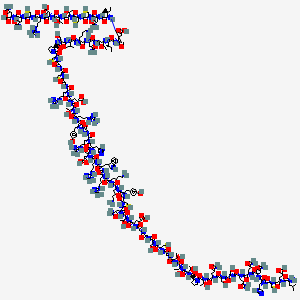
Cobrotoxin
alpha-Cobratoxin is a peptide toxin produced by certain cobras of the Naja genus, such as the Monocled cobra (Naja kaouthia). It is a muscle-type nicotinic acetylcholine receptor (nAChR) antagonist, which causes paralysis by preventing the binding of acetylcholine to the nAChR. (L1046) — Toxin and Toxin Target Database (T3DB)
- IUPAC name
- (4S)-5-[[(2S,3R)-1-[[(2S)-4-amino-1-[[(2R)-1-[[(2S)-1-[[(2S)-6-amino-1-[[(2S)-6-amino-1-[[(2S)-1-[[(2S)-1-[[(2S)-1-[[(2S)-1-[[(2S)-1-[[(2S)-1-[[2-[[(2S)-1-[[(2S)-1-[[(2S,3R)-1-[[(2S)-1-[[(2S)-1-[[2-[[(2R)-1-[[2-[[(2R)-1-[(2S)-2-[[(2S)-1-[[(2S)-1-[[(2S)-6-amino-1-[[(2S)-4-amino-1-[[2-[[(2S,3S)-1-[[(2S)-1-[[(2S,3S)-1-[[(2S)-4-amino-1-[[(2R)-1-[[(2R)-1-[[(2S,3R)-1-[[(2S,3R)-1-[[(2S)-1-[[(2S)-1-[[(2R)-1-[[(2S)-4-amino-1-[[(1S)-3-amino-1-carboxy-3-oxopropyl]amino]-1,4-dioxobutan-2-yl]amino]-1-oxo-3-sulfanylpropan-2-yl]amino]-5-carbamimidamido-1-oxopentan-2-yl]amino]-3-carboxy-1-oxopropan-2-yl]amino]-3-hydroxy-1-oxobutan-2-yl]amino]-3-hydroxy-1-oxobutan-2-yl]amino]-1-oxo-3-sulfanylpropan-2-yl]amino]-1-oxo-3-sulfanylpropan-2-yl]amino]-1,4-dioxobutan-2-yl]amino]-3-methyl-1-oxopentan-2-yl]amino]-4-carboxy-1-oxobutan-2-yl]amino]-3-methyl-1-oxopentan-2-yl]amino]-2-oxoethyl]amino]-1,4-dioxobutan-2-yl]amino]-1-oxohexan-2-yl]amino]-3-methyl-1-oxobutan-2-yl]amino]-3-hydroxy-1-oxopropan-2-yl]carbamoyl]pyrrolidin-1-yl]-1-oxo-3-sulfanylpropan-2-yl]amino]-2-oxoethyl]amino]-1-oxo-3-sulfanylpropan-2-yl]amino]-2-oxoethyl]amino]-5-carbamimidamido-1-oxopentan-2-yl]amino]-4-carboxy-1-oxobutan-2-yl]amino]-3-hydroxy-1-oxobutan-2-yl]amino]-5-carbamimidamido-1-oxopentan-2-yl]amino]-3-(4-hydroxyphenyl)-1-oxopropan-2-yl]amino]-2-oxoethyl]amino]-5-carbamimidamido-1-oxopentan-2-yl]amino]-3-(1H-imidazol-5-yl)-1-oxopropan-2-yl]amino]-3-carboxy-1-oxopropan-2-yl]amino]-5-carbamimidamido-1-oxopentan-2-yl]amino]-3-(1H-indol-3-yl)-1-oxopropan-2-yl]amino]-5-carbamimidamido-1-oxopentan-2-yl]amino]-1-oxohexan-2-yl]amino]-1-oxohexan-2-yl]amino]-3-(4-hydroxyphenyl)-1-oxopropan-2-yl]amino]-1-oxo-3-sulfanylpropan-2-yl]amino]-1,4-dioxobutan-2-yl]amino]-3-hydroxy-1-oxobutan-2-yl]amino]-4-[[2-[[2-[[(2S)-2-[[(2R)-2-[[2-[[(2S,3R)-2-[[(2S,3R)-2-[[(2S,3R)-2-[[(2S)-1-[(2S,3R)-2-[[(2S)-5-amino-2-[[(2S)-2-[[(2S)-2-[[(2S)-5-amino-2-[[(2S)-5-amino-2-[[(2S)-4-amino-2-[[(2S)-2-[[(2R)-2-[[(2S)-2-[[(2S)-2-amino-4-methylpentanoyl]amino]-4-carboxybutanoyl]amino]-3-sulfanylpropanoyl]amino]-3-(1H-imidazol-5-yl)propanoyl]amino]-4-oxobutanoyl]amino]-5-oxopentanoyl]amino]-5-oxopentanoyl]amino]-3-hydroxypropanoyl]amino]-3-hydroxypropanoyl]amino]-5-oxopentanoyl]amino]-3-hydroxybutanoyl]pyrrolidine-2-carbonyl]amino]-3-hydroxybutanoyl]amino]-3-hydroxybutanoyl]amino]-3-hydroxybutanoyl]amino]acetyl]amino]-3-sulfanylpropanoyl]amino]-3-hydroxypropanoyl]amino]acetyl]amino]acetyl]amino]-5-oxopentanoic acid
- Molecular formula
- C277H443N97O98S8
- Molecular weight
- 6957 g/mol
- Exact mass
- 6954.0495793 Da
- XLogP3
- -50.6
- Topological polar surface area
- 3250.0 Ų
- Hydrogen-bond donors
- 122
- Hydrogen-bond acceptors
- 118
- Covalent units
- 1
- Defined stereocentres
- 65
Also known as
Evidence from additional scientific databases
NIH PubChem PUG-View
Attributed physical-property, hazard, environmental and use annotations.
- Carcinogen Classification: No indication of carcinogenicity to humans (not listed by IARC). Source: Toxin and Toxin Target Database (T3DB)
- Exposure Routes: Injection (sting/bite) (L1814) Source: Toxin and Toxin Target Database (T3DB)
- Health Effects: Naja cobras have a strongly neurotoxic venom, which attacks the nervous system, causing paralysis, and many also have hemotoxic features which causes swelling, necrosis and has a significant anticoagulant effect. Naja bites can be fatal to humans. (L1047) Source: Toxin and Toxin Target Database (T3DB)
- Toxicity Summary: alpha-Cobratoxin is a muscle-type nicotinic acetylcholine receptor (nAChR) antagonist. It causes paralysis by preventing the binding of acetylcholine to the nAChR, as the nAChR is needed for synaptic transmission both in the central nervous system and at the neuromuscular junction. (L1046) Source: Toxin and Toxin Target Database (T3DB)
- Uses: alpha-Cobratoxin is a peptide toxin produced by certain cobras of the Naja genus, such as the Monocled cobra (Naja kaouthia). (L1046) Source: Toxin and Toxin Target Database (T3DB)
Mapped by: Existing checksum-valid CAS to unique PubChem CID match. Retrieved: 2026-08-31. Open source record
Scientific classifications and hazard annotations provide context and do not replace the market-specific regulatory decision shown above.
Additional source coverage and match status
| Source | Result | Checked |
|---|---|---|
| NIH PubChem PUG-View | Exact match | 2026-08-31 |
A recorded no-match is useful evidence that the source was checked; it is not a claim that the substance does not exist elsewhere.
Retrieved from NIH PubChem on 2026-08-31 by checksum-valid CAS matching. Chemical properties do not replace the regulatory decision on this page.