
Official EU label nameGlossary entry 6441
CI 73900
This record confirms an official common ingredient name for EU cosmetic product labelling. It does not by itself confirm that the substance is permitted, unrestricted or safe.
Global evidence snapshot
The resolved identity has matching regulatory evidence in 7 of 13 indexed market datasets: 7 country records and 1 EU Annex records. Every result and evidence gap is listed below.
Markets checked
13
Markets with evidence
7
Evidence gaps
6
Resolved identifiers
2
Resolved substance identity
CAS:1047-16-1
EC:213-879-2
Ingredient index records:
CI 73900
Cosmetic functions: COLORANT
5,12-Dihydroquino[2,3-b]acridine-7,14-dione
Inventory restriction note: IV/102
PIGMENT VIOLET 19
Cosmetic functions: HAIR DYEING
5,12-Dihydroquino[2,3-b]acridine-7,14-dione (CI 73900)
Inventory restriction note: II/1366
8 matched or reported names
CI 73900PIGMENT VIOLET 195,12-Dihydroquino[2,3-b]acridine-7,14-dione5,12-Dihydroquino[2,3-b]acridine-7,14-dione (Pigment Violet 19; CI 73900) when used as a substance in hair dye products5,12-Dihydroquino[2,3-b]acridine-7,14-dione (Pigment Violet 19)5,12-Dihydroquino[2,3-b]acridine-7,14-dione (Pigment Violet 19;5,12-dihidroquino[2,3-b]acridina-7,14-di ona (CI 73900), quando usado como substância que entra na composição de corantes capilares5,12-Dihydroquino[2,3-b]acridine-7,14-dione (pigment violet 19; CI 73900) (CAS No. 1047-16-1) when used as a substance in hair dye products
Regulatory evidence in all 13 markets
Open each matched record for its scope, concentration, conditions, warnings and official source version.
Swipe or scroll horizontally to see dataset coverage and next actions.
| Market | Result | Records | Dataset | Meaning / next action |
|---|---|---|---|---|
| European Union EU | Conditional positive-list match | 1Open record 1 | Complete annex dataset Regulation (EC) 1223/2009 consolidated to 1 May 2026 | Review every linked record and exact conditions. |
| Great Britain GB | Prohibited | 1Open record 1 | Complete consolidated annex dataset GB retained Regulation 1223/2009 schedules, effective 15 August 2026 | Review every linked record and exact conditions. |
| Canada CA | No local match | 0 | Complete Hotlist snapshot Health Canada Cosmetic Ingredient Hotlist, 13 August 2025 | The Hotlist is an administrative compliance tool, not an exhaustive safety approval list. |
| New Zealand NZ | Prohibited | 2Open record 1Open record 2 | Complete schedules dataset Cosmetic Products Group Standard schedules effective 1 January 2026 | Review every linked record and exact conditions. |
| ASEAN ASEAN | Prohibited | 1Open record 1 | Complete regional annex dataset ASEAN Cosmetic Directive annexes 2026-1, 22 June 2026 | Review every linked record and exact conditions. |
| China CN | No local match | 0 | Complete prohibited catalogues plus official-source workflow NMPA 2021 banned catalogues plus dynamic IECIC List I/List II system current since 2025 | IECIC listing is not blanket approval; absence may require the new cosmetic ingredient route, and restrictions are checked separately. |
| Japan JP | No local match | 0 | Complete Standards appendices dataset MHLW Standards for Cosmetics official English source and Japanese amendments checked for the imported snapshot | The Japanese text and subsequent notices are canonical; no local match is not a product-compliance conclusion. |
| South Korea KR | No local match | 0 | Complete current appendix dataset MFDS Notice 2026-19, effective 18 March 2026 | Korean source wording is canonical and other positive lists/notices may still apply to the formulation. |
| United States US | No local match | 0 | Complete enumerated federal ingredient rules eCFR Title 21 issue date 27 August 2026 | FDA has no general approved-cosmetic-ingredient catalogue; absence from these sections is not approval or proof of safety. |
| Australia AU | No local match | 0 | Complete cosmetic-relevant Poisons Standard subset plus official workflow Therapeutic Goods (Poisons Standard—June 2026) Instrument 2026 | An AICIS Inventory match is not cosmetic approval; no Inventory match can indicate a new, exempted, reported or confidential introduction. |
| Brazil BR | Prohibited | 1Open record 1 | Complete prohibited dataset plus current restricted-list workflow ANVISA RDC 1.029/2026 and RDC 1.030/2026, published 15 June 2026 | Review every linked record and exact conditions. |
| India IN | Prohibited | 1Open record 1 | Complete current Part 2 dataset plus official workflow for Parts 1, 3 and 4 Cosmetics Rules 2020 plus current BIS IS 4707 parts (1:2020, 2:2025, 3:2025, 4:2022) | Review every linked record and exact conditions. |
| Saudi Arabia SA | Prohibited | 1Open record 1 | Complete official list index SFDA live prohibited/restricted lists, snapshot 30 August 2026 | Review every linked record and exact conditions. |
No market rows match this filter.
Matching market records and conditions
Great Britain
GB retained Regulation 1223/2009 schedules, effective 15 August 2026New Zealand
Cosmetic Products Group Standard schedules effective 1 January 20265,12-Dihydroquino[2,3-b]acridine-7,14-dione (Pigment Violet 19)Permitted list with conditions
Colour index: 73900 · CAS: 1047-16-1 · Colour: Violet · Product scope: Rinse-off products
Schedule 6, reference 102, source row 104 · effective-2026-01-01
5,12-Dihydroquino[2,3-b]acridine-7,14-dione (Pigment Violet 19; CI 73900) when used as a substance in hair dye productsProhibited
Schedule 4, reference 1366, source row 1445 · effective-2026-01-01
ASEAN
ASEAN Cosmetic Directive annexes 2026-1, 22 June 2026Brazil
ANVISA RDC 1.029/2026 and RDC 1.030/2026, published 15 June 2026India
Cosmetics Rules 2020 plus current BIS IS 4707 parts (1:2020, 2:2025, 3:2025, 4:2022)Saudi Arabia
SFDA live prohibited/restricted lists, snapshot 30 August 2026Exact Annex II–VI evidence
Chemical identity and properties
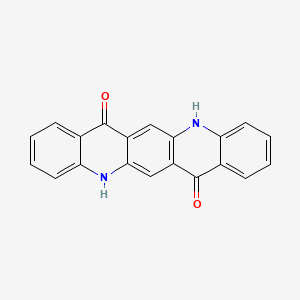
CAS 1047-16-1PubChem CID 13976
Quinacridone
Quinacridone is an organonitrogen heterocyclic compound and an organic heterotetracyclic compound. — ChEBI
- IUPAC name
- 5,12-dihydroquinolino[2,3-b]acridine-7,14-dione
- Molecular formula
- C20H12N2O2
- Molecular weight
- 312.3 g/mol
- Exact mass
- 312.089877630 Da
- XLogP3
- 4.0
- Topological polar surface area
- 58.2 Ų
- Hydrogen-bond donors
- 2
- Hydrogen-bond acceptors
- 4
- Covalent units
- 1
- Defined stereocentres
- 0
Also known as
CINQUASIA REDMonastral RedQuinacridone violetMonastral Violet RSunfast VioletCinquasia Red BCinquasia Red YMonastral Red B
16 more reported names
Monastral Red YMonastrol Red YPermanent MagentaPaliogen Red BGCinquasia Violet RDark violetSunfast Red 19Cinquasia VioletQuinacridone RedQuinacridone Red MCPermanent Red E 3BQuinacridone Violet MCPV Fast Red E 3BPV Fast Red E 5BHostaperm Red Violet ERHostaperm Red E 3B
External database identifiers
Evidence from additional scientific databases
EMBL-EBI ChEBI
Exact identifier matchCHEBI:174977
Quinacridone
- Formula
- C20H12N2O2
- Average mass
- 312.328 g/mol
- Monoisotopic mass
- 312.08988 Da
- Formal charge
- 0
- organonitrogen heterocyclic compound — is a (CHEBI:38101)
- organic heterotetracyclic compound — is a (CHEBI:38163)
- organonitrogen heterocyclic compound — is a (CHEBI:38101)
- organic heterotetracyclic compound — is a (CHEBI:38163)
Additional curated names
5,12-dihydroquinolino[2,3-b]acridine-7,14-dione
Cross-references from this source
- CAS: 1047-16-1 — ChemIDplus
- MANUAL_X_REF: 13369 — ChemSpider
- MANUAL_X_REF: HMDB0034058 — HMDB
Mapped by: Exact CAS cross-reference in the ChEBI compound record. Retrieved: 2026-08-31. Open source record
NIH PubChem PUG-View
Exact identifier match13976
Attributed physical-property, hazard, environmental and use annotations.
- Color/Form: Red to violet solid with blueish or yellowish tint depending upon crystalline form. Source: Hazardous Substances Data Bank (HSDB)
- Color/Form: particle characteristics: thin plates Source: Hazardous Substances Data Bank (HSDB)
- Density: 1.5 Source: Hazardous Substances Data Bank (HSDB)
- LogP: 1.9 (estimated) Source: Hazardous Substances Data Bank (HSDB)
- Melting Point: 390 °C Source: Human Metabolome Database (HMDB)
- Physical Description: Liquid; Other Solid; Dry Powder; Other Solid; CBI Source: EPA Chemical Data Reporting (CDR)
- Physical Description: Red to violet solid; Bluish or yellowish tint depending of form; [HSDB] Red odorless powder; [MSDSonline] Source: Haz-Map, Information on Hazardous Chemicals and Occupational Diseases
- Physical Description: Solid Source: Human Metabolome Database (HMDB)
- Refractive Index: Refractive index: quinacridine red (gamma), n(Na) Av. 2.04; quinacridine red (beta), Av. 2.02 Source: Hazardous Substances Data Bank (HSDB)
- Solubility: Insoluble in water Source: Hazardous Substances Data Bank (HSDB)
- Solubility: Insoluble in organic solvents and dispersion media. Source: Hazardous Substances Data Bank (HSDB)
- Note: This chemical does not meet GHS hazard criteria for 99.6% (760 of 763) of all reports. Source: European Chemicals Agency (ECHA)
- GHS Hazard Statements: Not Classified; Reported as not meeting GHS hazard criteria by 760 of 763 companies (only 0.4% companies provided GHS information). For more detailed information, please visit ECHA C&L website. Source: European Chemicals Agency (ECHA)
- ECHA C&L Notifications Summary: Aggregated GHS information provided per 763 reports by companies from 4 notifications to the ECHA C&L Inventory.; Reported as not meeting GHS hazard criteria per 760 of 763 reports by companies.; There are 2 notifications provided by 3 of 763 reports by companies with hazard statement code(s).; Information may vary between notifications depending on impurities, additives, and other factors. The percentage value in parenthesis indicates the notified classification ratio from companies that provide hazard codes. Only hazard codes with percentage values above 10% are shown. For more detailed information, please visit ECHA C&L website. Source: European Chemicals Agency (ECHA)
- Environmental Bioconcentration: Cinquasia red should not bioconcentrate, since it is insoluble, and therefore, will not be taken up into the body. Source: Hazardous Substances Data Bank (HSDB)
- Environmental Fate: Much of cinquasia red will be bound up in the components of landfills, junkyards, and general dump sites. Source: Hazardous Substances Data Bank (HSDB)
- Environmental Fate: Terrestrial: The insolubility of cinquasia red will cause it to collect in soils and sediments. Source: Hazardous Substances Data Bank (HSDB)
- Environmental Fate: Aquatic: Due to its insolubility, cinquasia red may reside in the water column for a substantial period, long enough to become part of deep sea sediments. Source: Hazardous Substances Data Bank (HSDB)
- Consumer Uses: Pigment Source: EPA Chemical Data Reporting (CDR)
- Industry Uses: Pigment Source: EPA Chemical Data Reporting (CDR)
- Sources/Uses: Used as pigment (paints, printing inks, plastics, rubber, alkyd resin enamels, textile emulsion inks, textiles, nitrocellulose, vinyl, and acrylic lacquers) and sensitizing dye in color photo electrophoresis; Used to tone and make other pigments; [HSDB] Source: Haz-Map, Information on Hazardous Chemicals and Occupational Diseases
- Industrial Processes with risk of exposure: Painting (Pigments, Binders, and Biocides) [Category: Paint]; Textiles (Printing, Dyeing, or Finishing) [Category: Industry] Source: Haz-Map, Information on Hazardous Chemicals and Occupational Diseases
- Uses: PAINTS, PRINTING INKS, PLASTICS, RUBBER Source: Hazardous Substances Data Bank (HSDB)
- Uses: Cinquasia red is used a sensitizing dye in color photoelectrophoresis. Source: Hazardous Substances Data Bank (HSDB)
- Uses: Pigment in textiles Source: Hazardous Substances Data Bank (HSDB)
- Uses: As colorants for plastics, quinacridone pigments may be used in all resins except nylon-66 and polystyrene./Quinacridone Pigments/ Source: Hazardous Substances Data Bank (HSDB)
- Uses: For more Uses (Complete) data for CINQUASIA RED (9 total), please visit the HSDB record page. Source: Hazardous Substances Data Bank (HSDB)
- Uses: Plastics -> Typical concentration range in plastic materials -> 2% Source: NORMAN Suspect List Exchange
Mapped by: Existing checksum-valid CAS to unique PubChem CID match. Retrieved: 2026-08-31. Open source record
Scientific classifications and hazard annotations provide context and do not replace the market-specific regulatory decision shown above.
Additional source coverage and match status
| Source | Result | Checked |
|---|---|---|
| EMBL-EBI ChEBI | Exact match | 2026-08-31 |
| NIH PubChem PUG-View | Exact match | 2026-08-31 |
A recorded no-match is useful evidence that the source was checked; it is not a claim that the substance does not exist elsewhere.
Retrieved from NIH PubChem on 2026-08-31 by checksum-valid CAS matching. Chemical properties do not replace the regulatory decision on this page.
Additional authoritative substance research
Each link searches that source for this identity. A link is a research route, not a claim that the source holds an exact record. What each source is, and its legal weight
Take this record further
Official source and scope
Imported from Commission Implementing Decision (EU) 2025/1175 (dataset version EU 2025/1175). The glossary supplies common ingredient names for the ingredient list required by Article 19(1)(g); it is not an approval or safety list.
Open official Decision