
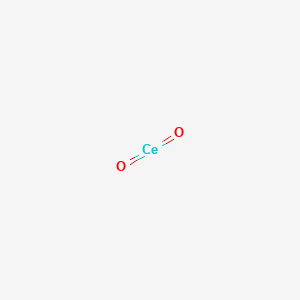
Ceria
Ceric oxide is a metal oxide with formula CeO2. It is used for polishing glass, in coatings for infra-red filters to prevent reflection, and as an oxidant and catalyst in organic synthesis. It is a metal oxide and a cerium molecular entity. — ChEBI
- IUPAC name
- dioxocerium
- Molecular formula
- CeO2
- Molecular weight
- 172.115 g/mol
- Exact mass
- 171.89528 Da
- Topological polar surface area
- 34.1 Ų
- Hydrogen-bond donors
- 0
- Hydrogen-bond acceptors
- 2
- Covalent units
- 1
- Defined stereocentres
- 0
Also known as
16 more reported names
External database identifiers
- ChEBI:CHEBI:79089
Evidence from additional scientific databases
NIH PubChem PUG-View
Attributed physical-property, hazard, environmental and use annotations.
- Density: 7.65 @25 °C Source: PAC Chemical Database, U.S. Department of Energy
- Melting Point: 2600 °C Source: PAC Chemical Database, U.S. Department of Energy
- Physical Description: Dry Powder; Other Solid; Dry Powder; Other Solid; Wet Solid; Large Crystals; CBI Source: EPA Chemical Data Reporting (CDR)
- Physical Description: White (pure) to pale yellow crystals; Insoluble in water; [Merck Index] Source: Haz-Map, Information on Hazardous Chemicals and Occupational Diseases
- GHS Hazard Statements: Not Classified; Reported as not meeting GHS hazard criteria by 565 of 651 companies Source: European Chemicals Agency (ECHA)
- ECHA C&L Notifications Summary: Aggregated GHS information provided per 651 reports by companies from 11 notifications to the ECHA C&L Inventory.; Reported as not meeting GHS hazard criteria per 565 of 651 reports by companies.; There are 9 notifications provided by 86 of 651 reports by companies with hazard statement code(s).; Information may vary between notifications depending on impurities, additives, and other factors. The percentage value in parenthesis indicates the notified classification ratio from companies that provide hazard codes. Only hazard codes with percentage values above 10% are shown. For more detailed information, please visit ECHA C&L website. Source: European Chemicals Agency (ECHA)
- Signal: Danger Source: NITE-CMC
- GHS Hazard Statements: H371: May cause damage to organs [Warning Specific target organ toxicity, single exposure]; H372: Causes damage to organs through prolonged or repeated exposure [Danger Specific target organ toxicity, repeated exposure] Source: NITE-CMC
- Precautionary Statement Codes: P260, P264, P270, P308+P316, P319, P405, and P501 (click each P-code to see the statement) Source: NITE-CMC
- Target Organs: Respiratory Source: EPA Integrated Risk Information System (IRIS)
- Consumer Uses: Abrasives; Pigment; Catalyst Source: EPA Chemical Data Reporting (CDR)
- Industry Uses: Drier; Pigment; Heat stabilizer; Processing aids, specific to petroleum production; Oxidizing agent; Catalyst; Processing aids not otherwise specified; Abrasives; Opacifer Source: EPA Chemical Data Reporting (CDR)
- Sources/Uses: Used to polish and decolorize glass, to opacify enamels, to analyze chemicals, to catalyze organic reactions, and to make coatings for heat-resistant alloys and infrared filters; [Merck Index] Cerium oxide nanoparticles are used in diesel fuel as combustion catalysts; [HSDB] Nanoparticles are used in solar and fuel cells, gas sensors, abrasives, oxygen pumps, and other metallurgic, glass, and ceramic applications; [PMID 21191487] Source: Haz-Map, Information on Hazardous Chemicals and Occupational Diseases
- Industrial Processes with risk of exposure: Glass Manufacturing [Category: Industry] Source: Haz-Map, Information on Hazardous Chemicals and Occupational Diseases
Mapped by: Existing checksum-valid CAS to unique PubChem CID match. Retrieved: 2026-08-31. Open source record
Scientific classifications and hazard annotations provide context and do not replace the market-specific regulatory decision shown above.
Additional source coverage and match status
| Source | Result | Checked |
|---|---|---|
| NIH PubChem PUG-View | Exact match | 2026-08-31 |
A recorded no-match is useful evidence that the source was checked; it is not a claim that the substance does not exist elsewhere.
Retrieved from NIH PubChem on 2026-08-31 by checksum-valid CAS matching. Chemical properties do not replace the regulatory decision on this page.