
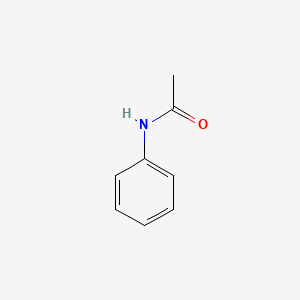
Acetanilide
N-phenylacetamide is a member of the class of acetamides that is acetamide in which one of the hydrogens attached to the nitrogen is substituted by a phenyl group. It has a role as an analgesic. It is an anilide and a member of acetamides. It is functionally related to an acetic acid. — ChEBI
- IUPAC name
- N-phenylacetamide
- Molecular formula
- C8H9NO
- Molecular weight
- 135.16 g/mol
- Exact mass
- 135.068413911 Da
- XLogP3
- 1.2
- Topological polar surface area
- 29.1 Ų
- Hydrogen-bond donors
- 1
- Hydrogen-bond acceptors
- 1
- Covalent units
- 1
- Defined stereocentres
- 0
Also known as
16 more reported names
External database identifiers
- ChEBI:CHEBI:28884
- ChEMBL:CHEMBL269644
- EPA DTXSID:DTXSID2022543
- PubMed:23125625
- PubMed:23099949
- PubMed:22991939
- PubMed:22927228
- PubMed:22790093
- PubMed:22693616
- PubMed:22666354
- PubMed:22654610
- PubMed:22645542
- PubMed:22641670
- PubMed:22626523
- PubMed:22587916
Evidence from additional scientific databases
EMBL-EBI ChEBI
N-phenylacetamide
A member of the class of acetamides that is acetamide in which one of the hydrogens attached to the nitrogen is substituted by a phenyl group.
- Formula
- C8H9NO
- Average mass
- 135.166 g/mol
- Monoisotopic mass
- 135.06841 Da
- Formal charge
- 0
- acetamides — is a (CHEBI:22160)
- anilide — is a (CHEBI:13248)
- analgesic — has role (CHEBI:35480)
- acetic acid — has functional parent (CHEBI:15366)
- analgesic — has role (CHEBI:35480)
- acetamides — is a (CHEBI:22160)
- anilide — is a (CHEBI:13248)
- 10866370 Source: PubMed
- 11754587 Source: PubMed
- 1271403 Source: PubMed
- 12873507 Source: PubMed
- 13215 Source: PubMed
- 15857133 Source: PubMed
- 19056282 Source: PubMed
- 22961681 Source: PubMed
- 23571415 Source: PubMed
- 23862058 Source: PubMed
- 24890655 Source: PubMed
- 26544630 Source: PubMed
- 27908763 Source: PubMed
- 2993621 Source: PubMed
- 30151092 Source: PubMed
- 30296683 Source: PubMed
- 38318365 Source: PubMed
- 38711345 Source: PubMed
- 6945436 Source: PubMed
- 8254605 Source: PubMed
- 850244 Source: PubMed
- 894678 Source: PubMed
Additional curated names
Cross-references from this source
Mapped by: Exact CAS cross-reference in the ChEBI compound record. Source updated: 2019-02-18. Retrieved: 2026-08-31. Open source record
NIH PubChem PUG-View
Attributed physical-property, hazard, environmental and use annotations.
- Autoignition Temperature: 1004 °F (NTP, 1992) Source: CAMEO Chemicals
- Autoignition Temperature: 985 + or - 10 °F. Source: Hazardous Substances Data Bank (HSDB)
- Boiling Point: 579 °F at 760 mmHg (NTP, 1992) Source: CAMEO Chemicals
- Boiling Point: 304 °C @ 760 MM HG Source: Hazardous Substances Data Bank (HSDB)
- Boiling Point: 304 °C @760 [mm Hg] Source: PAC Chemical Database, U.S. Department of Energy
- Color/Form: ORTHORHOMBIC PLATES OR SCALES FROM WATER Source: Hazardous Substances Data Bank (HSDB)
- Color/Form: WHITE SHINING CRYSTALLINE SCALES Source: Hazardous Substances Data Bank (HSDB)
- Color/Form: White, shining crystalline leaflets or white crystalline powder. Source: Hazardous Substances Data Bank (HSDB)
- Color/Form: Colorless, glossy, crystalline material. Source: Hazardous Substances Data Bank (HSDB)
- Density: 1.219 at 59 °F (NTP, 1992) - Denser than water; will sink Source: CAMEO Chemicals
- Density: 1.2190 @ 15 °C Source: Hazardous Substances Data Bank (HSDB)
- Density: 1.21 @ 20°C Source: PAC Chemical Database, U.S. Department of Energy
- Dissociation Constants: KB: 1X10-13 AT 28 °C Source: Hazardous Substances Data Bank (HSDB)
- Dissociation Constants: pKa = 0.50 at 25 °C (conjugate acid) Source: Hazardous Substances Data Bank (HSDB)
- Flash Point: 345 °F (NTP, 1992) Source: CAMEO Chemicals
- Flash Point: 169 °C Source: Haz-Map, Information on Hazardous Chemicals and Occupational Diseases
- Flash Point: 337 °F; 169 °C (OPEN CUP) Source: Hazardous Substances Data Bank (HSDB)
- LogP: Log Kow= 1.16 Source: Hazardous Substances Data Bank (HSDB)
- LogP: 1.16 Source: Human Metabolome Database (HMDB)
- Melting Point: 237.7 °F (NTP, 1992) Source: CAMEO Chemicals
- Melting Point: 114.3 °C Source: Hazardous Substances Data Bank (HSDB)
- Melting Point: 114.3 °C Source: PAC Chemical Database, U.S. Department of Energy
- Odor: ODORLESS Source: Hazardous Substances Data Bank (HSDB)
- Physical Description: Acetanilide is a white to gray solid. (NTP, 1992) Source: CAMEO Chemicals
- Physical Description: White odorless solid; [Hawley] White to gray solid; Sensitive to prolonged contact with air; [CAMEO] Off-white chips; [Alfa Aesar MSDS] Source: Haz-Map, Information on Hazardous Chemicals and Occupational Diseases
- Physical Description: Solid Source: Human Metabolome Database (HMDB)
- Refractive Index: INDEX OF REFRACTION: 1.515 (ALPHA), 1.620 (BETA), GREATER THAN 1.733 (GAMMA); PKA: 1 Source: Hazardous Substances Data Bank (HSDB)
- Solubility: less than 1 mg/mL at 72 °F (NTP, 1992) Source: CAMEO Chemicals
- Solubility: 1 G SOL IN 185 ML WATER, 3.4 ML ALC, 20 ML BOILING WATER, 3 ML METHANOL, 4 ML ACETONE, 0.6 ML BOILING ALCOHOL, IN 3.7 ML CHLOROFORM, 5 ML GLYCEROL, 8 ML DIOXANE, 47 ML BENZENE, 18 ML ETHER; VERY SPARINGLY SOL IN PETROLEUM ETHER; CHLORAL HYDRATE INCREASES SOLUBILITY IN WATER Source: Hazardous Substances Data Bank (HSDB)
- Solubility: SOL IN TOLUENE; VERY SOL IN HOT TOLUENE, IN CARBON TETRACHLORIDE Source: Hazardous Substances Data Bank (HSDB)
- Solubility: Water solubility= 6.93X10+3 mg/l at 25 °C Source: Hazardous Substances Data Bank (HSDB)
- Solubility: Slightly soluble in water; very soluble in ethanol and acetone; soluble in ethyl ether. Source: Hazardous Substances Data Bank (HSDB)
- Solubility: 6.39 mg/mL at 25 °C Source: Human Metabolome Database (HMDB)
- Solubility: >20.3 [ug/mL] (The mean of the results at pH 7.4) Source: Sanford-Burnham Center for Chemical Genomics
- Vapor Pressure: 1 mmHg at 237 °F (NTP, 1992) Source: CAMEO Chemicals
- Vapor Pressure: 0.00122 [mmHg] Source: Haz-Map, Information on Hazardous Chemicals and Occupational Diseases
- Vapor Pressure: 1.22X10⁻³ mm Hg at 25 °C Source: Hazardous Substances Data Bank (HSDB)
- Vapor Pressure: 0.000003 [mm Hg] @20 °C Source: PAC Chemical Database, U.S. Department of Energy
- First Aid: EYES: First check the victim for contact lenses and remove if present. Flush victim's eyes with water or normal saline solution for 20 to 30 minutes while simultaneously calling a hospital or poison control center. Do not put any ointments, oils, or medication in the victim's eyes without specific instructions from a physician. IMMEDIATELY transport the victim after flushing eyes to a hospital even if no symptoms (such as redness or irritation) develop.; SKIN: IMMEDIATELY flood affected skin with water while removing and isolating all contaminated clothing. Gently wash all affected skin areas thoroughly with soap and water. If symptoms such as redness or irritation develop, IMMEDIATELY call a physician and be prepared to transport the victim to a hospital for treatment.; INHALATION: IMMEDIATELY leave the contaminated area; take deep breaths of fresh air. If symptoms (such as wheezing, coughing, shortness of breath, or burning in the mouth, throat, or chest) develop, call a physician and be prepared to transport the victim to a hospital. Provide proper respiratory protection to rescuers entering an unknown atmosphere. Whenever possible, Self-Contained Breathing Apparatus (SCBA) shou Source: CAMEO Chemicals
- Note: This chemical does not meet GHS hazard criteria for 0.1% (2 of 1686) of reports. Source: European Chemicals Agency (ECHA)
- Signal: Warning Source: European Chemicals Agency (ECHA)
- GHS Hazard Statements: H302 (99.9%): Harmful if swallowed [Warning Acute toxicity, oral] Source: European Chemicals Agency (ECHA)
- Precautionary Statement Codes: P264, P270, P301+P317, P330, and P501 (click each P-code to see the statement) Source: European Chemicals Agency (ECHA)
- ECHA C&L Notifications Summary: Aggregated GHS information provided per 1686 reports by companies from 15 notifications to the ECHA C&L Inventory.; Reported as not meeting GHS hazard criteria per 2 of 1686 reports by companies.; There are 14 notifications provided by 1684 of 1686 reports by companies with hazard statement code(s).; Information may vary between notifications depending on impurities, additives, and other factors. The percentage value in parenthesis indicates the notified classification ratio from companies that provide hazard codes. Only hazard codes with percentage values above 10% are shown. For more detailed information, please visit ECHA C&L website. Source: European Chemicals Agency (ECHA)
- GHS Hazard Statements: H302 (100%): Harmful if swallowed [Warning Acute toxicity, oral]; H315 (100%): Causes skin irritation [Warning Skin corrosion/irritation]; H319 (100%): Causes serious eye irritation [Warning Serious eye damage/eye irritation]; H335 (100%): May cause respiratory irritation [Warning Specific target organ toxicity, single exposure; Respiratory tract irritation] Source: European Chemicals Agency (ECHA)
- Precautionary Statement Codes: P261, P264, P264+P265, P270, P271, P280, P301+P317, P302+P352, P304+P340, P305+P351+P338, P319, P321, P330, P332+P317, P337+P317, P362+P364, P403+P233, P405, and P501 (click each P-code to see the statement) Source: European Chemicals Agency (ECHA)
- ECHA C&L Notifications Summary: The GHS information provided by 1 company from 1 notification to the ECHA C&L Inventory. Source: European Chemicals Agency (ECHA)
- Signal: Danger Source: NITE-CMC
- GHS Hazard Statements: H302: Harmful if swallowed [Warning Acute toxicity, oral]; H320: Causes eye irritation [Warning Serious eye damage/eye irritation]; H336: May cause drowsiness or dizziness [Warning Specific target organ toxicity, single exposure; Narcotic effects]; H361: Suspected of damaging fertility or the unborn child [Warning Reproductive toxicity]; H370: Causes damage to organs [Danger Specific target organ toxicity, single exposure]; H372: Causes damage to organs through prolonged or repeated exposure [Danger Specific target organ toxicity, repeated exposure]; H402: Harmful to aquatic life [Hazardous to the aquatic environment, acute hazard] Source: NITE-CMC
- Precautionary Statement Codes: P203, P260, P261, P264, P264+P265, P270, P271, P273, P280, P301+P317, P304+P340, P305+P351+P338, P308+P316, P318, P319, P321, P330, P337+P317, P403+P233, P405, and P501 (click each P-code to see the statement) Source: NITE-CMC
- NFPA Health Rating: 3 - Materials that, under emergency conditions, can cause serious or permanent injury. Source: Hazardous Substances Data Bank (HSDB)
- NFPA Fire Rating: 1 - Materials that must be preheated before ignition can occur. Materials require considerable preheating, under all ambient temperature conditions, before ignition and combustion can occur. Source: Hazardous Substances Data Bank (HSDB)
- NFPA Instability Rating: 0 - Materials that in themselves are normally stable, even under fire conditions. Source: Hazardous Substances Data Bank (HSDB)
- Environmental Bioconcentration: An estimated BCF value of 4.5 was calculated for acetanilide(SRC), using an experimental log Kow of 1.16(1,SRC) and a recommended regression-derived equation(2). According to a classification scheme(3), this BCF value suggests that bioconcentration in aquatic organisms is low(SRC). Source: Hazardous Substances Data Bank (HSDB)
- Environmental Fate: TERRESTRIAL FATE: Based on a recommended classification scheme(1), a measured Koc value of 27(2,SRC), indicates that acetanilide will have very high mobility in soil(SRC). Volatilization of acetanilide from moist soil surfaces is not expected to be important(SRC) given an estimated Henry's Law constant of 6.2X10⁻⁹ atm-cu m/mole(SRC), using a fragment constant estimation method(3). The potential for volatilization of acetanilide from dry soil surfaces may not exist(SRC) based on the extrapolated vapor pressure of 1.2X10⁻³ mm Hg(4,SRC). Limited data suggest that acetanilide may undergo microbial degradation in soil. Source: Hazardous Substances Data Bank (HSDB)
- Environmental Fate: AQUATIC FATE: Based on a recommended classification scheme(1), a measured Koc value of 27(2,SRC),indicates that acetanilide is not expected to adsorb to suspended solids and sediment in water(SRC). Acetanilide is not expected to volatilize from water surfaces(1,SRC) based on an estimated Henry's Law constant of 6.2X10⁻⁹ atm-cu m/mole(SRC), developed using a fragment constant estimation method(3). According to a classification scheme(5), an estimated BCF value of 4.5(1,SRC), from an experimental log Kow(4,SRC), suggests that bioconcentration in aquatic organisms is low(SRC). Acetanilide should biodegrade rapidly in aquatic systems. Hydrolysis of acetanilide is not expected to be an environmentally important removal process in aquatic systems(SRC). Source: Hazardous Substances Data Bank (HSDB)
- Environmental Fate: ATMOSPHERIC FATE: According to a model of gas/particle partitioning of semivolatile organic compounds in the atmosphere(1), acetanilide, which has an extrapolated vapor pressure of 1.2X10⁻³ mm Hg at 25 °C(2,SRC), will exist solely as a vapor in the ambient atmosphere. Vapor-phase acetanilide is degraded in the atmosphere by reaction with photochemically-produced hydroxyl radicals(SRC); the half-life for this reaction in air is estimated to be about 1.3 days(3,SRC). Source: Hazardous Substances Data Bank (HSDB)
- Sources/Uses: Used in the manufacture of camphor, penicillin, sulfa drugs, and dyes; Also used as a stabilizer for hydrogen peroxide, an additive to cellulose ester varnishes, a rubber accelerator, an antiseptic, a plasticizer, and a veterinary analgesic and antipyretic agent; [HSDB] Source: Haz-Map, Information on Hazardous Chemicals and Occupational Diseases
- Industrial Processes with risk of exposure: Painting (Pigments, Binders, and Biocides) [Category: Paint]; Using Disinfectants or Biocides [Category: Clean] Source: Haz-Map, Information on Hazardous Chemicals and Occupational Diseases
- Uses: MFR OF MEDICINALS, DYES; STABILIZER FOR HYDROGEN PEROXIDE; AS ADDN TO CELLULOSE ESTER VARNISHES Source: Hazardous Substances Data Bank (HSDB)
- Uses: RUBBER ACCELERATOR Source: Hazardous Substances Data Bank (HSDB)
- Uses: MFR OF INTERMEDIATES; IN SYNTHETIC CAMPHOR; PRECURSOR IN PENICILLIN MFR Source: Hazardous Substances Data Bank (HSDB)
- Uses: Intermediate for sulfa drugs; hydrogen peroxide stabilizer; azo dye manufacture Source: Hazardous Substances Data Bank (HSDB)
- Uses: For more Uses (Complete) data for ACETANILIDE (9 total), please visit the HSDB record page. Source: Hazardous Substances Data Bank (HSDB)
Mapped by: Existing checksum-valid CAS to unique PubChem CID match. Retrieved: 2026-08-31. Open source record
Scientific classifications and hazard annotations provide context and do not replace the market-specific regulatory decision shown above.
Additional source coverage and match status
| Source | Result | Checked |
|---|---|---|
| EMBL-EBI ChEBI | Exact match | 2026-08-31 |
| NIH PubChem PUG-View | Exact match | 2026-08-31 |
A recorded no-match is useful evidence that the source was checked; it is not a claim that the substance does not exist elsewhere.
Retrieved from NIH PubChem on 2026-08-31 by checksum-valid CAS matching. Chemical properties do not replace the regulatory decision on this page.