
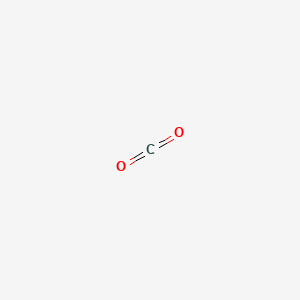
Carbon Dioxide
Carbon dioxide appears as a colorless odorless gas at atmospheric temperatures and pressures. Relatively nontoxic and noncombustible. Heavier than air and may asphyxiate by the displacement of air. Soluble in water. Forms carbonic acid, a mild acid. Under prolonged exposure to heat or fire the container may rupture violently and rocket. Used to freeze food, to control chemical reactions, and as a fire extinguishing agent. — CAMEO Chemicals
- IUPAC name
- carbon dioxide
- Molecular formula
- CO2
- Molecular weight
- 44.009 g/mol
- Exact mass
- 43.989829239 Da
- XLogP3
- 0.9
- Topological polar surface area
- 34.1 Ų
- Hydrogen-bond donors
- 0
- Hydrogen-bond acceptors
- 2
- Covalent units
- 1
- Defined stereocentres
- 0
Also known as
16 more reported names
External database identifiers
- ChEBI:CHEBI:16526
- ChEMBL:CHEMBL1231871
- EPA DTXSID:DTXSID4027028
- PubMed:39504919
- PubMed:37661366
- PubMed:29980036
- PubMed:28506824
- PubMed:28235547
- PubMed:27381457
- PubMed:25004876
- PubMed:24718106
- PubMed:23112626
- PubMed:23040776
- PubMed:22796211
- PubMed:22791361
Evidence from additional scientific databases
NIH PubChem PUG-View
Attributed physical-property, hazard, environmental and use annotations.
- Boiling Point: Sublimes (NIOSH, 2024) Source: CAMEO Chemicals
- Boiling Point: -78.464 °C (sublimes) Source: Hazardous Substances Data Bank (HSDB)
- Boiling Point: sublimes Source: Occupational Safety and Health Administration (OSHA)
- Boiling Point: -78.464 °C @760 [mm Hg] Source: PAC Chemical Database, U.S. Department of Energy
- Boiling Point: Sublimes Source: The National Institute for Occupational Safety and Health (NIOSH)
- Color/Form: Colorless gas Source: Hazardous Substances Data Bank (HSDB)
- Color/Form: Liquid: colorless Source: Hazardous Substances Data Bank (HSDB)
- Color/Form: Solid (dry ice): white, snow-like flakes or cubes Source: Hazardous Substances Data Bank (HSDB)
- Color/Form: Colorless ... gas [Note: Shipped as a liquefied compressed gas. Solid form is utilized as dry ice]. Source: Hazardous Substances Data Bank (HSDB)
- Density: 1.56 at -110.2 °F (USCG, 1999) - Denser than water; will sink Source: CAMEO Chemicals
- Density: Absolute density: 0.1146 lb/cu ft at 25 °C; density: (gas at 0 °C) 1.976 g/L at 760 mm Hg; (liq at 0 °C) 0.914 at 34.3 atm; (solid) at -56.6 °C) 1.512; critical density: 0.464 Source: Hazardous Substances Data Bank (HSDB)
- Density: Density: 1.799 g/L Source: Hazardous Substances Data Bank (HSDB)
- Density: Liquid: volatile, odorless, density 1.101 at -37 °C, specific volume 8.76 cu ft/lb at 70 °F Source: Hazardous Substances Data Bank (HSDB)
- Density: Absolute density, gas at 101.325 kPa at 0 °C: 1.9770 kg/cu m; relative density, gas at 101.325 kPa at 0 °C (Air = 1): 1.53 Source: Hazardous Substances Data Bank (HSDB)
- Density: Latent heat of vaporization = 353.4 J/g at the triple point; 231.3 J/g at 0 °C; viscosity = 0.015 mPa-sec at 298 K and 101.3 kPa; gas density = 1.976 g/L at 273 K and 101.3 kPa Source: Hazardous Substances Data Bank (HSDB)
- Density: 1.56 at -110.2 °F Source: Occupational Safety and Health Administration (OSHA)
- Density: 0.72 @25 °C Source: PAC Chemical Database, U.S. Department of Energy
- Density: 1.53(relative gas density) Source: The National Institute for Occupational Safety and Health (NIOSH)
- Flash Point: Not applicable Source: Hazardous Substances Data Bank (HSDB)
- LogP: 0.83 Source: Human Metabolome Database (HMDB)
- LogP: 0.83 Source: ILO-WHO International Chemical Safety Cards (ICSCs)
- Melting Point: -109.3 °F (USCG, 1999) Source: CAMEO Chemicals
- Melting Point: -109 °F (Sublimes) (NIOSH, 2024) Source: CAMEO Chemicals
- Melting Point: -56.558 °C (triple point) Source: Hazardous Substances Data Bank (HSDB)
- Melting Point: -56.5 °C Source: Human Metabolome Database (HMDB)
- Melting Point: -109 °F (sublimes) Source: Occupational Safety and Health Administration (OSHA)
- Melting Point: -26.366 °C Source: PAC Chemical Database, U.S. Department of Energy
- Melting Point: -109 °F (Sublimes) Source: The National Institute for Occupational Safety and Health (NIOSH)
- Odor: Odorless Source: Hazardous Substances Data Bank (HSDB)
- Odor: Faintly pungent odor Source: Hazardous Substances Data Bank (HSDB)
- Physical Description: Carbon dioxide appears as a colorless odorless gas at atmospheric temperatures and pressures. Relatively nontoxic and noncombustible. Heavier than air and may asphyxiate by the displacement of air. Soluble in water. Forms carbonic acid, a mild acid. Under prolonged exposure to heat or fire the container may rupture violently and rocket. Used to freeze food, to control chemical reactions, and as a fire extinguishing agent. Source: CAMEO Chemicals
- Physical Description: Carbon dioxide, refrigerated liquid appears as a colorless liquid. Relatively heavier than air and can asphyxiate by the displacement of air. Under prolonged exposure to heat or fire the container may rupture violently and rocket. Used as a refrigerant and in making carbonated beverages. Used to freeze food, to control chemical reactions and as a fire extinguishing agent. Source: CAMEO Chemicals
- Physical Description: Carbon dioxide, solid appears as an odorless, white solid. Can cause damaging frostbite. Noncombustible and nontoxic. Liquefies at -109 °F. Can asphyxiate by displacement of air. Used as a refrigerant. Source: CAMEO Chemicals
- Physical Description: Liquid; Gas Vapor; Liquid; Gas Vapor; Large Crystals; CBI Source: EPA Chemical Data Reporting (CDR)
- Physical Description: A colourless gas under normal environmental conditions with a slight pungent odour. Commercial carbon dioxide is shipped and handled as a liquid in pressurised cylinders or bulk storage systems, or in compressed solid blocks of ‘dry ice’. Solid (dry ice) forms usually contain added substances, such as propylene glycol or mineral oil, as binders Source: EU Food Improvement Agents
- Physical Description: Colorless, odorless gas; Note: Shipped as a liquefied compressed gas. Solid form is utilized as dry ice; [NIOSH] Source: Haz-Map, Information on Hazardous Chemicals and Occupational Diseases
- Physical Description: Liquid Source: Human Metabolome Database (HMDB)
- Physical Description: ODOURLESS COLOURLESS COMPRESSED LIQUEFIED GAS. Source: ILO-WHO International Chemical Safety Cards (ICSCs)
- Physical Description: Colorless, odorless gas. Source: Occupational Safety and Health Administration (OSHA)
- Physical Description: Colorless, odorless gas. [Note: Shipped as a liquefied compressed gas. Solid form is utilized as dry ice.] Source: The National Institute for Occupational Safety and Health (NIOSH)
- Refractive Index: Index of refraction: 1.6630 at 24 °C Source: Hazardous Substances Data Bank (HSDB)
- Solubility: 0.2 % at 77 °F (NIOSH, 2024) Source: CAMEO Chemicals
- Solubility: In water, 2.9X10+3 mg/L at 25 °C Source: Hazardous Substances Data Bank (HSDB)
- Solubility: Solubility in water (mL CO2/100 mL H2O at 760 mm Hg): 171 at 0 °C; 88 at 20 °C; 36 at 60 °C Source: Hazardous Substances Data Bank (HSDB)
- Solubility: Solubility in water: 0.704X10⁻³ mole fraction of CO2 in the liquid phase at 25 °C (gas at a partial pressure of 101.325 kPa in equilibrium with the solution) Source: Hazardous Substances Data Bank (HSDB)
- Solubility: Miscible with water (1.7 v/v at 0 °C, 0.76 v/v at 25 °C at 760 mm Hg partial pressure of CO2). Source: Hazardous Substances Data Bank (HSDB)
- Solubility: For more Solubility (Complete) data for Carbon dioxide (6 total), please visit the HSDB record page. Source: Hazardous Substances Data Bank (HSDB)
- Solubility: 1.48 mg/mL at 25 °C Source: Human Metabolome Database (HMDB)
- Solubility: Solubility in water, g/l: 2 (slightly soluble) Source: ILO-WHO International Chemical Safety Cards (ICSCs)
- Solubility: (77 °F): 0.2% Source: The National Institute for Occupational Safety and Health (NIOSH)
- Vapor Pressure: 56.5 atm (NIOSH, 2024) Source: CAMEO Chemicals
- Vapor Pressure: Vapor pressure = 10.5 mm Hg at -120 °C; 104.2 mm Hg at -100 °C; 569.1 mm Hg at -82 °C Source: Hazardous Substances Data Bank (HSDB)
- Vapor Pressure: 4.83X10+4 mm Hg at 25 °C Source: Hazardous Substances Data Bank (HSDB)
- Vapor Pressure: Vapor pressure, kPa at 20 °C: 5720 Source: ILO-WHO International Chemical Safety Cards (ICSCs)
- Vapor Pressure: 56.5 atm Source: Occupational Safety and Health Administration (OSHA)
- Vapor Pressure: 750 [mm Hg] @78.599999999999994 °C Source: PAC Chemical Database, U.S. Department of Energy
- Vapor Pressure: 56.5 atm Source: The National Institute for Occupational Safety and Health (NIOSH)
- Viscosity: 21.29 uPa-sec at 300 K /26.85 °C/ Source: Hazardous Substances Data Bank (HSDB)
- pH: The pH of saturated CO2 solutions varies from 3.7 at 101 kPa (1 atm) to 3.2 at 2370 kPa (23.4 atm) Source: Hazardous Substances Data Bank (HSDB)
- Carcinogen Classification: No indication of carcinogenicity (not listed by IARC). (L135) Source: Toxin and Toxin Target Database (T3DB)
- Exposure Routes: The substance can be absorbed into the body by inhalation. Source: ILO-WHO International Chemical Safety Cards (ICSCs)
- Exposure Routes: inhalation, skin and/or eye contact (liquid/solid) Source: The National Institute for Occupational Safety and Health (NIOSH)
- Exposure Routes: Inhalation (L1144) ; dermal (L1144) ; eye contact (L1144). Source: Toxin and Toxin Target Database (T3DB)
- First Aid: Excerpt from NIOSH Pocket Guide for Carbon dioxide:; Eye: FROSTBITE - If eye tissue is frozen, seek medical attention immediately; if tissue is not frozen, immediately and thoroughly flush the eyes with large amounts of water for at least 15 minutes, occasionally lifting the lower and upper eyelids. If irritation, pain, swelling, lacrimation, or photophobia persist, get medical attention as soon as possible.; Skin: FROSTBITE - If frostbite has occurred, seek medical attention immediately; do NOT rub the affected areas or flush them with water. In order to prevent further tissue damage, do NOT attempt to remove frozen clothing from frostbitten areas. If frostbite has NOT occurred, immediately and thoroughly wash contaminated skin with soap and water.; Breathing: RESPIRATORY SUPPORT - If a person breathes large amounts of this chemical, move the exposed person to fresh air at once. If breathing has stopped, perform artificial respiration. Keep the affected person warm and at rest. Get medical attention as soon as possible. (NIOSH, 2024) Source: CAMEO Chemicals
- ERG2024, Guide 120 (Carbon dioxide, refrigerated liquid; Carbon dioxide, compressed; Carbon dioxide, solid; Carbon dioxide): General First Aid:; · Call 911 or emergency medical service.; · Ensure that medical personnel are aware of the material(s) involved, take precautions to protect themselves and avoid contamination.; · Move victim to fresh air if it can be done safely.; · Administer oxygen if breathing is difficult.; · If victim is not breathing:; -- DO NOT perform mouth-to-mouth resuscitation; the victim may have ingested or inhaled the substance.; -- If equipped and pulse detected, wash face and mouth, then give artificial respiration using a proper respiratory medical device (bag-valve mask, pocket mask equipped with a one-way valve or other device).; -- If no pulse detected or no respiratory medical device available, provide continuous compressions. Conduct a pulse check every two minutes or monitor for any signs of spontaneous respirations.; · Remove and isolate contaminated clothing and shoes.; · For minor skin contact, avoid spreading material on unaffected skin.; · In case of contact with substance, remove immediately by flushing skin or eyes with running water for at least 20 minutes.; · For severe burns, immediate medical attention is required.; · Effects of exposure (inhalation, ingestion, Source: Emergency Response Guidebook (ERG)
- ERG2024, Guide 120 (Carbon dioxide, solid; Carbon dioxide; Carbon dioxide, refrigerated liquid; Carbon dioxide, compressed): General First Aid:; · Call 911 or emergency medical service.; · Ensure that medical personnel are aware of the material(s) involved, take precautions to protect themselves and avoid contamination.; · Move victim to fresh air if it can be done safely.; · Administer oxygen if breathing is difficult.; · If victim is not breathing:; -- DO NOT perform mouth-to-mouth resuscitation; the victim may have ingested or inhaled the substance.; -- If equipped and pulse detected, wash face and mouth, then give artificial respiration using a proper respiratory medical device (bag-valve mask, pocket mask equipped with a one-way valve or other device).; -- If no pulse detected or no respiratory medical device available, provide continuous compressions. Conduct a pulse check every two minutes or monitor for any signs of spontaneous respirations.; · Remove and isolate contaminated clothing and shoes.; · For minor skin contact, avoid spreading material on unaffected skin.; · In case of contact with substance, remove immediately by flushing skin or eyes with running water for at least 20 minutes.; · For severe burns, immediate medical attention is required.; · Effects of exposure (inhalation, ingestion, Source: Emergency Response Guidebook (ERG)
- First Aid: (General first aid procedures); Eye: Frostbite - If eye tissue is frozen, seek medical attention immediately; if tissue is not frozen, immediately and thoroughly flush the eyes with large amounts of water for at least 15 minutes, occasionally lifting the lower and upper eyelids. If irritation, pain, swelling, lacrimation, or photophobia persist, get medical attention as soon as possible.; Skin: Frostbite - Compressed gases may create low temperatures when they expand rapidly. Leaks and uses that allow rapid expansion may cause a frostbite hazard. Wear appropriate personal protective clothing to prevent the skin from becoming frozen.; Breathing: Respiratory support Source: The National Institute for Occupational Safety and Health (NIOSH)
- Note: This chemical does not meet GHS hazard criteria for 4.9% (77 of 1570) of reports. Source: European Chemicals Agency (ECHA)
- Signal: Warning Source: European Chemicals Agency (ECHA)
- GHS Hazard Statements: H280 (82%): Contains gas under pressure; may explode if heated [Warning Gases under pressure]; H281 (20.5%): Contains refrigerated gas; may cause cryogenic burns or injury [Warning Gases under pressure] Source: European Chemicals Agency (ECHA)
- Precautionary Statement Codes: P282, P336+P317, P403, and P410+P403 (click each P-code to see the statement) Source: European Chemicals Agency (ECHA)
- ECHA C&L Notifications Summary: Aggregated GHS information provided per 1570 reports by companies from 10 notifications to the ECHA C&L Inventory. Each notification may be associated with multiple companies.; Reported as not meeting GHS hazard criteria per 77 of 1570 reports by companies.; There are 9 notifications provided by 1493 of 1570 reports by companies with hazard statement code(s).; Information may vary between notifications depending on impurities, additives, and other factors. The percentage value in parenthesis indicates the notified classification ratio from companies that provide hazard codes. Only hazard codes with percentage values above 10% are shown. For more detailed information, please visit ECHA C&L website. Source: European Chemicals Agency (ECHA)
- Note: This chemical does not meet GHS hazard criteria for 97.4% (38 of 39) of all reports. Source: European Chemicals Agency (ECHA)
- GHS Hazard Statements: Not Classified; Reported as not meeting GHS hazard criteria by 38 of 39 companies (only 2.6% companies provided GHS information). For more detailed information, please visit ECHA C&L website. Source: European Chemicals Agency (ECHA)
- ECHA C&L Notifications Summary: Aggregated GHS information provided per 39 reports by companies from 2 notifications to the ECHA C&L Inventory.; Reported as not meeting GHS hazard criteria per 38 of 39 reports by companies.; There is 1 notification provided by 1 of 39 reports by companies with hazard statement code(s).; Information may vary between notifications depending on impurities, additives, and other factors. The percentage value in parenthesis indicates the notified classification ratio from companies that provide hazard codes. Only hazard codes with percentage values above 10% are shown. For more detailed information, please visit ECHA C&L website. Source: European Chemicals Agency (ECHA)
- Signal: Warning Source: NITE-CMC
- GHS Hazard Statements: H336: May cause drowsiness or dizziness [Warning Specific target organ toxicity, single exposure; Narcotic effects] Source: NITE-CMC
- Precautionary Statement Codes: P261, P271, P304+P340, P319, P403+P233, P405, and P501 (click each P-code to see the statement) Source: NITE-CMC
- Signal: Warning Source: Hazardous Substances Data Bank (HSDB)
- Health Effects: Carbon dioxide poisoning (Hypercapnia) can induce increased cardiac output, an elevation in arterial blood pressure, and a propensity toward arrhythmias (L1145). Source: Toxin and Toxin Target Database (T3DB)
- Target Organs: respiratory system, cardiovascular system Source: The National Institute for Occupational Safety and Health (NIOSH)
- Toxicity Summary: IDENTIFICATION AND USE: Carbon dioxide (CO2) is a colorless gas and liquid, or solid (dry ice): white, snow-like flakes or cubes. It is registered for pesticide use in the U.S. but approved pesticide uses may change periodically and so federal, state and local authorities must be consulted for currently approved uses. Carbon dioxide is used as a pesticide for insect control in stored grain under modified atmospheres containing approx. 60% carbon dioxide. It is also used as rodenticide (mice and rats). Other uses include refrigeration, carbonated beverages, aerosol propellant, chemical intermediate (carbonates, synthetic fibers, p-xylene, etc.), low-temperature testing, fire extinguishing, inert atmospheres, municipal water treatment, medicine, enrichment of air in greenhouses, fracturing and acidizing of oil wells, mining (Cardox method), miscible pressure source, hardening of foundry molds and cores, shielding gas for welding, cloud seeding, moderator in some types of nuclear reactors, immobilization for humane animal killing, special lasers, blowing agent, as demulsifier in tertiary oil recovery, possible source of methane, (liquid) carrier for powdered-coal slurry. Supercritical Source: Hazardous Substances Data Bank (HSDB)
- Toxicity Summary: Carbon dioxide causes widespread activation of the sympathetic nervous system and an increase in the plasma concentrations of epinephrine, norepinephrine, angiotensin, and other vasoactive peptides . The response is mediated by various subcortical centers in the hypothalamus, brainstem reticular formation and medulla. These areas can be excited locally by carbon dioxide, but they also receive afferents from the carotid and aortic chemoreceptors that are sensitive to changes in carbon dioxide in the blood. The results of sympathetic nervous system activation are, in general, opposite to the local effects of carbon dioxide. The sympathetic effects consist of an increase in cardiac contractility and heart rate and vasoconstriction (A628). Source: Toxin and Toxin Target Database (T3DB)
- Environmental Fate: The extensive sets of global CO2 measurements of the National Oceanic and Atmospheric Admin (NOAA) Geophysical Monitoring for Climatic Change (GMCC) division and of the Upper Atmosphere and Space Research Laboratory of Tohoku University are combined with a two-dimensional transport model to derive, in an "inverse" calculation, the latitudinal and seasonal distributions of sources and sinks of CO2 necessary to reproduce the observed concn. ... It is found that the southern oceans are a sink of carbon of 0.8 to 1.5 Gt/yr (1 Gt = 1 x 10 +15 g) and that the equatorial areas are a source to the atmosphere of 1.4 to 2.8 Gt. There seems to be significant seasonality in the sources and sinks of CO2, both in the tropics and in the southern oceans. Seasonal net ecosystem production north of 25 deg N is found to be 6.2 to 8.2 Gt of carbon. ... The global average net source of atmospheric CO2 estimated from the Tohoku data is 2.84 Gt C/yr, while for the GMCC data it is 2.98 Gt C/yr. Source: Hazardous Substances Data Bank (HSDB)
- Consumer Uses: Other; pH regulating agent; Stabilizing agent Source: EPA Chemical Data Reporting (CDR)
- Industry Uses: Intermediate; Processing aids, specific to petroleum production; Propellants, non-motive (blowing agents); Fixing agent (mordant); Soil amendments (fertilizers); Not Known or Reasonably Ascertainable; Processing aids not otherwise specified; Chemical reaction regulator; Other Source: EPA Chemical Data Reporting (CDR)
- Sources/Uses: Used in carbonated beverages, fire extinguishers, dry ice, and propellants; A product of fermentation; [ACGIH] A product of animal metabolism and released when organic materials burn; a constituent of the earth's atmosphere at about 0.03% by volume; [Merck Index # 1809] Used in the deliming stage of leather production; [PMID 21938525] Source: Haz-Map, Information on Hazardous Chemicals and Occupational Diseases
- Industrial Processes with risk of exposure: Aluminum Producing [Category: Industry]; Welding [Category: Weld]; Mining [Category: Industry]; Sewer and Wastewater Treatment [Category: Industry]; Firefighting [Category: Other]; Leather Tanning and Processing [Category: Industry]; Farming (Respiratory Hazards) [Category: Industry] Source: Haz-Map, Information on Hazardous Chemicals and Occupational Diseases
- Activities with risk of exposure: Smoking cigarettes [Category: Food & Drugs] Source: Haz-Map, Information on Hazardous Chemicals and Occupational Diseases
- Uses: For carbon dioxide (USEPA/OPP Pesticide Code: 016601) ACTIVE products with label matches. /SRP: Registered for use in the U.S. but approved pesticide uses may change periodically and so federal, state and local authorities must be consulted for currently approved uses./ Source: Hazardous Substances Data Bank (HSDB)
- Uses: Carbon dioxide is used as a pesticide for insect control in stored grain under modified atmospheres containing approx 60% carbon dioxide. Source: Hazardous Substances Data Bank (HSDB)
- Uses: Rodenticide (mice and rats) Source: Hazardous Substances Data Bank (HSDB)
- Uses: Refrigerant; processing of foods; preserving foods; crusting of food; cryogenic freezing of food; prodn of urea, sodium carbonate (Solvay process), methanol, carbonic acid, lead carbonate, potassium carbonate, potassium bicarbonate, ammonium carbonate, ammonium bicarbonate, sodium salicylate, carbonated petroleum, hydrocarbon products; provides an inert atmosphere for fire extinguishers, refinery products, petroleum products; displacing oxygen to prevent deterioration and flavor loss; in high pressure applications; oil well stimulation; in livestock slaughtering; as fertilizer; hardening of molds for metal castings Source: Hazardous Substances Data Bank (HSDB)
- Uses: For more Uses (Complete) data for Carbon dioxide (13 total), please visit the HSDB record page. Source: Hazardous Substances Data Bank (HSDB)
- Uses: Carbon dioxide is used by the food industry, the oil industry, and the chemical industry. It is used in many consumer products that require pressurized gas. Life jackets often contain canisters of pressured carbon dioxide for quick inflation. Aluminum capsules are also sold as supplies of compressed gas for airguns, paintball markers, for inflating bicycle tires, and for making seltzer (L1144). Source: Toxin and Toxin Target Database (T3DB)
Mapped by: Existing checksum-valid CAS to unique PubChem CID match. Retrieved: 2026-08-31. Open source record
Scientific classifications and hazard annotations provide context and do not replace the market-specific regulatory decision shown above.
Additional source coverage and match status
| Source | Result | Checked |
|---|---|---|
| NIH PubChem PUG-View | Exact match | 2026-08-31 |
A recorded no-match is useful evidence that the source was checked; it is not a claim that the substance does not exist elsewhere.
Retrieved from NIH PubChem on 2026-08-31 by checksum-valid CAS matching. Chemical properties do not replace the regulatory decision on this page.