
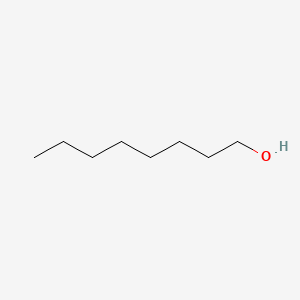
1-Octanol
Octan-1-ol is an octanol carrying the hydroxy group at position 1. It has a role as an antifungal agent, a fuel additive, a plant metabolite, a bacterial metabolite and a kairomone. It is a primary alcohol and an octanol. — ChEBI
- IUPAC name
- octan-1-ol
- Molecular formula
- C8H18O
- Molecular weight
- 130.23 g/mol
- Exact mass
- 130.135765193 Da
- XLogP3
- 3.0
- Topological polar surface area
- 20.2 Ų
- Hydrogen-bond donors
- 1
- Hydrogen-bond acceptors
- 1
- Covalent units
- 1
- Defined stereocentres
- 0
Also known as
16 more reported names
External database identifiers
- ChEBI:CHEBI:16188
- ChEMBL:CHEMBL26215
- EPA DTXSID:DTXSID7021940
- PubMed:37050113
- PubMed:29953848
- PubMed:28188220
- PubMed:23084055
- PubMed:23076175
- PubMed:23021646
- PubMed:23016629
- PubMed:22960319
- PubMed:22957589
- PubMed:22945558
- PubMed:22938605
- PubMed:22927031
Evidence from additional scientific databases
NIH PubChem PUG-View
Attributed physical-property, hazard, environmental and use annotations.
- Autoignition Temperature: 253 °C Source: ILO-WHO International Chemical Safety Cards (ICSCs)
- Boiling Point: 383 °F at 760 mmHg (USCG, 1999) Source: CAMEO Chemicals
- Boiling Point: 194.7 °C Source: Hazardous Substances Data Bank (HSDB)
- Boiling Point: 194.00 to 196.00 °C. @ 760.00 mm Hg Source: Human Metabolome Database (HMDB)
- Boiling Point: 194-195 °C Source: ILO-WHO International Chemical Safety Cards (ICSCs)
- Boiling Point: 195 °C Source: Joint FAO/WHO Expert Committee on Food Additives (JECFA)
- Boiling Point: 194.5 °C @760 [mm Hg] Source: PAC Chemical Database, U.S. Department of Energy
- Color/Form: Colorless liquid Source: Hazardous Substances Data Bank (HSDB)
- Density: 0.829 at 68 °F (USCG, 1999) - Less dense than water; will float Source: CAMEO Chemicals
- Density: 0.8262 g/cu cm at 25 °C Source: Hazardous Substances Data Bank (HSDB)
- Density: Relative density (water = 1): 0.83 Source: ILO-WHO International Chemical Safety Cards (ICSCs)
- Density: 0.822-0.830 Source: Joint FAO/WHO Expert Committee on Food Additives (JECFA)
- Density: 0.83 @ 20°C Source: PAC Chemical Database, U.S. Department of Energy
- Flash Point: 178 °F (USCG, 1999) Source: CAMEO Chemicals
- Flash Point: 81.1 °C Source: Haz-Map, Information on Hazardous Chemicals and Occupational Diseases
- Flash Point: 178 °F (81 °C) (Closed cup) Source: Hazardous Substances Data Bank (HSDB)
- Flash Point: 81 °C c.c. Source: ILO-WHO International Chemical Safety Cards (ICSCs)
- LogP: log Kow = 3.00 Source: Hazardous Substances Data Bank (HSDB)
- LogP: 3.00 Source: Human Metabolome Database (HMDB)
- LogP: 3.0 Source: ILO-WHO International Chemical Safety Cards (ICSCs)
- Melting Point: 5 °F (USCG, 1999) Source: CAMEO Chemicals
- Melting Point: -14.7 °C Source: Hazardous Substances Data Bank (HSDB)
- Melting Point: -15.5 °C Source: Human Metabolome Database (HMDB)
- Melting Point: -15.5 °C Source: ILO-WHO International Chemical Safety Cards (ICSCs)
- Melting Point: -14.8 °C Source: PAC Chemical Database, U.S. Department of Energy
- Odor: Fresh orange rose odor Source: Hazardous Substances Data Bank (HSDB)
- Odor: Penetrating aromatic odor Source: Hazardous Substances Data Bank (HSDB)
- Physical Description: Octanol appears as a clear colorless liquid with a penetrating aromatic odor. Insoluble in water and floats on water. Vapors heavier than air. Vapors may irritate the eyes, nose, and respiratory system. Source: CAMEO Chemicals
- Physical Description: Liquid Source: EPA Chemical Data Reporting (CDR)
- Physical Description: Colorless liquid with a rose-like or lemon-like odor; [AIHA] Source: Haz-Map, Information on Hazardous Chemicals and Occupational Diseases
- Physical Description: Liquid Source: Human Metabolome Database (HMDB)
- Physical Description: COLOURLESS LIQUID WITH CHARACTERISTIC ODOUR. Source: ILO-WHO International Chemical Safety Cards (ICSCs)
- Physical Description: colourless liquid/sharp fatty-citrus odour Source: Joint FAO/WHO Expert Committee on Food Additives (JECFA)
- Refractive Index: Index of refraction = 1.4205 at 20 °C/D Source: Hazardous Substances Data Bank (HSDB)
- Refractive Index: 1.428-1.431 Source: Joint FAO/WHO Expert Committee on Food Additives (JECFA)
- Solubility: In water, 540 mg/L at 25 °C Source: Hazardous Substances Data Bank (HSDB)
- Solubility: Miscible in ethanol, ether; soluble in carbon tetrachloride Source: Hazardous Substances Data Bank (HSDB)
- Solubility: Miscible with chloroform, mineral oil; immiscible with glycerol Source: Hazardous Substances Data Bank (HSDB)
- Solubility: SOL IN PROPYLENE GLYCOL. Source: Hazardous Substances Data Bank (HSDB)
- Solubility: 0.54 mg/mL Source: Human Metabolome Database (HMDB)
- Solubility: Solubility in water, mg/l at 20 °C: 0.30 (very poor) Source: ILO-WHO International Chemical Safety Cards (ICSCs)
- Solubility: soluble in most fixed oils, propylene glycol; insoluble in glycerin Source: Joint FAO/WHO Expert Committee on Food Additives (JECFA)
- Solubility: 1 ml in 5 ml 50% alcohol (in ethanol) Source: Joint FAO/WHO Expert Committee on Food Additives (JECFA)
- Vapor Pressure: 0.07 [mmHg] Source: Haz-Map, Information on Hazardous Chemicals and Occupational Diseases
- Vapor Pressure: Vapor pressure, Pa at 20 °C: 8.7 Source: ILO-WHO International Chemical Safety Cards (ICSCs)
- Vapor Pressure: 0.0794 [mm Hg] @25 °C Source: PAC Chemical Database, U.S. Department of Energy
- Viscosity: 7.288 mPa.s at 25 °C Source: Hazardous Substances Data Bank (HSDB)
- Exposure Routes: The substance can be absorbed into the body by inhalation and by ingestion. Source: ILO-WHO International Chemical Safety Cards (ICSCs)
- First Aid: Flush with copious amounts of water. (USCG, 1999) Source: CAMEO Chemicals
- Note: This chemical does not meet GHS hazard criteria for 0.2% (7 of 3216) of reports. Source: European Chemicals Agency (ECHA)
- Signal: Warning Source: European Chemicals Agency (ECHA)
- GHS Hazard Statements: H302+H312 (14.7%): Harmful if swallowed or in contact with skin [Warning Acute toxicity, oral; acute toxicity, dermal]; H302 (15.7%): Harmful if swallowed [Warning Acute toxicity, oral]; H312 (15.7%): Harmful in contact with skin [Warning Acute toxicity, dermal]; H315 (23.7%): Causes skin irritation [Warning Skin corrosion/irritation]; H319 (98.8%): Causes serious eye irritation [Warning Serious eye damage/eye irritation]; H412 (15.1%): Harmful to aquatic life with long lasting effects [Hazardous to the aquatic environment, long-term hazard] Source: European Chemicals Agency (ECHA)
- Precautionary Statement Codes: P264, P264+P265, P270, P273, P280, P301+P317, P302+P352, P305+P351+P338, P317, P321, P330, P332+P317, P337+P317, P362+P364, and P501 (click each P-code to see the statement) Source: European Chemicals Agency (ECHA)
- ECHA C&L Notifications Summary: Aggregated GHS information provided per 3216 reports by companies from 23 notifications to the ECHA C&L Inventory. Each notification may be associated with multiple companies.; Reported as not meeting GHS hazard criteria per 7 of 3216 reports by companies.; There are 22 notifications provided by 3209 of 3216 reports by companies with hazard statement code(s).; Information may vary between notifications depending on impurities, additives, and other factors. The percentage value in parenthesis indicates the notified classification ratio from companies that provide hazard codes. Only hazard codes with percentage values above 10% are shown. For more detailed information, please visit ECHA C&L website. Source: European Chemicals Agency (ECHA)
- GHS Hazard Statements: H319 (100%): Causes serious eye irritation [Warning Serious eye damage/eye irritation] Source: European Chemicals Agency (ECHA)
- Precautionary Statement Codes: P264+P265, P280, P305+P351+P338, and P337+P317 (click each P-code to see the statement) Source: European Chemicals Agency (ECHA)
- ECHA C&L Notifications Summary: Aggregated GHS information provided per 9 reports by companies from 1 notifications to the ECHA C&L Inventory.; Information may vary between notifications depending on impurities, additives, and other factors. The percentage value in parenthesis indicates the notified classification ratio from companies that provide hazard codes. Only hazard codes with percentage values above 10% are shown. For more detailed information, please visit ECHA C&L website. Source: European Chemicals Agency (ECHA)
- Signal: Danger Source: NITE-CMC
- GHS Hazard Statements: H227: Combustible liquid [Warning Flammable liquids]; H319: Causes serious eye irritation [Warning Serious eye damage/eye irritation]; H370: Causes damage to organs [Danger Specific target organ toxicity, single exposure]; H371: May cause damage to organs [Warning Specific target organ toxicity, single exposure]; H401: Toxic to aquatic life [Hazardous to the aquatic environment, acute hazard]; H412: Harmful to aquatic life with long lasting effects [Hazardous to the aquatic environment, long-term hazard] Source: NITE-CMC
- Precautionary Statement Codes: P210, P260, P264, P264+P265, P270, P273, P280, P305+P351+P338, P308+P316, P321, P337+P317, P370+P378, P403, P405, and P501 (click each P-code to see the statement) Source: NITE-CMC
- Signal: Warning Source: NITE-CMC
- NFPA Health Rating: 1 - Materials that, under emergency conditions, can cause significant irritation. Source: Hazardous Substances Data Bank (HSDB)
- NFPA Fire Rating: 2 - Materials that must be moderately heated or exposed to relatively high ambient temperatures before ignition can occur. Materials would not under normal conditions form hazardous atmospheres with air, but under high ambient temperatures or under moderate heating could release vapor in sufficient quantities to produce hazardous atmospheres with air. Source: Hazardous Substances Data Bank (HSDB)
- NFPA Instability Rating: 0 - Materials that in themselves are normally stable, even under fire conditions. Source: Hazardous Substances Data Bank (HSDB)
- Toxicity Summary: IDENTIFICATION AND USE: 1-Octanol is a colorless liquid used in the determination of partition coefficients, perfumery, cosmetics, organic synthesis, solvent manufacture of high-boiling esters, antifoaming agent, and as a flavoring agent. 1-octanol is registered for pesticide use in the USA but approved pesticide uses may change periodically and so federal, state and local authorities must be consulted for currently approved uses. It has been used as experimental medication to treat tremor in patients. HUMAN EXPOSURE AND TOXICITY: In a human patch test, 1-octanol in 2% petrolatum was neither a skin irritant nor a skin sensitizer. Octanol has caused transient injury of corneal epithelium, with recovery in 48 hr. Common signs of exposure to 1-octanol are CNS: headache, muscle weakness, giddiness, ataxia, confusion, delirium, coma. Gastrointestinal: nausea, vomiting, diarrhea (odor of the alcohol in excreta). Irritation of skin, eyes, throat from vapor or liquid with cough and dyspnea. The annoying odor of 1-octanol may mask sensory irritation and prevent subjects with enhanced chemical sensitivity from concentrating on performance in a demanding task. ANIMAL STUDIES: 1-Octanol was sl Source: Hazardous Substances Data Bank (HSDB)
- Toxicity Summary: The existing information was reviewed by the independent Expert Panel for Fragrance Safety and supports the use of 1-octanol as described in this safety assessment. Data from 1-octanol and read-across analog heptyl alcohol (CAS # 111-70-6) show that 1-octanol is not expected to be genotoxic. Data on read-across analog heptyl alcohol (CAS # 111-70-6) provide a calculated Margin of Exposure (MOE) greater than 100 for the repeated dose toxicity and fertility endpoints. Data on 1-octanol provide a calculated MOE greater than 100 for the developmental toxicity endpoint. Data from read-across analog 1-decanol (CAS # 112-30-1) provided a No Expected Sensitization Induction Level (NESIL) of 10000 μg/cm2 for the skin sensitization endpoint. 1-octanol is not expected to be photoirritating/photoallergenic based on an evaluation of the ultraviolet/visible (UV/Vis) spectra. The local respiratory toxicity endpoint was evaluated using the Threshold of Toxicological Concern (TTC) for a Cramer Class I material, and the exposure is below the TTC (1.4 mg/day). Source: Pertti (Bert) Hakkinen's Toxicology and Other Annotations
- Environmental Bioconcentration: An estimated BCF of 44 was calculated in fish for 1-octanol(SRC), using a log Kow of 3.00(1) and a regression-derived equation(2). According to a classification scheme(3), this BCF suggests the potential for bioconcentration in aquatic organisms is moderate(SRC). Source: Hazardous Substances Data Bank (HSDB)
- Environmental Fate: TERRESTRIAL FATE: Based on a classification scheme(1), a reported Koc value of 38(2), indicates that 1-octanol is expected to have very high mobility in soil(SRC). Volatilization of 1-octanol from moist soil surfaces is expected to be an important fate process(SRC) given a Henry's Law constant of 2.5X10⁻⁵ atm-cu m/mole(3). 1-Octanol is not expected to volatilize from dry soil surfaces(SRC) based upon a vapor pressure of 0.0794 mm Hg at 25 °C(4). A 89% of theoretical BOD using activated sludge in the Japanese MITI test(5) suggests that biodegradation is an important environmental fate process in soil(SRC). Source: Hazardous Substances Data Bank (HSDB)
- Environmental Fate: AQUATIC FATE: Based on a classification scheme(1), a reported Koc value of 38(2), indicates that 1-octanol is not expected to adsorb to suspended solids and sediment(SRC). Volatilization from water surfaces is expected(3) based upon a Henry's Law constant of 2.5X10⁻⁵ atm-cu m/mole(4). Using this Henry's Law constant and an estimation method(3), volatilization half-lives for a model river and model lake are 43 hours and 17 days, respectively(SRC). 1-Octanol is not expected to undergo hydrolysis in the environment due to the lack of functional groups that hydrolyze under environmental conditions(3). According to a classification scheme(5), an estimated BCF of 44(SRC), from its log Kow of 3.00(6) and a regression-derived equation(7), suggests the potential for bioconcentration in aquatic organisms is moderate(SRC). Based on aqueous biodegradation screening test results, 1-octanol should biodegrade rapidly in aquatic environments(8-10). Source: Hazardous Substances Data Bank (HSDB)
- Environmental Fate: ATMOSPHERIC FATE: According to a model of gas/particle partitioning of semivolatile organic compounds in the atmosphere(1), 1-octanol, which has a vapor pressure of 0.0794 mm Hg at 25 °C(2), is expected to exist solely as a vapor in the ambient atmosphere. Vapor-phase 1-octanol is degraded in the atmosphere by reaction with photochemically-produced hydroxyl radicals(SRC); the half-life for this reaction in air is estimated to be 27 hours(SRC), calculated from its rate constant of 1.44X10⁻¹¹ cu cm/molecule-sec at 25 °C(3). Physical removal from air via precipitation has been shown to occur(4). 1-Octanol does not contain chromophores that absorb at wavelengths >290 nm(5) and, therefore, is not expected to be susceptible to direct photolysis by sunlight(SRC). Source: Hazardous Substances Data Bank (HSDB)
- Consumer Uses: Oxidizing agent; Fragrance; Not Known or Reasonably Ascertainable; Monomers; Solvent; Lubricating agent; Wetting agent (non-aqueous); Other Source: EPA Chemical Data Reporting (CDR)
- Industry Uses: Oxidizing agent; Intermediate; Not Known or Reasonably Ascertainable; Fragrance; Surfactant (surface active agent); Other; Wetting agent (non-aqueous); Lubricating agent; Solvent Source: EPA Chemical Data Reporting (CDR)
- Sources/Uses: Used in perfumery, cosmetics, shampoos, emulsifiers, detergents, and food flavors; Also used as a solvent (esters, coatings, lacquers, printing inks, textile additives, and pesticides), citric acid extractant, frothing agent, antifoaming agent in drilling muds, and growth inhibitor in tobacco production; [HSDB] Source: Haz-Map, Information on Hazardous Chemicals and Occupational Diseases
- Uses: For 1-octanol (USEPA/OPP Pesticide Code: 079037) ACTIVE products with label matches. /SRP: Registered for use in the USA but approved pesticide uses may change periodically and so federal, state and local authorities must be consulted for currently approved uses./ Source: Hazardous Substances Data Bank (HSDB)
- Uses: ... plant growth regulator ... of tobacco. Source: Hazardous Substances Data Bank (HSDB)
- Uses: Perfumery, cosmetics, organic synthesis, solvent manufacture of high-boiling esters, antifoaming agent, flavoring agent. Source: Hazardous Substances Data Bank (HSDB)
- Uses: Mixtures of 1-hexanol and 1-octanol serve as frothing agents (bubbling promoters) in flotation, e.g., of coal. Large amounts are added to aqueous drilling muds to prevent frothing during drilling for oil and gas. Source: Hazardous Substances Data Bank (HSDB)
- Uses: For more Uses (Complete) data for 1-OCTANOL (9 total), please visit the HSDB record page. Source: Hazardous Substances Data Bank (HSDB)
Mapped by: Existing checksum-valid CAS to unique PubChem CID match. Retrieved: 2026-08-31. Open source record
Scientific classifications and hazard annotations provide context and do not replace the market-specific regulatory decision shown above.
Additional source coverage and match status
| Source | Result | Checked |
|---|---|---|
| NIH PubChem PUG-View | Exact match | 2026-08-31 |
A recorded no-match is useful evidence that the source was checked; it is not a claim that the substance does not exist elsewhere.
Retrieved from NIH PubChem on 2026-08-31 by checksum-valid CAS matching. Chemical properties do not replace the regulatory decision on this page.