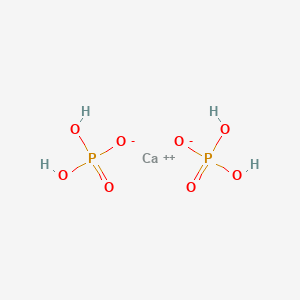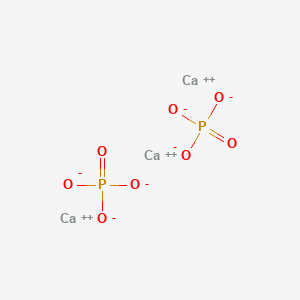
Tricalcium Phosphate
Calcium phosphate is typically available as an over the counter supplement, antacid, or as an added ingredient in some toothpastes. — DrugBank
- IUPAC name
- tricalcium diphosphate
- Molecular formula
- Ca3O8P2
- Molecular weight
- 310.18 g/mol
- Exact mass
- 309.7946135 Da
- Topological polar surface area
- 173.0 Ų
- Hydrogen-bond donors
- 0
- Hydrogen-bond acceptors
- 8
- Covalent units
- 5
- Defined stereocentres
- 0
Also known as
16 more reported names
External database identifiers
- ChEBI:CHEBI:9679
- ChEMBL:CHEMBL2106566
- EPA DTXSID:DTXSID1049803
- PubMed:39887523
- PubMed:37678662
- PubMed:22522029
- PubMed:18782374
- PubMed:14600836
- PubMed:12784042
Evidence from additional scientific databases
NIH PubChem PUG-View
Attributed physical-property, hazard, environmental and use annotations.
- Color/Form: White amorphous powder Source: Hazardous Substances Data Bank (HSDB)
- Color/Form: White, crystalline powder Source: Hazardous Substances Data Bank (HSDB)
- Color/Form: Two crystalline modifications are known, the high temperature alpha- and the low-temperature beta-form, transition temperature 110 °C. Source: Hazardous Substances Data Bank (HSDB)
- Color/Form: Rhombohedral crystals /Whitlockite/ Source: Hazardous Substances Data Bank (HSDB)
- Density: 2 to 3 at 68 °F (USCG, 1999) Source: CAMEO Chemicals
- Density: 3.14 g/cu cm Source: Hazardous Substances Data Bank (HSDB)
- Density: 2.5 @ 20°C Source: PAC Chemical Database, U.S. Department of Energy
- Melting Point: >450 Source: DrugBank
- Melting Point: 1670 °C Source: Hazardous Substances Data Bank (HSDB)
- Odor: Odorless Source: Hazardous Substances Data Bank (HSDB)
- Physical Description: Calcium phosphate is an odorless white solid. Sinks and mixes with water. (USCG, 1999) Source: CAMEO Chemicals
- Physical Description: Dry Powder; Liquid Source: EPA Chemical Data Reporting (CDR)
- Physical Description: Wet Solid Source: EPA Chemical Data Reporting (CDR)
- Physical Description: A white, odourless powder which is stable in air Source: EU Food Improvement Agents
- Physical Description: White odorless solid; [HSDB] White odorless powder; [MSDSonline] Source: Haz-Map, Information on Hazardous Chemicals and Occupational Diseases
- Physical Description: White odorless solid; [CAMEO] Source: Haz-Map, Information on Hazardous Chemicals and Occupational Diseases
- Refractive Index: INDEX OF REFRACTION: 1.629, 1.626 Source: Hazardous Substances Data Bank (HSDB)
- Solubility: 7.7g/L Source: DrugBank
- Solubility: Practically insoluble in water; insoluble in ethanol, soluble in dilute hydrochloric and nitric acid Source: EU Food Improvement Agents
- Solubility: Practically insol in alcohol and acetic acid; sol in dilute hydrochloric acid, nitric acid Source: Hazardous Substances Data Bank (HSDB)
- Solubility: Solubility in cold water: 2 mg/100 cc Source: Hazardous Substances Data Bank (HSDB)
- Solubility: 2.5 mg/100 g water at 25 °C Source: Hazardous Substances Data Bank (HSDB)
- First Aid: INHALATION: move to clean air; see physician in case of persistent coughing, expectoration, chest pain, or shortness of breath.; INGESTION: get medical attention quickly; induce vomiting by giving large amounts of water or warm salty water, or by tickling back of patient's throat; continue until vomitus is clear; follow with milk, eggs, or olive oil to soothe stomach.; EYES: immediately flush with large quantities of running water for at least 15 min., holding eyelids apart to insure thorough flushing of eyes and lids; do not attempt to neutralize with chemical agents; get medical attention quickly; if physician is (USCG, 1999) Source: CAMEO Chemicals
- Note: This chemical does not meet GHS hazard criteria for 95.7% (529 of 553) of all reports. Source: European Chemicals Agency (ECHA)
- GHS Hazard Statements: Not Classified; Reported as not meeting GHS hazard criteria by 529 of 553 companies (only 4.3% companies provided GHS information). For more detailed information, please visit ECHA C&L website. Source: European Chemicals Agency (ECHA)
- ECHA C&L Notifications Summary: Aggregated GHS information provided per 553 reports by companies from 6 notifications to the ECHA C&L Inventory.; Reported as not meeting GHS hazard criteria per 529 of 553 reports by companies.; There are 4 notifications provided by 24 of 553 reports by companies with hazard statement code(s).; Information may vary between notifications depending on impurities, additives, and other factors. The percentage value in parenthesis indicates the notified classification ratio from companies that provide hazard codes. Only hazard codes with percentage values above 10% are shown. For more detailed information, please visit ECHA C&L website. Source: European Chemicals Agency (ECHA)
- Note: This chemical does not meet GHS hazard criteria for 75% (27 of 36) of all reports. Source: European Chemicals Agency (ECHA)
- Signal: Danger Source: European Chemicals Agency (ECHA)
- GHS Hazard Statements: H318 (25%): Causes serious eye damage [Danger Serious eye damage/eye irritation] Source: European Chemicals Agency (ECHA)
- Precautionary Statement Codes: P264+P265, P280, P305+P354+P338, and P317 (click each P-code to see the statement) Source: European Chemicals Agency (ECHA)
- ECHA C&L Notifications Summary: Aggregated GHS information provided per 36 reports by companies from 2 notifications to the ECHA C&L Inventory.; Reported as not meeting GHS hazard criteria per 27 of 36 reports by companies.; There is 1 notification provided by 9 of 36 reports by companies with hazard statement code(s).; Information may vary between notifications depending on impurities, additives, and other factors. The percentage value in parenthesis indicates the notified classification ratio from companies that provide hazard codes. Only hazard codes with percentage values above 10% are shown. For more detailed information, please visit ECHA C&L website. Source: European Chemicals Agency (ECHA)
- Cosmetic Ingredient Review Conclusion: The CIR Expert Panel concluded that the following 31 ingredients are safe in the present practices of use and concentration in cosmetics as described in this safety assessment, when formulated to be non-irritating...Calcium Phosphate... Source: Cosmetic Ingredient Review (CIR)
- Cosmetic Ingredient Review Finding(s): Safe for use in cosmetics, with qualifications Source: Cosmetic Ingredient Review (CIR)
- Cosmetic Ingredient Review Conclusion: The CIR Expert Panel concluded that the following 31 ingredients are safe in the present practices of use and concentration in cosmetics as described in this safety assessment, when formulated to be non-irritating...Tricalcium Phosphate... Source: Cosmetic Ingredient Review (CIR)
- Toxicity Summary: IDENTIFICATION AND USE: White amorphous, or crystaline powder. It is odorless and tasteless. It is practically insoluble in alcohol, and acetic acid, and soluble in dilute hydrochloric acid, and nitric acid. Slightly soluble in water. It is used in the manufacture of fertilizers, phosphate compounds, manufacture of milk glass, polishing and dental powders, porcelains, pottery, enameling; clarifying sugar syrups; in animal feeds; as noncaking agent; in textile industry. It is used as a stabilizer in plastics; in meat tenderizers; in food as a buffer and used in medical applications as a calcium replenisher. It veterinary medicine it is used as a dietary supplement and an antacid. It is used in the manufacture of luminescent materials. HUMAN EXPOSURE AND TOXICITY: Tricalcium phosphate is not irritating and toxic doses by ingestion would have to be more than 2 g/kg. Skin sensitization is unusual. Aspiration or inhalation could cause chemical pneumonitis. Implantation of material will cause foreign body reaction. Tricalcium phosphate is contraindicated in treatment of hypocalcemia with hyperphosphatemia which may occur in hypoparathyroidism and renal failure. ANIMAL STUDIES: Tricalcium Source: Hazardous Substances Data Bank (HSDB)
- Consumer Uses: Corrosion inhibitor; Not Known or Reasonably Ascertainable; Pigment; Lubricating agent Source: EPA Chemical Data Reporting (CDR)
- Consumer Uses: Intermediate; Filler Source: EPA Chemical Data Reporting (CDR)
- Industry Uses: Lubricating agent; Not Known or Reasonably Ascertainable; Corrosion inhibitor; Soil amendments (fertilizers) Source: EPA Chemical Data Reporting (CDR)
- Industry Uses: Filler; Intermediate Source: EPA Chemical Data Reporting (CDR)
- Cosmetic Ingredient Review Link: CIR ingredient: Calcium Phosphate Source: Cosmetic Ingredient Review (CIR)
- Cosmetic Ingredient Review Link: CIR ingredient: Tricalcium Phosphate Source: Cosmetic Ingredient Review (CIR)
- Sources/Uses: Found in the minerals oxydapatit, voelicherite, and whitlockite; [Merck Index] Used to make fertilizers, phosphoric acid, phosphorus compounds, milk-glass, polishing and dental powders, porcelains, pottery, and luminescent materials; Also used in enamels, white pigments for ceramics, meat tenderizers, food buffers and flow conditioners, and as a non-caking agent, a mordant in dyeing, a stabilizer for plastics, a clarifying agent for sugar syrups, a polishing agent, a calcium supplement, and a veterinary antacid; [HSDB] Source: Haz-Map, Information on Hazardous Chemicals and Occupational Diseases
- Industrial Processes with risk of exposure: Textiles (Printing, Dyeing, or Finishing) [Category: Industry]; Glass Manufacturing [Category: Industry] Source: Haz-Map, Information on Hazardous Chemicals and Occupational Diseases
- Activities with risk of exposure: Ceramics making [Category: Hobbies]; Enameling [Category: Hobbies] Source: Haz-Map, Information on Hazardous Chemicals and Occupational Diseases
- Sources/Uses: Permitted for use as an inert ingredient in non-food pesticide products; [EPA] Used in fertilizers, food additives, and animal feeds; [IUCLID] Also used in glass manufacture; [EPA OHM/TADS] Source: Haz-Map, Information on Hazardous Chemicals and Occupational Diseases
- Industrial Processes with risk of exposure: Glass Manufacturing [Category: Industry]; Farming (Feed Additives) [Category: Industry] Source: Haz-Map, Information on Hazardous Chemicals and Occupational Diseases
- Uses: Manuf of fertilizers, H3PO4 and P compds; manuf milk-glass, polishing and dental powders, porcelains, pottery; enameling; clarifying sugar syrups; in animal feeds; as noncaking agent; in the textile industry. Source: Hazardous Substances Data Bank (HSDB)
- Uses: STABILIZER FOR PLASTICS; IN MEAT TENDERIZERS; IN FOOD AS BUFFER Source: Hazardous Substances Data Bank (HSDB)
- Uses: THERAP CAT: Calcium replenisher. Source: Hazardous Substances Data Bank (HSDB)
- Uses: THERAP CAT (VET): Has been used as a dietary supplement, and as an antacid. Source: Hazardous Substances Data Bank (HSDB)
- Uses: For more Uses (Complete) data for TRICALCIUM PHOSPHATE (6 total), please visit the HSDB record page. Source: Hazardous Substances Data Bank (HSDB)
Mapped by: Existing checksum-valid CAS to unique PubChem CID match. Retrieved: 2026-08-31. Open source record
Scientific classifications and hazard annotations provide context and do not replace the market-specific regulatory decision shown above.
Additional source coverage and match status
| Source | Result | Checked |
|---|---|---|
| EMBL-EBI ChEBI | No exact record | 2026-08-31 |
| NIH PubChem PUG-View | Exact match | 2026-08-31 |
A recorded no-match is useful evidence that the source was checked; it is not a claim that the substance does not exist elsewhere.
Retrieved from NIH PubChem on 2026-08-31 by checksum-valid CAS matching. Chemical properties do not replace the regulatory decision on this page.