
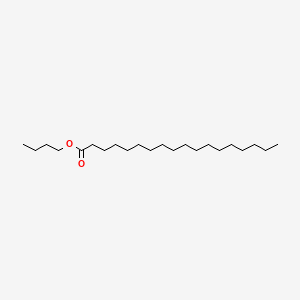
Butyl Stearate
Butyl octadecanoate is a fatty acid ester that is the butyl ester of stearic acid. It has a role as an algal metabolite. It is functionally related to an octadecanoic acid. — ChEBI
- IUPAC name
- butyl octadecanoate
- Molecular formula
- C22H44O2
- Molecular weight
- 340.6 g/mol
- Exact mass
- 340.334130642 Da
- XLogP3
- 9.8
- Topological polar surface area
- 26.3 Ų
- Hydrogen-bond donors
- 0
- Hydrogen-bond acceptors
- 2
- Covalent units
- 1
- Defined stereocentres
- 0
Also known as
16 more reported names
External database identifiers
- ChEBI:CHEBI:85983
- EPA DTXSID:DTXSID5027013
- PubMed:22125769
- PubMed:18058303
- PubMed:15919187
Evidence from additional scientific databases
NIH PubChem PUG-View
Attributed physical-property, hazard, environmental and use annotations.
- Autoignition Temperature: 671 °F (355 °C) Source: Hazardous Substances Data Bank (HSDB)
- Boiling Point: 343 °C Source: Hazardous Substances Data Bank (HSDB)
- Boiling Point: 343.00 °C. @ 25.00 mm Hg Source: Human Metabolome Database (HMDB)
- Boiling Point: 343 °C; 220-225 °C (25 mm Hg) Source: Joint FAO/WHO Expert Committee on Food Additives (JECFA)
- Color/Form: Crystals from alcohol, propanol, or ether Source: Hazardous Substances Data Bank (HSDB)
- Color/Form: WAXY OR OILY (ABOVE 20 °C) Source: Hazardous Substances Data Bank (HSDB)
- Color/Form: COLORLESS OR VERY PALE YELLOW LIQUID ABOVE 20 °C Source: Hazardous Substances Data Bank (HSDB)
- Density: 0.854 @ 25 °C/4 °C Source: Hazardous Substances Data Bank (HSDB)
- Density: 0.855-0.875 Source: Joint FAO/WHO Expert Committee on Food Additives (JECFA)
- Flash Point: 320 °F (160 °C) (CLOSED CUP) Source: Hazardous Substances Data Bank (HSDB)
- Melting Point: 27 °C Source: Hazardous Substances Data Bank (HSDB)
- Melting Point: 27.5 °C Source: Human Metabolome Database (HMDB)
- Odor: ODORLESS OR FAINTLY FATTY ODOR Source: Hazardous Substances Data Bank (HSDB)
- Odor: FATTY FRUITY ODOR Source: Hazardous Substances Data Bank (HSDB)
- Physical Description: Wet Solid; Liquid Source: EPA Chemical Data Reporting (CDR)
- Physical Description: Colorless liquid; m[ = 19.5-20 deg C; [Hawley] Solid or colorless or very pale liquid (above 20 deg C); mp = 27 deg C; [HSDB] Odorless oily liquid; mp approximately 23 deg C; [MSDSonline] Source: Haz-Map, Information on Hazardous Chemicals and Occupational Diseases
- Physical Description: Solid Source: Human Metabolome Database (HMDB)
- Physical Description: colourless, waxy solid, odourless or with a faintly fatty odour Source: Joint FAO/WHO Expert Committee on Food Additives (JECFA)
- Refractive Index: Index of refraction: 1.4328 @ 50 °C/D Source: Hazardous Substances Data Bank (HSDB)
- Solubility: Insoluble in water; soluble in ethanol; very soluble in acetone Source: Hazardous Substances Data Bank (HSDB)
- Solubility: SOL IN MINERAL OR VEGETABLE OILS Source: Hazardous Substances Data Bank (HSDB)
- Solubility: SOLUBILITY IN WATER: 0.29% @ 25 °C Source: Hazardous Substances Data Bank (HSDB)
- Solubility: 1.7 mg/mL at 25 °C Source: Human Metabolome Database (HMDB)
- Solubility: (in ethanol) Source: Joint FAO/WHO Expert Committee on Food Additives (JECFA)
- Vapor Pressure: 0.0000058 [mmHg] Source: Haz-Map, Information on Hazardous Chemicals and Occupational Diseases
- Vapor Pressure: 5.80X10⁻⁶ mm Hg @ 25 °C Source: Hazardous Substances Data Bank (HSDB)
- Note: This chemical does not meet GHS hazard criteria for 91.6% (901 of 984) of all reports. Source: European Chemicals Agency (ECHA)
- GHS Hazard Statements: Not Classified; Reported as not meeting GHS hazard criteria by 901 of 984 companies (only 8.4% companies provided GHS information). For more detailed information, please visit ECHA C&L website. Source: European Chemicals Agency (ECHA)
- ECHA C&L Notifications Summary: Aggregated GHS information provided per 984 reports by companies from 8 notifications to the ECHA C&L Inventory.; Reported as not meeting GHS hazard criteria per 901 of 984 reports by companies.; There are 6 notifications provided by 83 of 984 reports by companies with hazard statement code(s).; Information may vary between notifications depending on impurities, additives, and other factors. The percentage value in parenthesis indicates the notified classification ratio from companies that provide hazard codes. Only hazard codes with percentage values above 10% are shown. For more detailed information, please visit ECHA C&L website. Source: European Chemicals Agency (ECHA)
- NFPA Health Rating: 1 - Materials that, under emergency conditions, can cause significant irritation. Source: Hazardous Substances Data Bank (HSDB)
- NFPA Fire Rating: 1 - Materials that must be preheated before ignition can occur. Materials require considerable preheating, under all ambient temperature conditions, before ignition and combustion can occur. Source: Hazardous Substances Data Bank (HSDB)
- NFPA Instability Rating: 0 - Materials that in themselves are normally stable, even under fire conditions. Source: Hazardous Substances Data Bank (HSDB)
- Cosmetic Ingredient Review Conclusion: The CIR Expert Panel concluded that the alkyl esters, listed subsequently, are safe in the present practices of use and concentration described in this safety assessment when formulated to be non-irritating. Source: Cosmetic Ingredient Review (CIR)
- Cosmetic Ingredient Review Finding(s): Safe for use in cosmetics, with qualifications Source: Cosmetic Ingredient Review (CIR)
- Environmental Bioconcentration: An estimated BCF of 1 was calculated for n-butyl stearate(SRC), using an estimated log Kow of 9.70(1,SRC) and a regression-derived equation(2). According to a classification scheme(3), the estimated BCF suggests the potential for bioconcentration in aquatic organisms is low. Source: Hazardous Substances Data Bank (HSDB)
- Environmental Fate: TERRESTRIAL FATE: Based on a classification scheme(1), an estimated Koc value of 39,000(SRC), determined from a structure estimation method(2), indicates that n-butyl stearate is expected to be immobile in soil(SRC). Volatilization of n-butyl stearate from moist soil surfaces is expected to be an important fate process(SRC) given an estimated Henry's Law constant of 0.038 atm-cu m/mole(SRC), using a fragment constant estimation method(3). However, adsorption to soil is expected to attenuate volatilization(SRC). n-Butyl stearate is not expected to volatilize from dry soil surfaces(SRC) based upon a vapor pressure of 5.8X10⁻⁶ mm Hg(4). n-Butyl stearate is expected to rapidly biodegrade in aerobic soils as suggested by the rapid biodegradation of structurally similar long-chain fatty acid esters(5-7). Source: Hazardous Substances Data Bank (HSDB)
- Environmental Fate: AQUATIC FATE: Based on a classification scheme(1), an estimated Koc value of 39,000(SRC), determined from a structure estimation method(2), indicates that n-butyl stearate is expected to adsorb to suspended solids and sediment in water(SRC). Volatilization from water surfaces is expected(3) based upon an estimated Henry's Law constant of 0.038 atm-cu m/mole(SRC), developed using a fragment constant estimation method(4). Volatilization half-lives for a model river and model lake are 5 hours and 7 days, respectively(SRC), using an estimation method(3). However, volatilization from water surfaces is expected to be attenuated by adsorption to suspended solids and sediment in the water column(SRC). The volatilization half-life from a model pond is estimated to be about 64 hours ignoring adsorption; when considering maximum adsorption the volatilization half-life increases to 12 months(5). According to a classification scheme(6), a estimated BCF of 3, from an estimated log Kow of 7.90(12) and a regression-derived equation(7), suggests the potential for bioconcentration in aquatic organisms is low. n-Butyl stearate is expected to rapidly biodegrade in aerobic waters as suggested by the ra Source: Hazardous Substances Data Bank (HSDB)
- Environmental Fate: ATMOSPHERIC FATE: According to a model of gas/particle partitioning of semivolatile organic compounds in the atmosphere(1), n-butyl stearate, which has a vapor pressure of 5.8X10⁻⁶ mm Hg at 25 °C(2), will exist in both the vapor and particulate phases in the ambient atmosphere. Vapor-phase n-butyl stearate is degraded in the atmosphere by reaction with photochemically-produced hydroxyl radicals(SRC); the half-life for this reaction in air is estimated to be 15 hours(SRC) from its estimated rate constant of 2.6X10⁻¹¹ cu cm/molecule-sec at 25 °C(3). Particulate-phase n-butyl stearate may be removed from the air by wet and dry deposition(SRC). Source: Hazardous Substances Data Bank (HSDB)
- Consumer Uses: Not Known or Reasonably Ascertainable; Processing aids not otherwise specified; Surfactant (surface active agent); Anti-adhesive/cohesive Source: EPA Chemical Data Reporting (CDR)
- Industry Uses: Processing aids not otherwise specified; Surfactant (surface active agent); Lubricating agent; Anti-adhesive/cohesive; Intermediate Source: EPA Chemical Data Reporting (CDR)
- Cosmetic Ingredient Review Link: CIR ingredient: Butyl Stearate Source: Cosmetic Ingredient Review (CIR)
- Sources/Uses: Used as a flavor and solvent for flavors; as plasticizer for cellulose acetate butyrate, cellulose nitrate, ethyl cellulose, polystyrene, and laminated fiber products; as lubricant in extrusion and molding of polyvinyl chloride; as emollient in creams, lotions, and lipsticks; as solvent, spreading agent, and softening agent in plastics, textiles, cosmetics, and rubber industries; to make leather cloth and leather varnishes; in polishes, special lubricants, and coatings; in carbon paper and inks; as damp-proofer for concrete; in propellants; as water proofing agent and defoamer; [HSBD] Source: Haz-Map, Information on Hazardous Chemicals and Occupational Diseases
- Industrial Processes with risk of exposure: Pulp and Paper Processing [Category: Industry]; Textiles (Fiber & Fabric Manufacturing) [Category: Industry]; Painting (Pigments, Binders, and Biocides) [Category: Paint]; Plastic Composites Manufacturing [Category: Industry]; Leather Tanning and Processing [Category: Industry]; Cement Producing [Category: Industry] Source: Haz-Map, Information on Hazardous Chemicals and Occupational Diseases
- Uses: DIRECT FOOD ADDITIVE AS SYNTHETIC FLAVOR. Source: Hazardous Substances Data Bank (HSDB)
- Uses: PLASTICIZER FOR CELLULOSE ACETATE BUTYRATE, CELLULOSE NITRATE, ETHYL CELLULOSE, POLYSTYRENE; LUBRICANT IN EXTRUSION & MOLDING OF POLYVINYL CHLORIDE; EMOLLIENT IN CREAMS, LOTIONS, & LIPSTICKS. Source: Hazardous Substances Data Bank (HSDB)
- Uses: SOLVENT FOR FLAVORS--BUTTER, BANANA. Source: Hazardous Substances Data Bank (HSDB)
- Uses: Solvent, spreading and softening agent in plastics, textiles, cosmetics, rubber industries. Source: Hazardous Substances Data Bank (HSDB)
- Uses: For more Uses (Complete) data for N-BUTYL STEARATE (11 total), please visit the HSDB record page. Source: Hazardous Substances Data Bank (HSDB)
Mapped by: Existing checksum-valid CAS to unique PubChem CID match. Retrieved: 2026-08-31. Open source record
Scientific classifications and hazard annotations provide context and do not replace the market-specific regulatory decision shown above.
Additional source coverage and match status
| Source | Result | Checked |
|---|---|---|
| NIH PubChem PUG-View | Exact match | 2026-08-31 |
A recorded no-match is useful evidence that the source was checked; it is not a claim that the substance does not exist elsewhere.
Retrieved from NIH PubChem on 2026-08-31 by checksum-valid CAS matching. Chemical properties do not replace the regulatory decision on this page.