
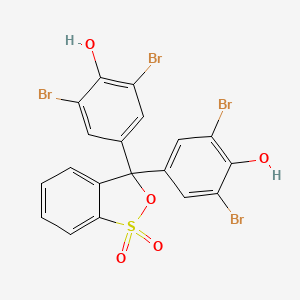
Bromophenol Blue
Bromophenol blue is 3H-2,1-Benzoxathiole 1,1-dioxide in which both of the hydrogens at position 3 have been substituted by 3,5-dibromo-4-hydroxyphenyl groups. It is used as a laboratory indicator, changing from yellow below pH 3 to purple at pH 4.6, and as a size marker for monitoring the progress of agarose gel and polyacrylamide gel electrophoresis. It has also been used as an industrial dye. It has a role as a dye, an acid-base indicator and a two-colour indicator. It is a member of phenols, an organobromine compound, a 2,1-benzoxathiole, a sultone and an arenesulfonate ester. — ChEBI
- IUPAC name
- 2,6-dibromo-4-[3-(3,5-dibromo-4-hydroxyphenyl)-1,1-dioxo-2,1lambda6-benzoxathiol-3-yl]phenol
- Molecular formula
- C19H10Br4O5S
- Molecular weight
- 670.0 g/mol
- Exact mass
- 669.69415 Da
- XLogP3
- 5.8
- Topological polar surface area
- 92.2 Ų
- Hydrogen-bond donors
- 2
- Hydrogen-bond acceptors
- 5
- Covalent units
- 1
- Defined stereocentres
- 0
Also known as
16 more reported names
External database identifiers
- ChEBI:CHEBI:59424
- ChEMBL:CHEMBL2103765
- EPA DTXSID:DTXSID6041682
- PubMed:19520855
- PubMed:18562314
Evidence from additional scientific databases
NIH PubChem PUG-View
Attributed physical-property, hazard, environmental and use annotations.
- Color/Form: Hexagonal prisms from acetic acid and acetone Source: Hazardous Substances Data Bank (HSDB)
- Color/Form: Elongated hexagonal prisms from acetic acid and acetone Source: Hazardous Substances Data Bank (HSDB)
- Dissociation Constants: pKa = 4.0 Source: Hazardous Substances Data Bank (HSDB)
- Melting Point: Decomposes at 279 °C (An orange discoloration with formation of a green sublimate sets in at 210 °C) Source: Hazardous Substances Data Bank (HSDB)
- Physical Description: Odorless solid; Color varies (tan, orange, light pink, purple, or red) [CHEMINFO] Slightly soluble in water; [MSDSonline] Source: Haz-Map, Information on Hazardous Chemicals and Occupational Diseases
- Solubility: Soluble in acetic acid Source: Hazardous Substances Data Bank (HSDB)
- Solubility: Soluble in water (about 0.4 g/100 mL); more soluble in methyl and ethyl alcohol, and in benzene. Freely soluble in NaOH solutions with the formation of a water-soluble sodium salt. Source: Hazardous Substances Data Bank (HSDB)
- Solubility: In water, 3 mg/mL Source: Hazardous Substances Data Bank (HSDB)
- Environmental Bioconcentration: An estimated BCF of 1.4X10+4 was calculated in fish for bromophenol blue(SRC), using an estimated log Kow of 6.77(1) and a regression-derived equation(2). According to a classification scheme(3), this BCF suggests the potential for bioconcentration in aquatic organisms is very high, provided the compound is not metabolized by the organism(SRC). Source: Hazardous Substances Data Bank (HSDB)
- Environmental Fate: TERRESTRIAL FATE: Based on a classification scheme(1), an estimated Koc value of 1.5X10+6(SRC), determined from a structure estimation method(2), indicates that bromophenol blue is expected to be immobile in soil(SRC). The pKa of bromophenol blue is 4.0(3), indicating that this compound will almost entirely exist in anion form in the environment and anions generally do not adsorb more strongly to soils containing organic carbon and clay than their neutral counterparts(4). Volatilization from moist soil surfaces is not expected because the acid exists as an anion and anions do not volatilize. Bromophenol is not expected to volatilize from dry soil surfaces(SRC) based upon an estimated vapor pressure of 2.7X10⁻¹⁷ mm Hg(SRC), determined from a fragment constant method(5). Bromophenol blue has been found to be biodegraded by select fungi(6). Source: Hazardous Substances Data Bank (HSDB)
- Environmental Fate: AQUATIC FATE: Based on a classification scheme(1), an estimated Koc value of 1.5X10+6(SRC), determined from a structure estimation method(2), indicates that bromophenol blue is expected to adsorb to suspended solids and sediment(SRC). A pKa of 4.0(3) indicates bromophenol blue will exist almost entirely in the anion form at pH values of 5 to 9 and therefore volatilization from water surfaces is not expected to be an important fate process(4). According to a classification scheme(5), an estimated BCF of 1.4X10+4(SRC), from an estimated log Kow of 6.77(6) and a regression-derived equation(7), suggests the potential for bioconcentration in aquatic organisms is very high, provided the compound is not metabolized by the organism(SRC). Bromophenol blue is not expected to undergo hydrolysis in the environment due to the lack of functional groups that hydrolyze under environmental conditions(8). Bromophenol blue has been found to be biodegraded by select fungi(9). Source: Hazardous Substances Data Bank (HSDB)
- Environmental Fate: ATMOSPHERIC FATE: According to a model of gas/particle partitioning of semivolatile organic compounds in the atmosphere(1), bromophenol blue, which has an estimated vapor pressure of 2.7X10⁻¹⁷ mm Hg at 25 °C(SRC), determined from a fragment constant method(2), is expected to exist solely in the particulate phase in the ambient atmosphere. Particulate-phase bromophenol blue may be removed from the air by wet or dry deposition(SRC). Bromophenol blue has a maximum absorbance wavelength of 598 nm(3) and therefore may be susceptible to direct photolysis by sunlight(SRC). Source: Hazardous Substances Data Bank (HSDB)
- Sources/Uses: Used as a dye, laboratory indicator, and biological stain; [ChemIDplus] Source: Haz-Map, Information on Hazardous Chemicals and Occupational Diseases
- Industrial Processes with risk of exposure: Textiles (Printing, Dyeing, or Finishing) [Category: Industry] Source: Haz-Map, Information on Hazardous Chemicals and Occupational Diseases
- Uses: As indicator, pH 3.0 yellow; pH 4.6 purple. Source: Hazardous Substances Data Bank (HSDB)
- Uses: Vital dye for vitreoretinal surgery Source: Hazardous Substances Data Bank (HSDB)
- Uses: Adsorption Indicators. Indicator: bromophenol blue; Titratable ions: Cl, I; Titrant (Reagent): Ag; Color change: yellow - green - greenish blue. /from table/ Source: Hazardous Substances Data Bank (HSDB)
- Uses: Vital dye for vitreoretinal surgery. Source: Hazardous Substances Data Bank (HSDB)
Mapped by: Existing checksum-valid CAS to unique PubChem CID match. Retrieved: 2026-08-31. Open source record
Scientific classifications and hazard annotations provide context and do not replace the market-specific regulatory decision shown above.
Additional source coverage and match status
| Source | Result | Checked |
|---|---|---|
| NIH PubChem PUG-View | Exact match | 2026-08-31 |
A recorded no-match is useful evidence that the source was checked; it is not a claim that the substance does not exist elsewhere.
Retrieved from NIH PubChem on 2026-08-31 by checksum-valid CAS matching. Chemical properties do not replace the regulatory decision on this page.