
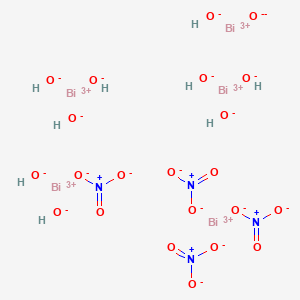
Bismuth Subnitrate
Bismuth subnitrate, also referred to as bismuth oxynitrate or bismuthyl nitrate, is a highly water-soluble crystalline compound that has been used as a treatment for duodenal ulcers and anti-diarrheic agent. The use of bismuth substrate as an active ingredient in over-the-counter antacids is approved by the FDA. — DrugBank
- IUPAC name
- pentabismuth;oxygen(2-);nonahydroxide;tetranitrate
- Molecular formula
- Bi5H9N4O22
- Molecular weight
- 1461.99 g/mol
- Exact mass
- 1461.87284 Da
- Topological polar surface area
- 262.0 Ų
- Hydrogen-bond donors
- 9
- Hydrogen-bond acceptors
- 22
- Covalent units
- 19
- Defined stereocentres
- 0
Also known as
16 more reported names
External database identifiers
- EPA DTXSID:DTXSID40893872
- PubMed:14530870
- PubMed:7733075
- PubMed:2682129
- PubMed:2129809
Evidence from additional scientific databases
NIH PubChem PUG-View
Attributed physical-property, hazard, environmental and use annotations.
- Boiling Point: Decomposes at 260 Source: DrugBank
- Boiling Point: BOILING POINT: 260 °C -HNO3 /BIONO3.H2O/ Source: Hazardous Substances Data Bank (HSDB)
- Color/Form: HEAVY, MICROCRYSTALLINE POWDER Source: Hazardous Substances Data Bank (HSDB)
- Color/Form: WHITE POWDER Source: Hazardous Substances Data Bank (HSDB)
- Density: 4.928 Source: Hazardous Substances Data Bank (HSDB)
- Melting Point: Decomposes at 260 Source: DrugBank
- Melting Point: 260 °C DECOMP Source: Hazardous Substances Data Bank (HSDB)
- Odor: ODORLESS Source: Hazardous Substances Data Bank (HSDB)
- Physical Description: Liquid; Dry Powder Source: EPA Chemical Data Reporting (CDR)
- Physical Description: Odorless, slightly hygroscopic solid; [Merck Index] White powder, insoluble; [MSDSonline] Source: Haz-Map, Information on Hazardous Chemicals and Occupational Diseases
- Solubility: Insoluble Source: DrugBank
- Solubility: PRACTICALLY INSOL IN WATER, ALC; SOL IN DILUTE HYDROCHLORIC ACID & NITRIC ACID Source: Hazardous Substances Data Bank (HSDB)
- Solubility: PRACTICALLY INSOL IN ORGANIC SOLVENTS Source: Hazardous Substances Data Bank (HSDB)
- pH: SHOWS ACID TO MOISTENED LITMUS PAPER Source: Hazardous Substances Data Bank (HSDB)
- Note: This chemical does not meet GHS hazard criteria for 58.1% (115 of 198) of all reports. Source: European Chemicals Agency (ECHA)
- Signal: Danger Source: European Chemicals Agency (ECHA)
- GHS Hazard Statements: H272 (24.2%): May intensify fire; oxidizer [Danger Oxidizing liquids; Oxidizing solids]; H315 (23.2%): Causes skin irritation [Warning Skin corrosion/irritation]; H319 (23.2%): Causes serious eye irritation [Warning Serious eye damage/eye irritation]; H335 (23.2%): May cause respiratory irritation [Warning Specific target organ toxicity, single exposure; Respiratory tract irritation]; H372 (17.7%): Causes damage to organs through prolonged or repeated exposure [Danger Specific target organ toxicity, repeated exposure] Source: European Chemicals Agency (ECHA)
- Precautionary Statement Codes: P210, P220, P260, P261, P264, P264+P265, P270, P271, P280, P302+P352, P304+P340, P305+P351+P338, P319, P321, P332+P317, P337+P317, P362+P364, P370+P378, P403+P233, P405, and P501 (click each P-code to see the statement) Source: European Chemicals Agency (ECHA)
- ECHA C&L Notifications Summary: Aggregated GHS information provided per 198 reports by companies from 10 notifications to the ECHA C&L Inventory. Each notification may be associated with multiple companies.; Reported as not meeting GHS hazard criteria per 115 of 198 reports by companies.; There are 8 notifications provided by 83 of 198 reports by companies with hazard statement code(s).; Information may vary between notifications depending on impurities, additives, and other factors. The percentage value in parenthesis indicates the notified classification ratio from companies that provide hazard codes. Only hazard codes with percentage values above 10% are shown. For more detailed information, please visit ECHA C&L website. Source: European Chemicals Agency (ECHA)
- Signal: Danger Source: NITE-CMC
- GHS Hazard Statements: H371: May cause damage to organs [Warning Specific target organ toxicity, single exposure]; H372: Causes damage to organs through prolonged or repeated exposure [Danger Specific target organ toxicity, repeated exposure] Source: NITE-CMC
- Precautionary Statement Codes: P260, P264, P270, P308+P316, P319, P405, and P501 (click each P-code to see the statement) Source: NITE-CMC
- Industry Uses: Catalyst Source: EPA Chemical Data Reporting (CDR)
- Sources/Uses: Used to make enamel fluxes, cosmetics, antacids, and antiulceratives; [Merck Index] Used as an astringent, adsorbent, and protective; in topical lotions and ointments; [HSDB] Source: Haz-Map, Information on Hazardous Chemicals and Occupational Diseases
- Activities with risk of exposure: Enameling [Category: Hobbies] Source: Haz-Map, Information on Hazardous Chemicals and Occupational Diseases
- Uses: IN PREPN OF MILK OF BISMUTH, AS ASTRINGENT, ADSORBENT, & PROTECTANT Source: Hazardous Substances Data Bank (HSDB)
- Uses: COATING AGENT IN PREPARATIONS FOR GASTRITIS; IN BLEACHING CREAMS Source: Hazardous Substances Data Bank (HSDB)
- Uses: Medication Source: Hazardous Substances Data Bank (HSDB)
Mapped by: Existing checksum-valid CAS to unique PubChem CID match. Retrieved: 2026-08-31. Open source record
Scientific classifications and hazard annotations provide context and do not replace the market-specific regulatory decision shown above.
Additional source coverage and match status
| Source | Result | Checked |
|---|---|---|
| NIH PubChem PUG-View | Exact match | 2026-08-31 |
A recorded no-match is useful evidence that the source was checked; it is not a claim that the substance does not exist elsewhere.
Retrieved from NIH PubChem on 2026-08-31 by checksum-valid CAS matching. Chemical properties do not replace the regulatory decision on this page.