
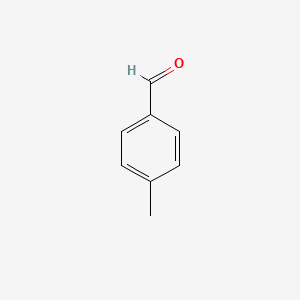
4-Methylbenzaldehyde
P-tolualdehyde is a tolualdehyde compound with the methyl substituent at the 4-position. It has a role as a plant metabolite. — ChEBI
- IUPAC name
- 4-methylbenzaldehyde
- Molecular formula
- C8H8O
- Molecular weight
- 120.15 g/mol
- Exact mass
- 120.057514874 Da
- XLogP3
- 2.1
- Topological polar surface area
- 17.1 Ų
- Hydrogen-bond donors
- 0
- Hydrogen-bond acceptors
- 1
- Covalent units
- 1
- Defined stereocentres
- 0
Also known as
16 more reported names
External database identifiers
- ChEBI:CHEBI:28617
- ChEMBL:CHEMBL190927
- EPA DTXSID:DTXSID9041520
- PubMed:27633901
- PubMed:27569861
- PubMed:22925715
- PubMed:22719636
- PubMed:22590372
- PubMed:22590364
- PubMed:22590031
- PubMed:22589993
- PubMed:22476521
- PubMed:22346982
- PubMed:22346908
- PubMed:22346658
Evidence from additional scientific databases
EMBL-EBI ChEBI
p-tolualdehyde
A tolualdehyde compound with the methyl substituent at the 4-position.
- Formula
- C8H8O
- Average mass
- 120.151 g/mol
- Monoisotopic mass
- 120.05751 Da
- Formal charge
- 0
- tolualdehyde — is a (CHEBI:27020)
- plant metabolite — has role (CHEBI:76924)
- plant metabolite — has role (CHEBI:76924)
- tolualdehyde — is a (CHEBI:27020)
Additional curated names
Cross-references from this source
- CAS: 104-87-0 — NIST Chemistry WebBook
- CAS: 104-87-0 — KEGG COMPOUND
- CAS: 104-87-0 — ChemIDplus
- REGISTRY_NUMBER: 27123 — Gmelin
- REGISTRY_NUMBER: 385772 — Reaxys
- MANUAL_X_REF: 4-Methylbenzaldehyde — Wikipedia
- MANUAL_X_REF: C06758 — KEGG COMPOUND
- MANUAL_X_REF: CPD-8773 — MetaCyc
- MANUAL_X_REF: HMDB0029638 — HMDB
Mapped by: Exact CAS cross-reference in the ChEBI compound record. Source updated: 2024-05-30. Retrieved: 2026-08-31. Open source record
NIH PubChem PUG-View
Attributed physical-property, hazard, environmental and use annotations.
- Boiling Point: 204 °C Source: Hazardous Substances Data Bank (HSDB)
- Boiling Point: BP: 106 °C at 10 mm Hg Source: Hazardous Substances Data Bank (HSDB)
- Boiling Point: 204.00 °C. @ 760.00 mm Hg Source: Human Metabolome Database (HMDB)
- Color/Form: COLORLESS LIQUID Source: Hazardous Substances Data Bank (HSDB)
- Density: 1.0194 g/cu cm at 17 °C Source: Hazardous Substances Data Bank (HSDB)
- Melting Point: -6 °C Source: Hazardous Substances Data Bank (HSDB)
- Melting Point: -6 °C Source: Human Metabolome Database (HMDB)
- Odor: Floral odor Source: Hazardous Substances Data Bank (HSDB)
- Physical Description: Liquid Source: EPA Chemical Data Reporting (CDR)
- Physical Description: Colorless liquid with a floral odor; [HSDB] Source: Haz-Map, Information on Hazardous Chemicals and Occupational Diseases
- Physical Description: Liquid Source: Human Metabolome Database (HMDB)
- Refractive Index: SADTLER REF NUMBER: 21549 (IR, PRISM); INDEX OF REFRACTION: 1.5454 AT 20 °C Source: Hazardous Substances Data Bank (HSDB)
- Refractive Index: Index of refraction: 1.5454 at 20 °C Source: Hazardous Substances Data Bank (HSDB)
- Solubility: Miscible with ethanol, ethyl ether, acetone; very soluble in chloroform Source: Hazardous Substances Data Bank (HSDB)
- Solubility: In water, 2.27X10+3 mg/L at 25 °C Source: Hazardous Substances Data Bank (HSDB)
- Solubility: 2.27 mg/mL at 25 °C Source: Human Metabolome Database (HMDB)
- Vapor Pressure: 0.25 [mmHg] Source: Haz-Map, Information on Hazardous Chemicals and Occupational Diseases
- Vapor Pressure: 2.5X10⁻¹ mm Hg at 25 °C Source: Hazardous Substances Data Bank (HSDB)
- Signal: Warning Source: European Chemicals Agency (ECHA)
- GHS Hazard Statements: H302 (99.8%): Harmful if swallowed [Warning Acute toxicity, oral]; H319 (90.9%): Causes serious eye irritation [Warning Serious eye damage/eye irritation] Source: European Chemicals Agency (ECHA)
- Precautionary Statement Codes: P264, P264+P265, P270, P280, P301+P317, P305+P351+P338, P330, P337+P317, and P501 (click each P-code to see the statement) Source: European Chemicals Agency (ECHA)
- ECHA C&L Notifications Summary: Aggregated GHS information provided per 1818 reports by companies from 11 notifications to the ECHA C&L Inventory. Each notification may be associated with multiple companies.; Information may vary between notifications depending on impurities, additives, and other factors. The percentage value in parenthesis indicates the notified classification ratio from companies that provide hazard codes. Only hazard codes with percentage values above 10% are shown. For more detailed information, please visit ECHA C&L website. Source: European Chemicals Agency (ECHA)
- Signal: Warning Source: NITE-CMC
- GHS Hazard Statements: H227: Combustible liquid [Warning Flammable liquids]; H302: Harmful if swallowed [Warning Acute toxicity, oral]; H315: Causes skin irritation [Warning Skin corrosion/irritation]; H319: Causes serious eye irritation [Warning Serious eye damage/eye irritation]; H335: May cause respiratory irritation [Warning Specific target organ toxicity, single exposure; Respiratory tract irritation]; H336: May cause drowsiness or dizziness [Warning Specific target organ toxicity, single exposure; Narcotic effects] Source: NITE-CMC
- Precautionary Statement Codes: P210, P261, P264, P264+P265, P270, P271, P280, P301+P317, P302+P352, P304+P340, P305+P351+P338, P319, P321, P330, P332+P317, P337+P317, P362+P364, P370+P378, P403, P403+P233, P405, and P501 (click each P-code to see the statement) Source: NITE-CMC
- Environmental Bioconcentration: An estimated BCF of 8 was calculated in fish for 4-methylbenzaldehyde(SRC), using a water solubility of 2,270 mg/L(1) and a regression-derived equation(2). According to a classification scheme(3), this BCF suggests the potential for bioconcentration in aquatic organisms is low(SRC). Source: Hazardous Substances Data Bank (HSDB)
- Environmental Fate: TERRESTRIAL FATE: Based on a classification scheme(1), an estimated Koc value of 62(SRC), determined from a water solubility of 2,270 mg/L(2) and a regression-derived equation(3), indicates that 4-methylbenzaldehyde is expected to have high mobility in soil(SRC). Volatilization of 4-methylbenzaldehyde from moist soil surfaces is expected to be an important fate process(SRC) given an estimated Henry's Law constant of 1.7X10⁻⁵ atm-cu m/mole(SRC), derived from its vapor pressure, 0.25 mm Hg(4), and its water solubility(2). 4-Methylbenzaldehyde is expected to volatilize from dry soil surfaces(SRC) based upon its vapor pressure(4). Based on limited information, 4-methylbenzaldehyde is expected to biodegrade in soil(SRC). A Pseudomonas strain was able to utilize 4-methylbenzaldehyde as the sole carbon source(5); a yeast strain grown with both this compound and either sucrose or pyruvate biodegraded 4-methylbenzaldehyde to the respective aromatic carbinol or alcohol(6). Source: Hazardous Substances Data Bank (HSDB)
- Environmental Fate: AQUATIC FATE: Based on a classification scheme(1), an estimated Koc value of 62(SRC), determined from a water solubility of 2,270 mg/L(2) and a regression-derived equation(3), indicates that 4-methylbenzaldehyde is not expected to adsorb to suspended solids and sediment(SRC). Volatilization from water surfaces is expected(3) based upon an estimated Henry's Law constant of 1.7X10⁻⁵ atm-cu m/mole(SRC), derived from its vapor pressure, 0.25 mm Hg(4), and its water solubility(2). Using this Henry's Law constant and an estimation method(3), volatilization half-lives for a model river and model lake are 2.4 and 21 days, respectively(SRC). According to a classification scheme(5), an estimated BCF of 8(SRC), from its water solubility(2) and a regression-derived equation(3), suggests the potential for bioconcentration in aquatic organisms is low(SRC). Based on limited data, biodegradation of 4-methylbenzaldehyde will take place in water(SRC). A Pseudomonas strain was able to utilize 4-methylbenzaldehyde as the sole carbon source(6); a yeast strain grown with both this compound and either sucrose or pyruvate biodegraded 4-methylbenzaldehyde to the respective aromatic carbinol or alcohol(7). Source: Hazardous Substances Data Bank (HSDB)
- Environmental Fate: ATMOSPHERIC FATE: According to a model of gas/particle partitioning of semivolatile organic compounds in the atmosphere(1), 4-methylbenzaldehyde, which has a vapor pressure of 0.25 mm Hg at 25 °C(2), is expected to exist solely as a vapor in the ambient atmosphere. Vapor-phase 4-methylbenzaldehyde is degraded in the atmosphere by reaction with photochemically-produced hydroxyl radicals(SRC); the half-life for this reaction in air is estimated to be 21 hrs(SRC), calculated from its rate constant of 1.8X10⁻¹¹ cu cm/molecule-sec at 25 °C(3). The reactivity of 4-methylbenzaldehyde (1 ppm) with NOx (0.5 ppm) in light was measured in a smog chamber as 1.78 ppb/min(4). 4-Methylbenzaldehyde contains chromophores that absorb at wavelengths >290 nm(5) and therefore may be susceptible to direct photolysis by sunlight(SRC). Source: Hazardous Substances Data Bank (HSDB)
- Consumer Uses: Intermediate Source: EPA Chemical Data Reporting (CDR)
- Industry Uses: Intermediate; Fragrance Source: EPA Chemical Data Reporting (CDR)
- Sources/Uses: Used in flavors, perfumes, and as an intermediate for pharmaceuticals and dyestuffs; [HSDB] Source: Haz-Map, Information on Hazardous Chemicals and Occupational Diseases
- Uses: In perfumes; pharmaceutical and dyestuff intermediate, flavoring agent Source: Hazardous Substances Data Bank (HSDB)
- Uses: Derivatives: 4-methylphenylacetaldehyde Source: Hazardous Substances Data Bank (HSDB)
Mapped by: Existing checksum-valid CAS to unique PubChem CID match. Retrieved: 2026-08-31. Open source record
Scientific classifications and hazard annotations provide context and do not replace the market-specific regulatory decision shown above.
Additional source coverage and match status
| Source | Result | Checked |
|---|---|---|
| EMBL-EBI ChEBI | Exact match | 2026-08-31 |
| NIH PubChem PUG-View | Exact match | 2026-08-31 |
A recorded no-match is useful evidence that the source was checked; it is not a claim that the substance does not exist elsewhere.
Retrieved from NIH PubChem on 2026-08-31 by checksum-valid CAS matching. Chemical properties do not replace the regulatory decision on this page.