Official EU label nameGlossary entry 29939

VIOLACEIN

This record confirms an official common ingredient name for EU cosmetic product labelling. It does not by itself confirm that the substance is permitted, unrestricted or safe.

Global evidence snapshot

The resolved identity has matching regulatory evidence in 0 of 13 indexed market datasets: 0 country records and 0 EU Annex records. Every result and evidence gap is listed below.

0 markets with evidence
Markets checked
13
Markets with evidence
0
Evidence gaps
13
Resolved identifiers
1

Resolved substance identity

CAS:548-54-9
Ingredient index records:
VIOLACEIN
Cosmetic functions: ANTIMICROBIAL, ANTIOXIDANT, COLORANT

2H-Indol-2-one, 3-[1,2-dihydro-5-(5-hydroxy-1H-indol-3-yl)-2-oxo-3H-pyrrol-3-ylidene]-1,3-dihydro-, (3E)-

1 matched or reported name
VIOLACEIN

Regulatory evidence across markets

None of the 13 markets tracked here holds an imported rule under the name VIOLACEIN.

That is a statement about this inventory, not about the law: no imported rule is not evidence that a substance is permitted. A rule may exist under a different name, under a CAS or EC number this glossary entry does not carry, or in a dataset not yet imported.

Chemical identity and properties

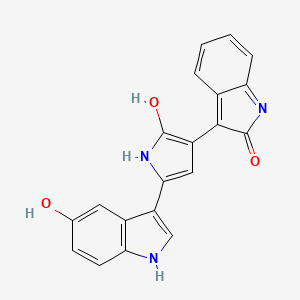
PubChem 2D chemical structure for CAS 548-54-9
CAS 548-54-9PubChem CID 11053

Violacein

Violacein is a member of the class of hydroxyindoles resulting from the formal oxidative coupling between the 3-position of 1,3-dihydro-2H-indol-2-one and the 3-position of 1,3-dihydro-2H-pyrrol-2-one, which is substituted at the 5 position by a 5-hydroxy-1H-indol-3-yl group, where the newly-formed double bond has E configuration. It is a purple chromobacterial pigment that has antibacterial, antifungal, antiprotozoan, and anticancer properties. It has a role as an antibacterial agent, an antineoplastic agent, an antifungal agent, an apoptosis inducer and a bacterial metabolite. It is a member of pyrroles, a member of oxindoles, an olefinic compound and a member of hydroxyindoles. It is functionally related to a proviolacein. — ChEBI

IUPAC name
3-[2-hydroxy-5-(5-hydroxy-1H-indol-3-yl)-1H-pyrrol-3-yl]indol-2-one
Molecular formula
C20H13N3O3
Molecular weight
343.3 g/mol
Exact mass
343.09569129 Da
XLogP3
2.7
Topological polar surface area
101.0 Ų
Hydrogen-bond donors
4
Hydrogen-bond acceptors
3
Covalent units
1
Defined stereocentres
0

Also known as

QJH0DSQ3SGUNII-QJH0DSQ3SGBRN 00499232-INDOLINONE, 3-(2-(5-HYDROXYINDOL-3-YL)-5-OXO-2-PYRROLIN-4-YLIDENE)-3-(2-(5-Hydroxyindol-3-yl)-5-oxo-2-pyrrolin-4-ylidene)-2-indolinone4-26-00-00715 (Beilstein Handbook Reference)(E)-3-(5-(5-Hydroxy-1H-indol-3-yl)-2-oxo-1,2-dihydro-3H-pyrrol-3-ylidene)indolin-2-one(3E)-3-[5-(5-hydroxy-1H-indol-3-yl)-2-oxo-1,2-dihydro-3H-pyrrol-3-ylidene]-1,3-dihydro-2H-indol-2-one
16 more reported names
Anorosin(3Z)-violaceinVIOLACEIN [MI]CHEBI:131914GLXC-23822EX-A13905Oxindole, 3-(2-(5-hydroxyindol-3-yl)-5-oxo-2-pyrrolin-4-ylidene)-Oxindole, 3-(2-(5-hydroxyindol-3-yl)-5-oxo-2-pyrrolin-4-ylidene)- (6CI)DA-59016HY-119809CS-0078057(3E)-3-[5-(5-hydroxy-1H-indol-3-yl)-2-oxo-1H-pyrrol-3-ylidene]indolin-2-one(Z)-3-(5-(5-Hydroxy-1H-indol-3-yl)-2-oxo-1,2-dihydro-3H-pyrrol-3-ylidene)indolin-2-one3-(5-(5-Hydroxy-1H-indol-3-yl)-2-oxo-1,2-dihydro-3H-pyrrol-3-ylidene)indolin-2-one(3E)-3-(1,2-dihydro-5-(5-hydroxy-1H-indol-3-yl)-2-oxo-3H-pyrrol-3-ylidene)-1,3-dihydro-2H-indol-2-one2H-INDOL-2-ONE, 3-(1,2-DIHYDRO-5-(5-HYDROXY-1H-INDOL-3-YL)-2-OXO-3H-PYRROL-3-YLIDENE)-1,3-DIHYDRO-, (3E)-
External database identifiers

Retrieved from NIH PubChem on 2026-08-31 by checksum-valid CAS matching. Chemical properties do not replace the regulatory decision on this page.

Take this record further

Screen in a formulaOpen standalone comparison

Official source and scope

Imported from Commission Implementing Decision (EU) 2025/1175 (dataset version EU 2025/1175). The glossary supplies common ingredient names for the ingredient list required by Article 19(1)(g); it is not an approval or safety list.

Open official Decision